

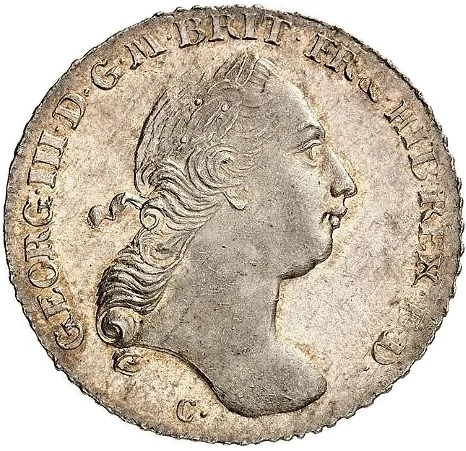
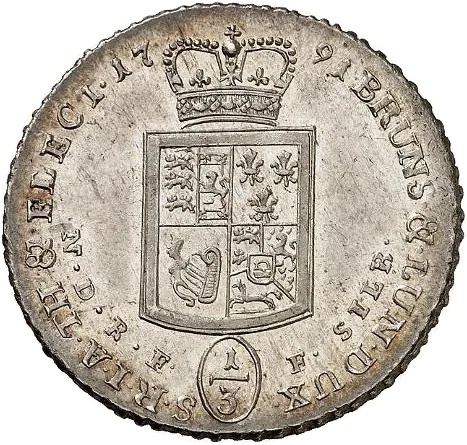
⅓ thaler – Brunswick-Lüneburg-Calenberg-Hannover
Add to wishlist
Germany
Context
Material
References
KM: #
Numista: #231517
Value
Bullion value: $16.10
Obverse
Reverse
Description:
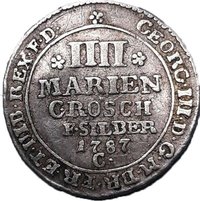
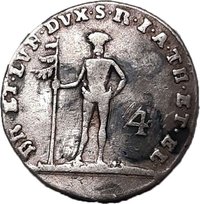
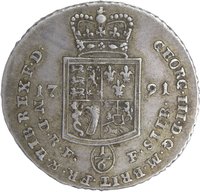
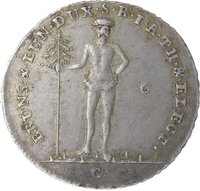
Quartered arms, crown above, value below.
Inscription:
BRUNS.&.LUN.DUC S.R.I.A.TH&ELECT
Script: Latin
Edge
Reeded
Mints
| Name | Mark |
|---|---|
| Clausthal | — |
Mintings
| Year | Mint Mark | Mintage | Quality | Collection |
|---|---|---|---|---|
| 1789 | — | — | ||
| 1790 | C | — | ||
| 1791 | C | — | ||
| 1800 | C | — |
Historical background
In 1789, the currency situation in the Duchy of Brunswick-Lüneburg, specifically the Principality of Calenberg (with its capital in Hanover), was characterized by significant complexity and fragmentation. The region operated within the framework of the Holy Roman Empire's monetary system, which meant a proliferation of different circulating coins from various German states. Alongside local Hanoverian issues, numerous foreign coins, particularly from neighbouring Brunswick-Wolfenbüttel and the large silver Reichsthaler, were in common use. This created a challenging environment for trade, as merchants and officials had to constantly refer to conversion tables for the multitude of currencies, each with fluctuating intrinsic values based on their silver content.
The monetary standard was based on the Conventionsmünze system, established by the 1753 Imperial Coinage Treaty (Reichsmünzfuß). The principal large silver coin was the Conventionsthaler, valued at ⅔ of a Cologne Mark of fine silver. In Hanoverian accounting, this subdivided into 24 Gute Groschen, each of 12 Pfennige. However, the physical coinage in circulation was a mix of older issues and newer, slightly debased Reichsthaler, leading to a distinction between Courant (accounting) money and current (actual coin) money. Furthermore, the state's finances were strained following its involvement in the American Revolutionary War and the recent, costly accession of Elector George III to the British throne, which placed pressure on the treasury and monetary stability.
Overall, the system was administratively cumbersome and economically inefficient on the eve of the French Revolution. While not in a state of acute crisis in 1789, the need for rationalization was clear. This complex legacy would soon be challenged by the inflationary pressures of the Napoleonic Wars, ultimately leading to major monetary reforms in the early 19th century, including Hanover's brief adoption of the French Franc system during Westphalian rule and later integration into the North German Thaler zone.
The monetary standard was based on the Conventionsmünze system, established by the 1753 Imperial Coinage Treaty (Reichsmünzfuß). The principal large silver coin was the Conventionsthaler, valued at ⅔ of a Cologne Mark of fine silver. In Hanoverian accounting, this subdivided into 24 Gute Groschen, each of 12 Pfennige. However, the physical coinage in circulation was a mix of older issues and newer, slightly debased Reichsthaler, leading to a distinction between Courant (accounting) money and current (actual coin) money. Furthermore, the state's finances were strained following its involvement in the American Revolutionary War and the recent, costly accession of Elector George III to the British throne, which placed pressure on the treasury and monetary stability.
Overall, the system was administratively cumbersome and economically inefficient on the eve of the French Revolution. While not in a state of acute crisis in 1789, the need for rationalization was clear. This complex legacy would soon be challenged by the inflationary pressures of the Napoleonic Wars, ultimately leading to major monetary reforms in the early 19th century, including Hanover's brief adoption of the French Franc system during Westphalian rule and later integration into the North German Thaler zone.
✨ Legendary