

4 mariengroschen – Brunswick-Lüneburg-Calenberg-Hannover
Add to wishlist
Germany
Context
Material
References
KM: #
Numista: #394133
Value
Bullion value: $5.60
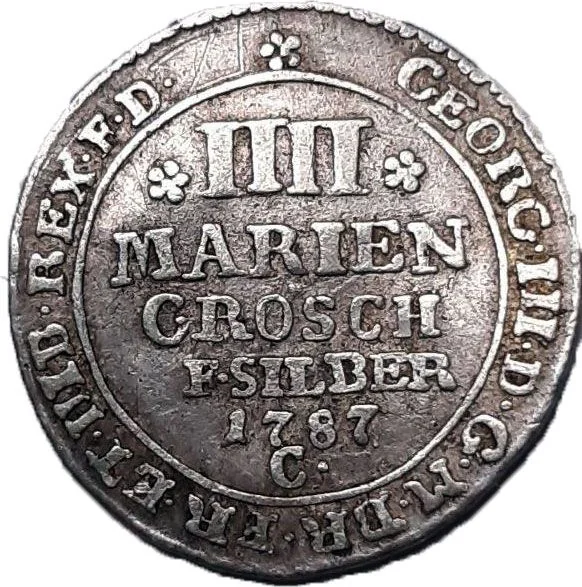
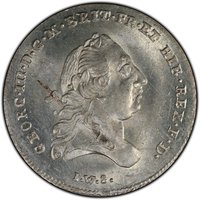
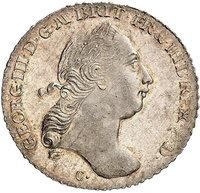
Obverse
Description:
Central inscription: denomination and mintmaster initials. Surrounding legend with date.
Inscription:
*IIII*
MARIEN
GROSCH
F-SILBER
1787
C.
GEORG·III·D·G·M·BR·FR·ET·HIB·REX·F·D
MARIEN
GROSCH
F-SILBER
1787
C.
GEORG·III·D·G·M·BR·FR·ET·HIB·REX·F·D
Script: Latin
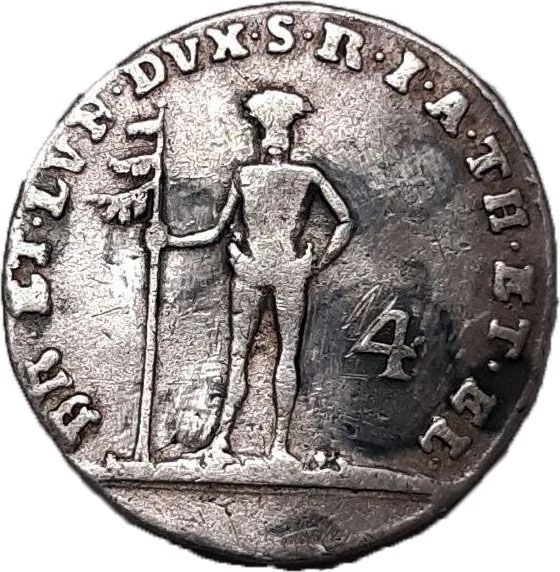
Reverse
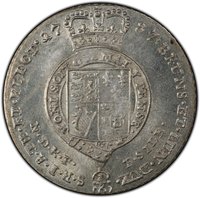
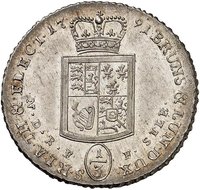
Description:
Wild man holding pine, denomination right.
Inscription:
BR·ET·LVN·DVX·S·R·I·A·TH·E·T·E·L
4
4
Script: Latin
Edge
Plain
Mints
| Name | Mark |
|---|---|
| Clausthal | — |
Mintings
| Year | Mint Mark | Mintage | Quality | Collection |
|---|---|---|---|---|
| 1787 | .C. | — | ||
| 1788 | .C. | — |
Historical background
In 1787, the currency situation in the Duchy of Brunswick-Lüneburg, specifically the Principality of Calenberg (with its capital in Hanover), was characterized by significant complexity and fragmentation. The territory was part of the Holy Roman Empire and operated within the monetary sphere of the Reichsthaler, but practical circulation was dominated by a multitude of different coins. Alongside local Hanoverian issues, there was a heavy influx of currencies from neighboring German states, as well as French Louis d'or and Dutch ducats, used for larger transactions. This created a chaotic environment where exchange rates fluctuated constantly, and the value of money was often tied to its specific metallic content and origin rather than a stable, state-backed guarantee.
The root of this disorder lay in the region's political structure. While under the personal rule of the British monarch (George III), Hanover itself lacked a centralized minting policy strong enough to enforce a uniform currency. Different cities and estates historically held minting rights, leading to a legacy of debased and irregular coinage. Furthermore, the government's own financial needs, particularly to fund its military, often led to the issuance of lightweight or inferior coinage (Kippermünze), which further eroded public trust and exacerbated the confusion in everyday commerce.
Consequently, merchants and the public faced considerable hardship. Simple trade required specialized knowledge of coin valuations, and transactions were slowed by the need to weigh and assay coins. This monetary anarchy acted as a drag on economic development and state administration. By 1787, these pressures were building toward a necessary reform, which would culminate in the introduction of the "Conventionsfuß" standard later in the decade, an attempt to align Hanover's currency with the more stable Reichsthaler used in northern Germany and bring order to the chaotic monetary landscape.
The root of this disorder lay in the region's political structure. While under the personal rule of the British monarch (George III), Hanover itself lacked a centralized minting policy strong enough to enforce a uniform currency. Different cities and estates historically held minting rights, leading to a legacy of debased and irregular coinage. Furthermore, the government's own financial needs, particularly to fund its military, often led to the issuance of lightweight or inferior coinage (Kippermünze), which further eroded public trust and exacerbated the confusion in everyday commerce.
Consequently, merchants and the public faced considerable hardship. Simple trade required specialized knowledge of coin valuations, and transactions were slowed by the need to weigh and assay coins. This monetary anarchy acted as a drag on economic development and state administration. By 1787, these pressures were building toward a necessary reform, which would culminate in the introduction of the "Conventionsfuß" standard later in the decade, an attempt to align Hanover's currency with the more stable Reichsthaler used in northern Germany and bring order to the chaotic monetary landscape.
✨ Legendary