

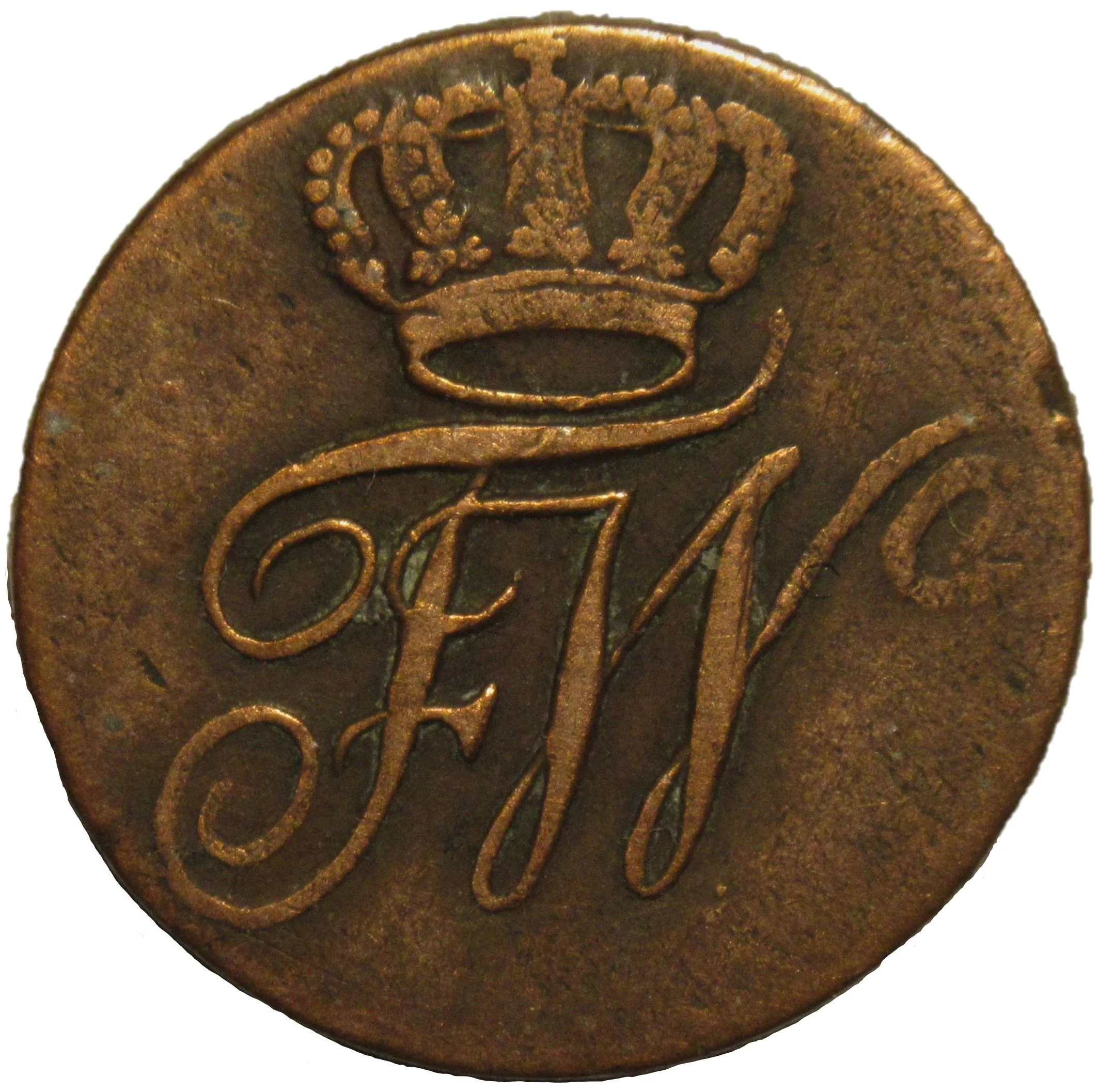
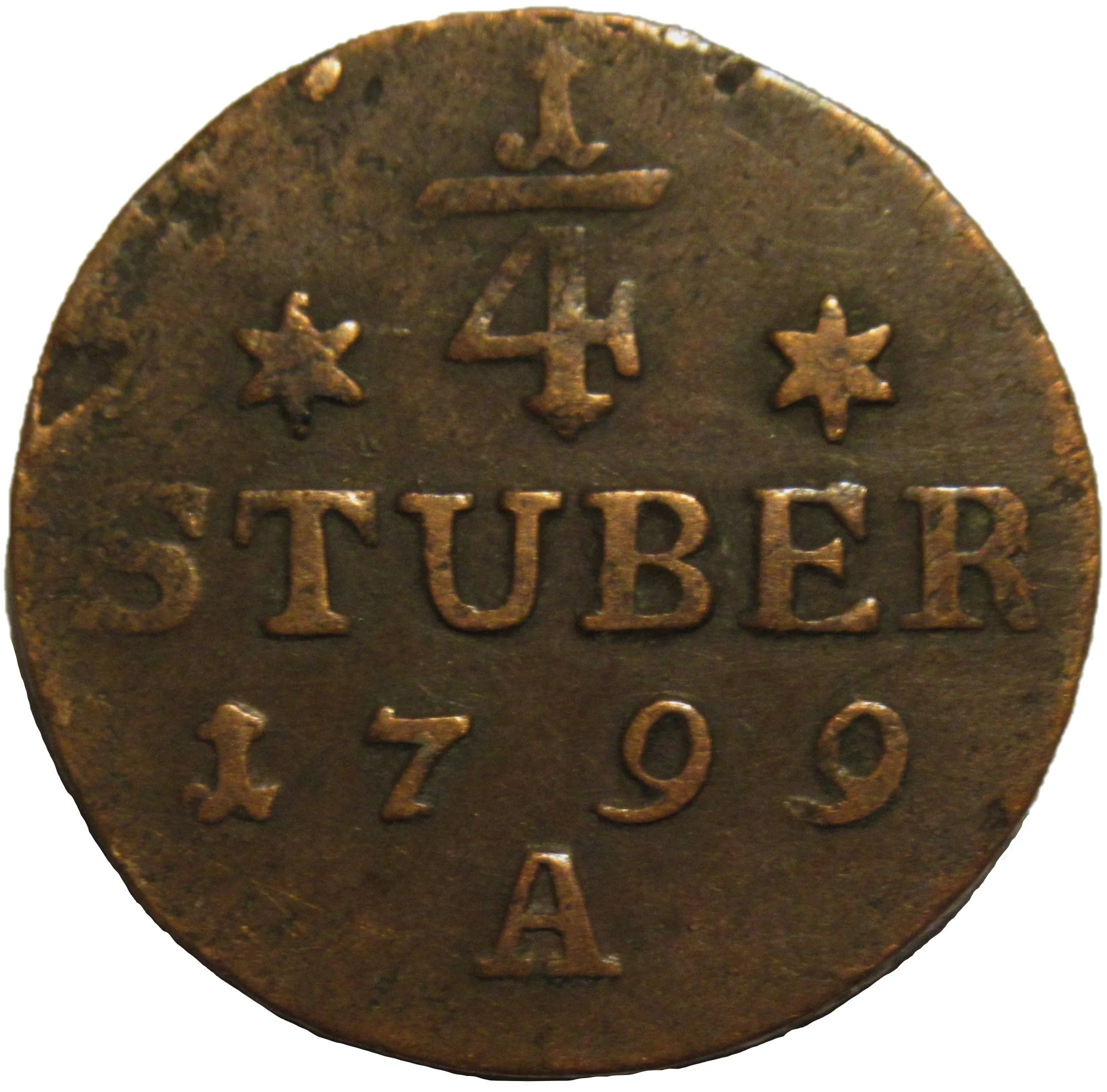
¼ stüber – East Frisia
Add to wishlist
Germany
Context
Years: 1799–1804
Country: Germany
Issuer: East Frisia
Ruler: Frederick William III
Currency:
Demonetized: Yes
Total mintage: 1,728,000
Material
Diameter: 18 mm
Weight: 3.1 g
Thickness: 1.5 mm
Shape: Round
Composition: Copper
Standard: Gold tenth ounce
Magnetic: No
Alignment: Medal alignment
flip
References
KM: #
Numista: #23070
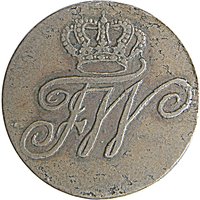
Obverse
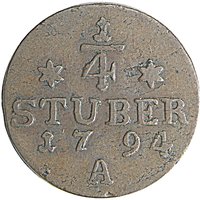
Reverse
Edge
Plain
Mints
| Name | Mark |
|---|---|
| Berlin | A |
Historical background
In 1799, the currency situation in East Frisia was characterized by significant complexity and instability, a direct consequence of its political status. The region was not an independent state but a Prussian province, having been annexed by the Kingdom of Prussia in 1744. As such, the official currency was the Prussian Reichsthaler, divided into 24 Groschen, each of 12 Pfennige. However, Prussia's own monetary system was undergoing reforms, and the state's fiscal demands to fund its wars placed a strain on the currency's consistency and value, affecting its eastern provinces.
Alongside the official Prussian currency, older and foreign coins remained in widespread circulation, creating a chaotic monetary environment. Dutch guilders and ducats, a legacy of East Frisia's historical trade links across the North Sea, were particularly common. Furthermore, various German states' thalers and smaller regional coins circulated freely, their value determined not by law but by fluctuating local agreement on their silver content. This necessitated the constant use of published exchange tables (Wechseltabellen) for merchants and citizens to conduct daily business, as the value of one coin against another was neither fixed nor uniform.
This monetary fragmentation was exacerbated by the broader turmoil of the French Revolutionary Wars. While East Frisia was not a battlefield in 1799, the conflict disrupted trade and created economic uncertainty across Northern Europe. The presence of foreign troops and the shifting political landscape contributed to occasional currency shortages and hoarding. Ultimately, the situation reflected East Frisia's position as a peripheral province within a larger kingdom, where practical, everyday commerce relied on a jumble of coins from a fading feudal past amidst the pressures of modernizing state control and international conflict.
Alongside the official Prussian currency, older and foreign coins remained in widespread circulation, creating a chaotic monetary environment. Dutch guilders and ducats, a legacy of East Frisia's historical trade links across the North Sea, were particularly common. Furthermore, various German states' thalers and smaller regional coins circulated freely, their value determined not by law but by fluctuating local agreement on their silver content. This necessitated the constant use of published exchange tables (Wechseltabellen) for merchants and citizens to conduct daily business, as the value of one coin against another was neither fixed nor uniform.
This monetary fragmentation was exacerbated by the broader turmoil of the French Revolutionary Wars. While East Frisia was not a battlefield in 1799, the conflict disrupted trade and created economic uncertainty across Northern Europe. The presence of foreign troops and the shifting political landscape contributed to occasional currency shortages and hoarding. Ultimately, the situation reflected East Frisia's position as a peripheral province within a larger kingdom, where practical, everyday commerce relied on a jumble of coins from a fading feudal past amidst the pressures of modernizing state control and international conflict.
⭐ Rare