

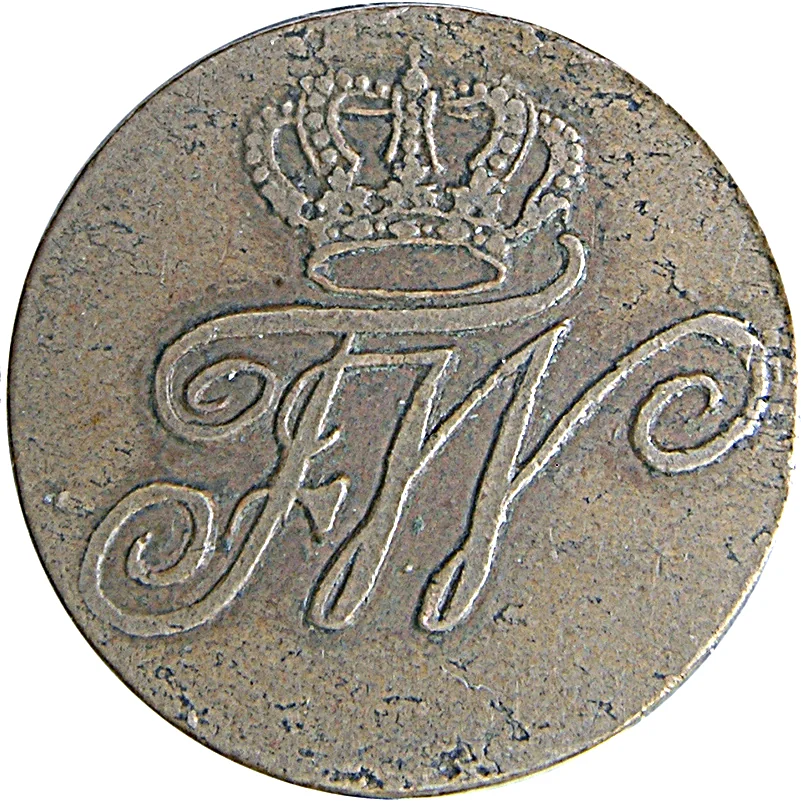
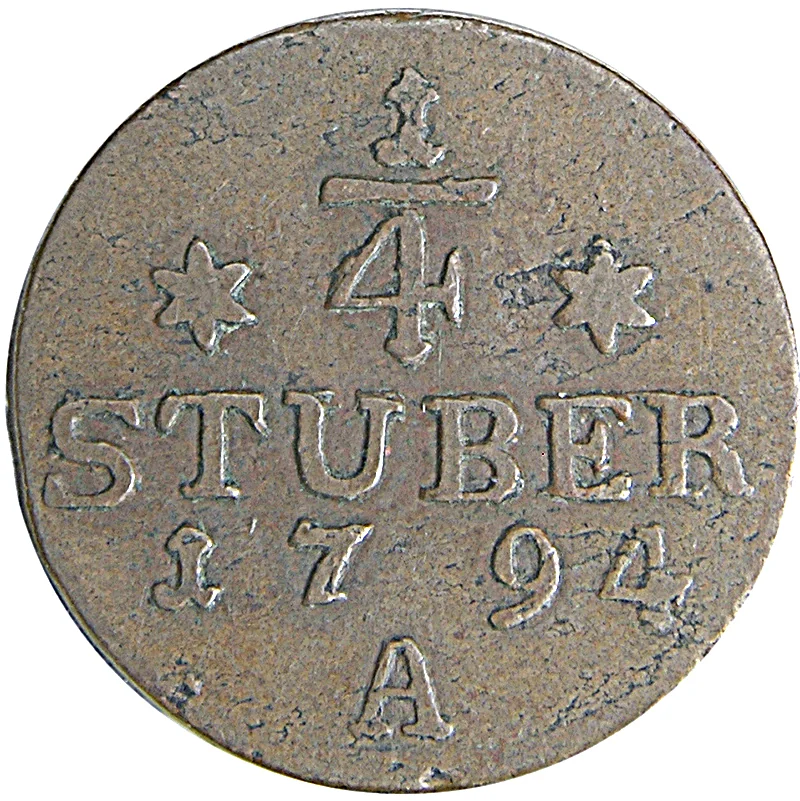
¼ stüber – East Frisia
Add to wishlist
Germany
Context
Year: 1794
Country: Germany
Issuer: East Frisia
Ruler: Frederick William II
Currency:
Demonetized: Yes
Material
Diameter: 18.5 mm
Weight: 3.06 g
Thickness: 1.48 mm
Shape: Round
Composition: Copper
Standard: Gold tenth ounce
Magnetic: No
Alignment: Medal alignment
flip
References
KM: #
Numista: #75787
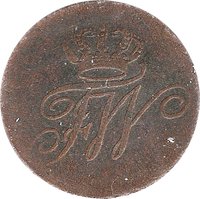
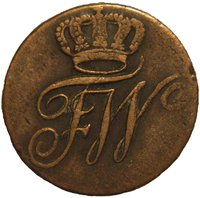
Obverse
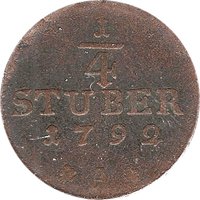
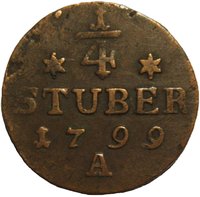
Reverse
Description:
Dated four-line legend with denomination and mintmark.
Inscription:
1/4
STUBER
1794
A
STUBER
1794
A
Script: Latin
Edge
Plain
Mints
| Name | Mark |
|---|---|
| Berlin | A |
Mintings
| Year | Mint Mark | Mintage | Quality | Collection |
|---|---|---|---|---|
| 1794 | A | — |
Historical background
In 1794, East Frisia found itself in a complex and transitional currency situation, caught between its historical ties, regional German systems, and the encroaching influence of revolutionary France. Officially, the region was a Prussian province, having been annexed in 1744, and thus the Reichsthaler was the official unit of account. However, the practical monetary landscape was a fragmented mosaic. A multitude of physical coins circulated simultaneously, including older Dutch guilders and ducats from its trade links with the Netherlands, various German Kleinstaat coins from neighbouring territories, and even residual local issues, all with fluctuating exchange values against the Prussian standard.
This monetary plurality created significant challenges for daily commerce and administration. The value of coins depended not only on their denomination but also on their metal content, age, and place of origin, leading to constant calculations and widespread confusion. The situation was further strained by the broader geopolitical turmoil. While East Frisia itself was not yet a battlefield, the War of the First Coalition (1792-1797) was raging nearby, disrupting trade routes and causing economic uncertainty. This often led to hoarding of full-weight specie, the circulation of debased coins, and general monetary instability.
Crucially, 1794 marked a point of growing external pressure that would soon overhaul this system entirely. French revolutionary armies had advanced into the Austrian Netherlands and the German Rhineland, directly bordering East Frisia's sphere of influence. Although French troops would not directly occupy East Frisia until 1806, the economic and ideological shockwaves of the Revolution were already being felt. The French expansion heralded the impending end of the old Holy Roman Empire's monetary fragmentation, setting the stage for the eventual introduction of a decimal-based, uniform currency system under Napoleonic rule in the following decade.
This monetary plurality created significant challenges for daily commerce and administration. The value of coins depended not only on their denomination but also on their metal content, age, and place of origin, leading to constant calculations and widespread confusion. The situation was further strained by the broader geopolitical turmoil. While East Frisia itself was not yet a battlefield, the War of the First Coalition (1792-1797) was raging nearby, disrupting trade routes and causing economic uncertainty. This often led to hoarding of full-weight specie, the circulation of debased coins, and general monetary instability.
Crucially, 1794 marked a point of growing external pressure that would soon overhaul this system entirely. French revolutionary armies had advanced into the Austrian Netherlands and the German Rhineland, directly bordering East Frisia's sphere of influence. Although French troops would not directly occupy East Frisia until 1806, the economic and ideological shockwaves of the Revolution were already being felt. The French expansion heralded the impending end of the old Holy Roman Empire's monetary fragmentation, setting the stage for the eventual introduction of a decimal-based, uniform currency system under Napoleonic rule in the following decade.
💎 Extremely Rare