

10 Francs – Monaco
Monaco
Context
Years: 1975–1982
Issuer: Monaco 
Ruler: Rainier III
Currency:
(1960—2001)
Demonetized: Yes
Total mintage: 894,000
Material
Diameter: 26 mm
Weight: 10 g
Thickness: 2.5 mm
Shape: Round
Composition: Copper-aluminium-nickel
Technique: Milled
Alignment: Coin alignment
flip
References
KM: #Click to copy to clipboard154
Numista: #1235
Value
Exchange value: 10 MCF
Obverse
Description:
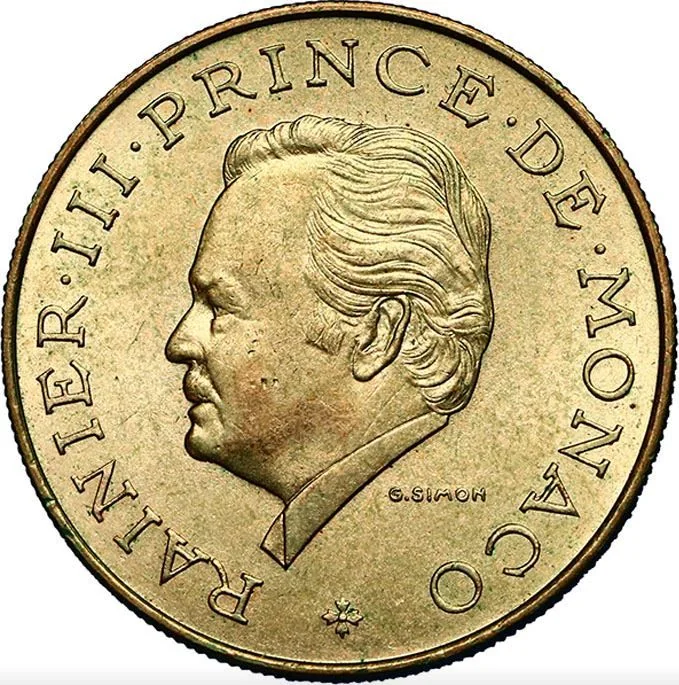
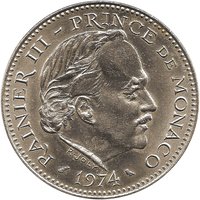
Rainier III, left-facing portrait.
Inscription:
RAINIER·III·PRINCE·DE·MONACO
G.SIMON
G.SIMON
Script: Latin
Engraver: Georges Simon
Reverse
Description:
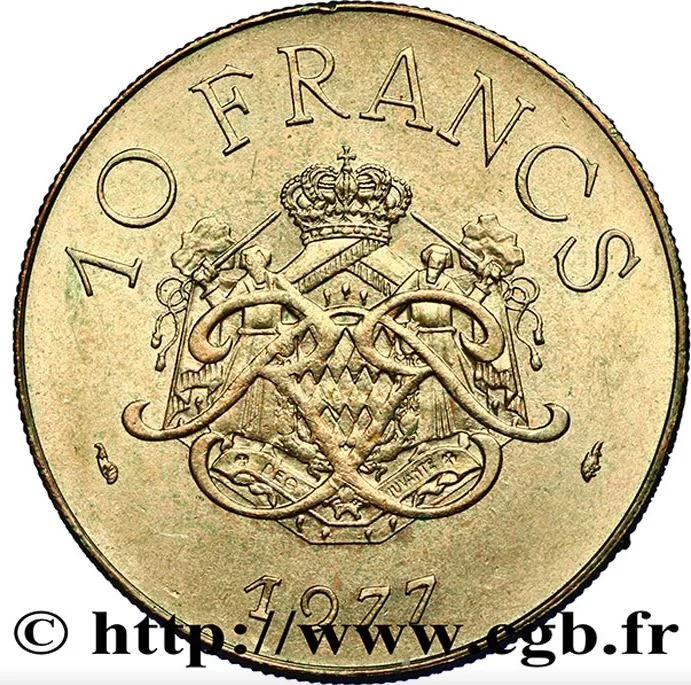
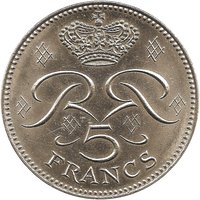
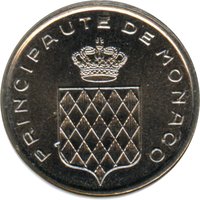
Monaco's coat of arms with Prince Rainier III's monogram.
Inscription:
10 FRANCS
RR
1977
RR
1977
Script: Latin
Engraver: Georges Simon
Edge
Reeded
Categories
| Symbol> Crown |
| Person> Monarch |
| Person> Religious figure |
| Symbols> Monogram |
| Object> Cold weapons |
| Symbols> Coat of Arms |
| Mustache/Beard |
Mints
| Name | Mark |
|---|---|
| Monnaie de Paris | — |
Mintings
| Year | Mint Mark | Mintage | Quality | Collection |
|---|---|---|---|---|
| 1975 | — | 16,000 | ||
| 1976 | — | 16,000 | ||
| 1977 | — | 16,000 | ||
| 1978 | — | 190,500 | ||
| 1979 | — | 190,500 | ||
| 1981 | — | 235,000 | ||
| 1982 | — | 230,000 |
Historical background
In 1975, Monaco's currency situation was fundamentally defined by its unique political and economic relationship with France, governed by the 1918 Franco-Monégasque Treaty. As a result, the Principality did not issue its own independent, freely circulating currency. Instead, the legal tender was the French franc, and Monaco minted its own franc coins that were legally equivalent to French francs and circulated interchangeably within its territory. These distinctive Monégasque coins, featuring the effigy of Prince Rainier III, held nominal face value but were primarily intended for collectors and tourists, with their metallic value often exceeding their face value.
The year 1975 fell within a period of significant monetary instability for the French franc, which directly impacted Monaco. France was grappling with the aftermath of the 1973 oil crisis, leading to high inflation and a weakening currency. This context meant that Monaco, by extension, was subject to the same inflationary pressures and economic uncertainties as its larger neighbor. The franc's vulnerabilities were part of what would eventually lead European nations to seek greater monetary stability through mechanisms like the European Monetary System (EMS), established in 1979.
Therefore, Monaco in 1975 had no autonomous monetary policy; its currency was effectively an extension of the French franc system during a turbulent economic decade. The Principality's financial stability relied entirely on the health of the French economy and the policies enacted by the Banque de France. This arrangement underscored Monaco's deep integration with France, ensuring monetary stability through the backing of a larger state while foregoing independent control over its currency, a trade-off that remained a cornerstone of its economic framework.
The year 1975 fell within a period of significant monetary instability for the French franc, which directly impacted Monaco. France was grappling with the aftermath of the 1973 oil crisis, leading to high inflation and a weakening currency. This context meant that Monaco, by extension, was subject to the same inflationary pressures and economic uncertainties as its larger neighbor. The franc's vulnerabilities were part of what would eventually lead European nations to seek greater monetary stability through mechanisms like the European Monetary System (EMS), established in 1979.
Therefore, Monaco in 1975 had no autonomous monetary policy; its currency was effectively an extension of the French franc system during a turbulent economic decade. The Principality's financial stability relied entirely on the health of the French economy and the policies enacted by the Banque de France. This arrangement underscored Monaco's deep integration with France, ensuring monetary stability through the backing of a larger state while foregoing independent control over its currency, a trade-off that remained a cornerstone of its economic framework.
🌱 Very Common