

1 centime – Monaco
Add to wishlist
Monaco
Context
Years: 1976–1995
Issuer: Monaco
Ruler: Rainier III
Currency:
(1960—2001)
Demonetized: Yes
Total mintage: 190,000
Material
Diameter: 15 mm
Weight: 1.65 g
Thickness: 1.3 mm
Shape: Round
Composition: Stainless steel
Technique: Milled
Alignment: Coin alignment
flip
References
KM: #
Numista: #6366
Value
Exchange value: 0.01 MCF
Obverse
Description:
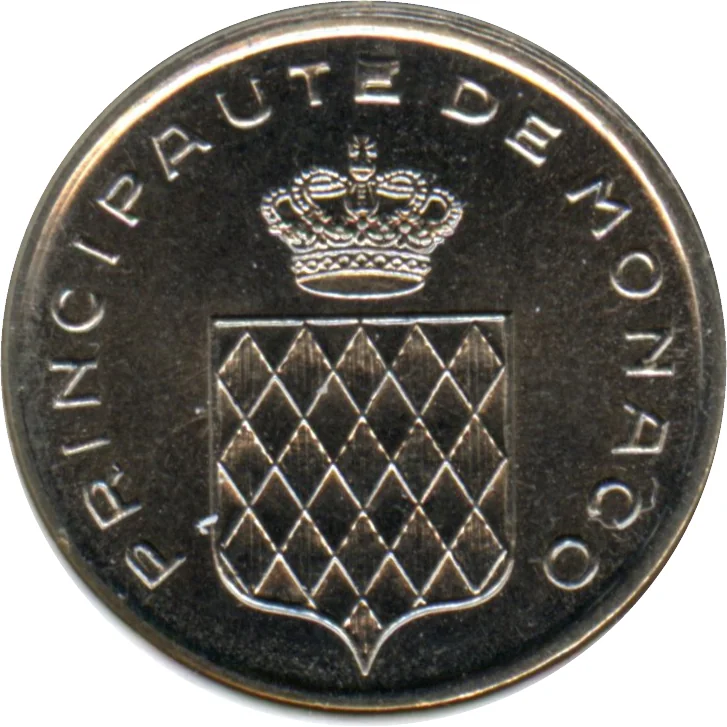
Crowned shield.
Inscription:
PRINCIPAUTE DE MONACO
Translation:
Principality of Monaco
Script: Latin
Language: French
Engraver: Georges Simon
Reverse
Description:
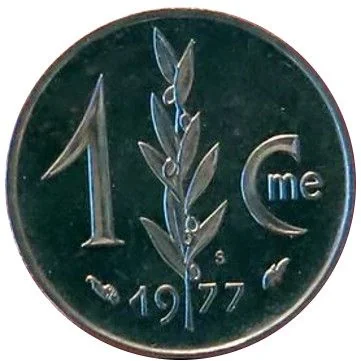
Olive branch with shared date and denomination.
Inscription:
1 Cme
S
19 77
S
19 77
Translation:
One Cent
S
1977
S
1977
Script: Latin
Engraver: Georges Simon
Edge
Plain
Categories
| Symbols> Coat of Arms |
| Symbol> Crown |
Mints
| Name | Mark |
|---|---|
| Monnaie de Paris | — |
Mintings
| Year | Mint Mark | Mintage | Quality | Collection |
|---|---|---|---|---|
| 1976 | — | 25,000 | ||
| 1977 | — | 25,000 | ||
| 1978 | — | 50,000 | ||
| 1979 | — | 50,000 | ||
| 1982 | — | 10,000 | ||
| 1995 | — | 30,000 | In sets |
Historical background
In 1976, Monaco's currency situation was intrinsically linked to that of France, operating under a long-standing monetary agreement that granted the Principality the right to issue its own coinage while using French banknotes as legal tender. This arrangement, formalized in the 1963 Franco-Monégasque Treaty, established the French franc as the official currency for all major transactions and paper money. Monaco's own coins, the Monégasque franc, were minted with identical specifications, value, and metallic composition to their French counterparts and circulated interchangeably within the country's borders.
The year 1976 fell within a period of relative monetary stability for the franc zone, following the turbulent early 1970s which saw the end of the Bretton Woods system. However, the French franc itself was part of the European "snake in the tunnel" exchange rate mechanism, an early attempt at European monetary cooperation that aimed to limit fluctuations between member currencies. Consequently, Monaco's monetary policy was effectively set by the Banque de France, with the Principality having no independent central bank or authority over interest rates or money supply.
Therefore, the background for Monaco in 1976 is one of complete monetary dependency and harmony with France. There was no separate "currency situation" or crisis specific to Monaco; its financial stability was directly contingent on the performance and policies of the French franc. The Monégasque coinage served primarily as a symbol of national sovereignty and a collector's item, while the practical economy operated seamlessly with French currency, a relationship that would continue until the adoption of the euro by both nations in 2002.
The year 1976 fell within a period of relative monetary stability for the franc zone, following the turbulent early 1970s which saw the end of the Bretton Woods system. However, the French franc itself was part of the European "snake in the tunnel" exchange rate mechanism, an early attempt at European monetary cooperation that aimed to limit fluctuations between member currencies. Consequently, Monaco's monetary policy was effectively set by the Banque de France, with the Principality having no independent central bank or authority over interest rates or money supply.
Therefore, the background for Monaco in 1976 is one of complete monetary dependency and harmony with France. There was no separate "currency situation" or crisis specific to Monaco; its financial stability was directly contingent on the performance and policies of the French franc. The Monégasque coinage served primarily as a symbol of national sovereignty and a collector's item, while the practical economy operated seamlessly with French currency, a relationship that would continue until the adoption of the euro by both nations in 2002.
🌱 Common