

1 Cent – United States
United States
Context
Year: 1787
Issuer: United States 
Issuing organization: American Congress
Period:
(since 1776)
Currency:
(since 1785)
Material
References
KM: #Click to copy to clipboardEA30.1-30.
Numista: #23012
Value
Exchange value: 0.01 USD = $0.01
Obverse
Description:
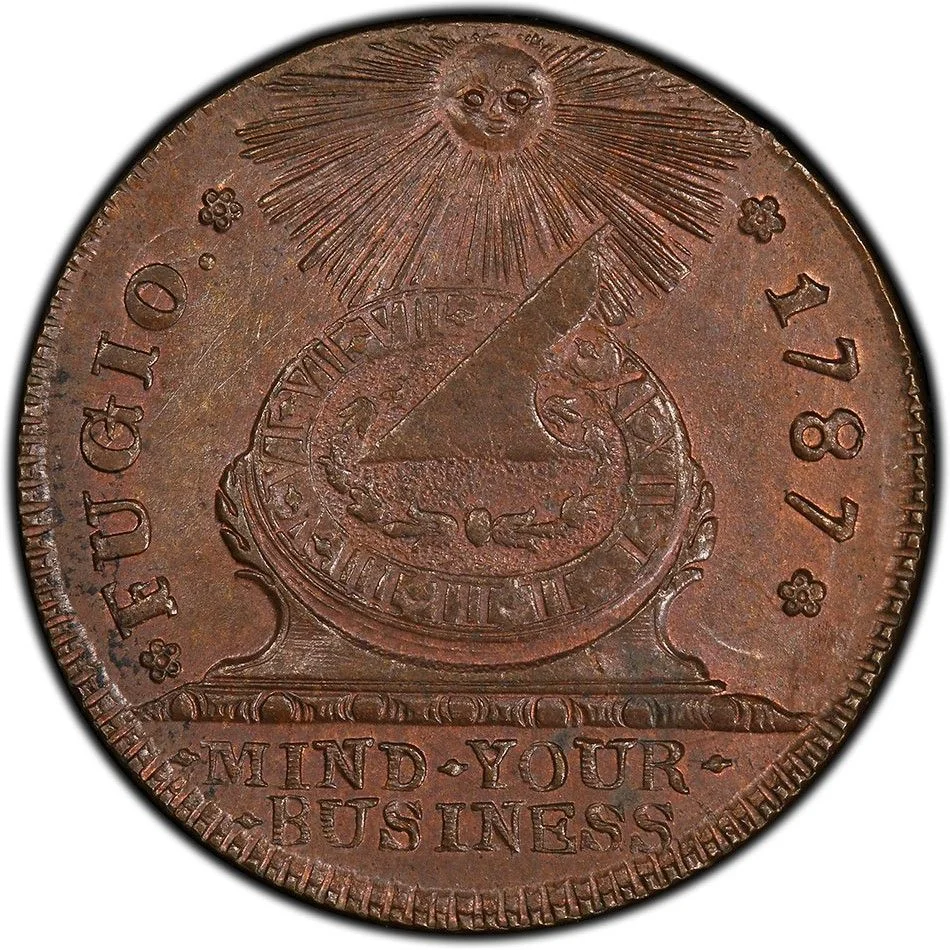
Sundial bearing an inscription.
Inscription:
FUGIO 1787
MIND YOUR
BUSINESS
MIND YOUR
BUSINESS
Script: Latin
Engraver: Abel Buell
Designer: Benjamin Franklin
Reverse
Description:
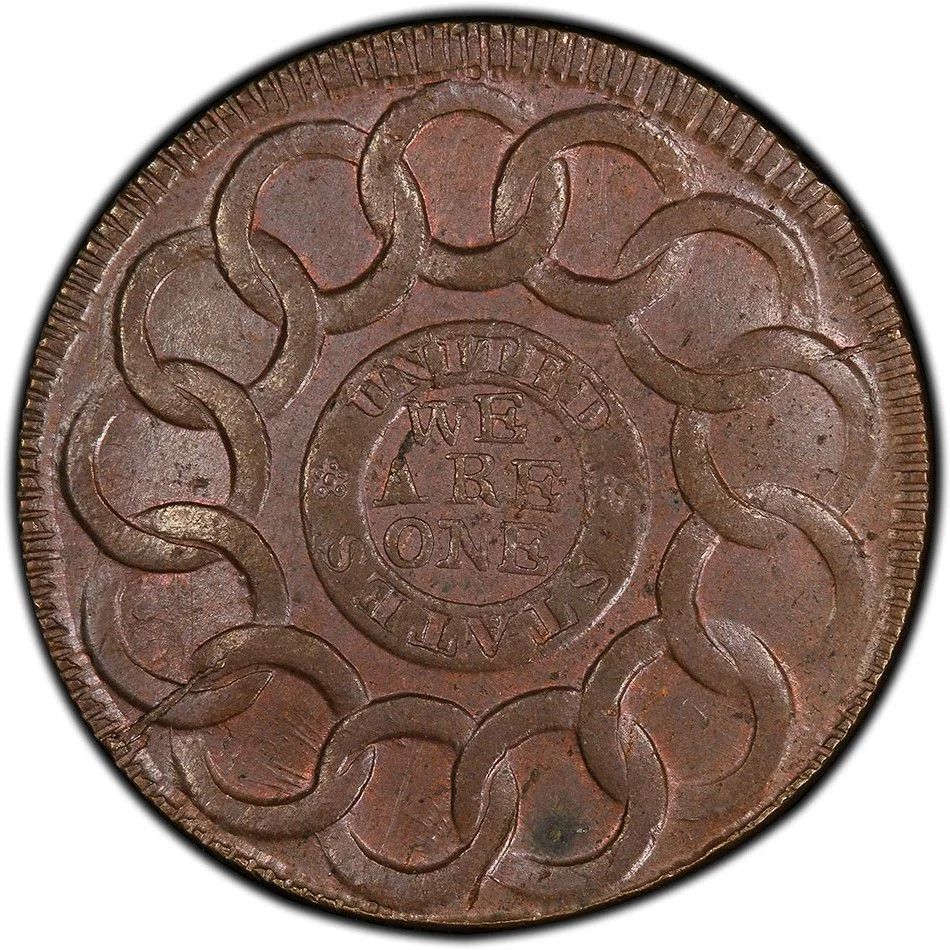
Thirteen interlinked rings symbolizing the colonies.
Inscription:
UNITED STATES
WE ARE ONE
WE ARE ONE
Script: Latin
Engraver: Abel Buell
Designer: Benjamin Franklin
Edge
Mints
| Name | Mark |
|---|---|
| New Haven | — |
| Rupert, Vermont | — |
Mintings
| Year | Mint Mark | Mintage | Quality | Collection |
|---|---|---|---|---|
| — | — | — | ||
| — | — | — | BU | |
| 1787 | — | — |
Historical background
In 1787, the United States faced a severe monetary crisis rooted in the weaknesses of the Articles of Confederation. The central government lacked the power to tax or regulate commerce, and its only fiscal tool was to request funds from the states, which were often ignored. To finance the Revolutionary War, both Congress and the individual states had issued vast quantities of paper money and debt certificates, leading to catastrophic inflation. By the war's end, continental currency was virtually worthless, giving rise to the phrase "not worth a continental." The nation operated with a chaotic mix of depreciated paper, foreign coins like the Spanish dollar, and various state-issued currencies, creating a crippling lack of a uniform, stable medium of exchange.
This monetary disarray severely hampered economic recovery and interstate trade. Debtors, including many farmers, clamored for state governments to issue more paper money to ease their repayment burdens, leading to policies like tender laws that forced creditors to accept devalued currency. In contrast, creditors and merchants suffered from these inflationary measures and longed for sound money backed by specie (gold or silver). This tension erupted in incidents like Shays' Rebellion in Massachusetts, where indebted farmers revolted against foreclosures and hard-money policies, starkly demonstrating the economic instability threatening the young nation.
The currency crisis was therefore a primary catalyst for the Constitutional Convention in Philadelphia in 1787. The delegates sought to create a federal government with the authority to resolve the financial chaos. Consequently, the new Constitution explicitly addressed these failures by granting Congress the sole power "to coin money [and] regulate the value thereof," while simultaneously prohibiting the states from coining money or emitting bills of credit. This critical shift established a foundation for national economic unity, aiming to replace the patchwork of unreliable currencies with a single, stable monetary system to foster commerce, ensure contract reliability, and underpin the nation's credit.
This monetary disarray severely hampered economic recovery and interstate trade. Debtors, including many farmers, clamored for state governments to issue more paper money to ease their repayment burdens, leading to policies like tender laws that forced creditors to accept devalued currency. In contrast, creditors and merchants suffered from these inflationary measures and longed for sound money backed by specie (gold or silver). This tension erupted in incidents like Shays' Rebellion in Massachusetts, where indebted farmers revolted against foreclosures and hard-money policies, starkly demonstrating the economic instability threatening the young nation.
The currency crisis was therefore a primary catalyst for the Constitutional Convention in Philadelphia in 1787. The delegates sought to create a federal government with the authority to resolve the financial chaos. Consequently, the new Constitution explicitly addressed these failures by granting Congress the sole power "to coin money [and] regulate the value thereof," while simultaneously prohibiting the states from coining money or emitting bills of credit. This critical shift established a foundation for national economic unity, aiming to replace the patchwork of unreliable currencies with a single, stable monetary system to foster commerce, ensure contract reliability, and underpin the nation's credit.
⭐ Somewhat Rare