

1 Thaler – Brunswick-Lüneburg-Calenberg
Germany
Context
Years: 1650–1664
Country: Germany 
Issuer: Brunswick-Lüneburg-Calenberg
Ruler: George William
Currency:
Demonetized: Yes
Material
References
KM: #Click to copy to clipboard57.1
Numista: #220534
Value
Bullion value: $81.59
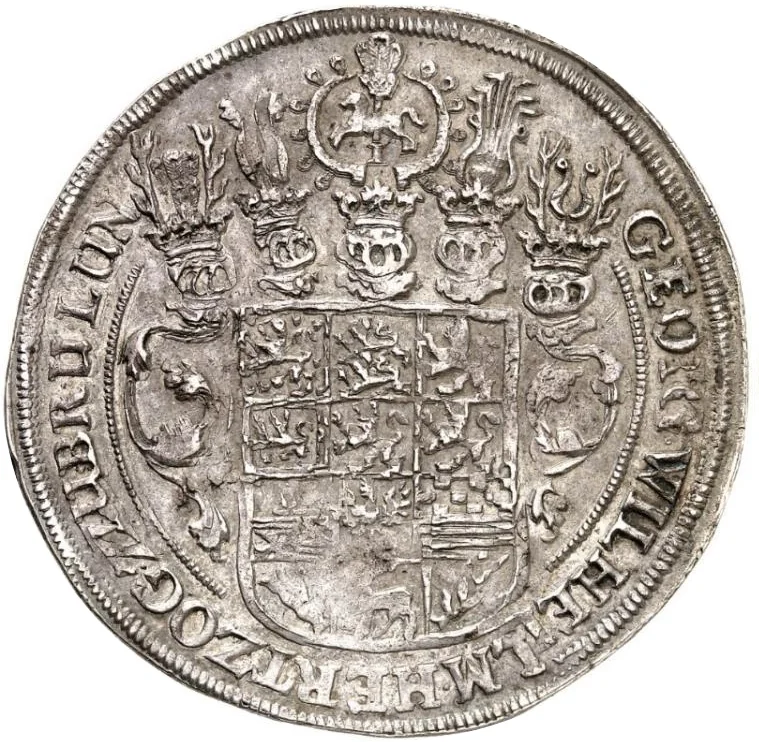
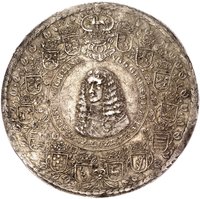
Obverse
Description:
Armed and helmeted.
Inscription:
GEORG • WILHELM• HIRTZOG • ZU • BR • TU • LU
Script: Latin
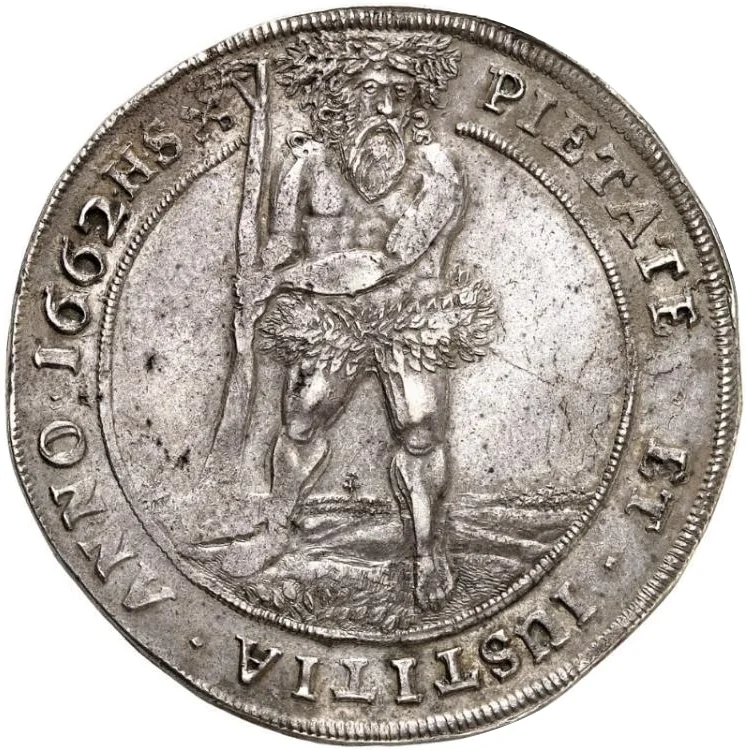
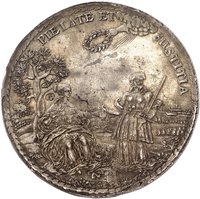
Reverse
Edge
Mints
| Name | Mark |
|---|---|
| Zellerfeld | — |
Mintings
| Year | Mint Mark | Mintage | Quality | Collection |
|---|---|---|---|---|
| 1650 | — | — | ||
| 1654 | — | — | ||
| 1655 | — | — | ||
| 1656 | — | — | ||
| 1657 | — | — | ||
| 1658 | — | — | ||
| 1659 | — | — | ||
| 1660 | — | — | ||
| 1661 | — | — | ||
| 1662 | — | — | ||
| 1663 | — | — | ||
| 1664 | — | — |
Historical background
In 1650, the currency situation in the Principality of Calenberg (part of the broader Brunswick-Lüneburg duchies) was characterized by severe instability and fragmentation, a direct legacy of the Thirty Years' War. The war had caused massive economic devastation, depleting silver reserves and leading successive rulers to debase the coinage repeatedly to finance military expenditures. Consequently, the monetary system was a chaotic mix of depreciated local coins, such as the Mariengroschen and Gute Groschen, alongside a plethora of still-circulating foreign and older imperial coins, all with fluctuating and unreliable values. This "bad money" severely disrupted trade and credit.
The core of the problem lay in the absence of a uniform, trusted currency. While the Holy Roman Empire's official currency was the Reichsthaler, a silver coin containing a specified amount of fine metal, its actual circulation was limited. In daily transactions, people used a confusing array of smaller Landmünzen (regional coins) whose value in relation to the Reichsthaler was arbitrarily set by the princely mint and often manipulated. This created a two-tier system where debts contracted in Reichsthaler had to be paid in devalued local coins, harming creditors and creating widespread distrust.
Recognizing this crisis, the ruling Duke George William initiated monetary reforms later in the 1650s, aiming to stabilize the currency. The goal was to restore confidence by aligning the principality's coinage more closely with the imperial standards, thereby facilitating commerce and recovery. Thus, the situation in 1650 represents the low point of post-war monetary chaos, poised on the cusp of concerted, though challenging, efforts to impose order and restore the integrity of the coinage for economic revival.
The core of the problem lay in the absence of a uniform, trusted currency. While the Holy Roman Empire's official currency was the Reichsthaler, a silver coin containing a specified amount of fine metal, its actual circulation was limited. In daily transactions, people used a confusing array of smaller Landmünzen (regional coins) whose value in relation to the Reichsthaler was arbitrarily set by the princely mint and often manipulated. This created a two-tier system where debts contracted in Reichsthaler had to be paid in devalued local coins, harming creditors and creating widespread distrust.
Recognizing this crisis, the ruling Duke George William initiated monetary reforms later in the 1650s, aiming to stabilize the currency. The goal was to restore confidence by aligning the principality's coinage more closely with the imperial standards, thereby facilitating commerce and recovery. Thus, the situation in 1650 represents the low point of post-war monetary chaos, poised on the cusp of concerted, though challenging, efforts to impose order and restore the integrity of the coinage for economic revival.
✨ Legendary