

Obverse
Description:
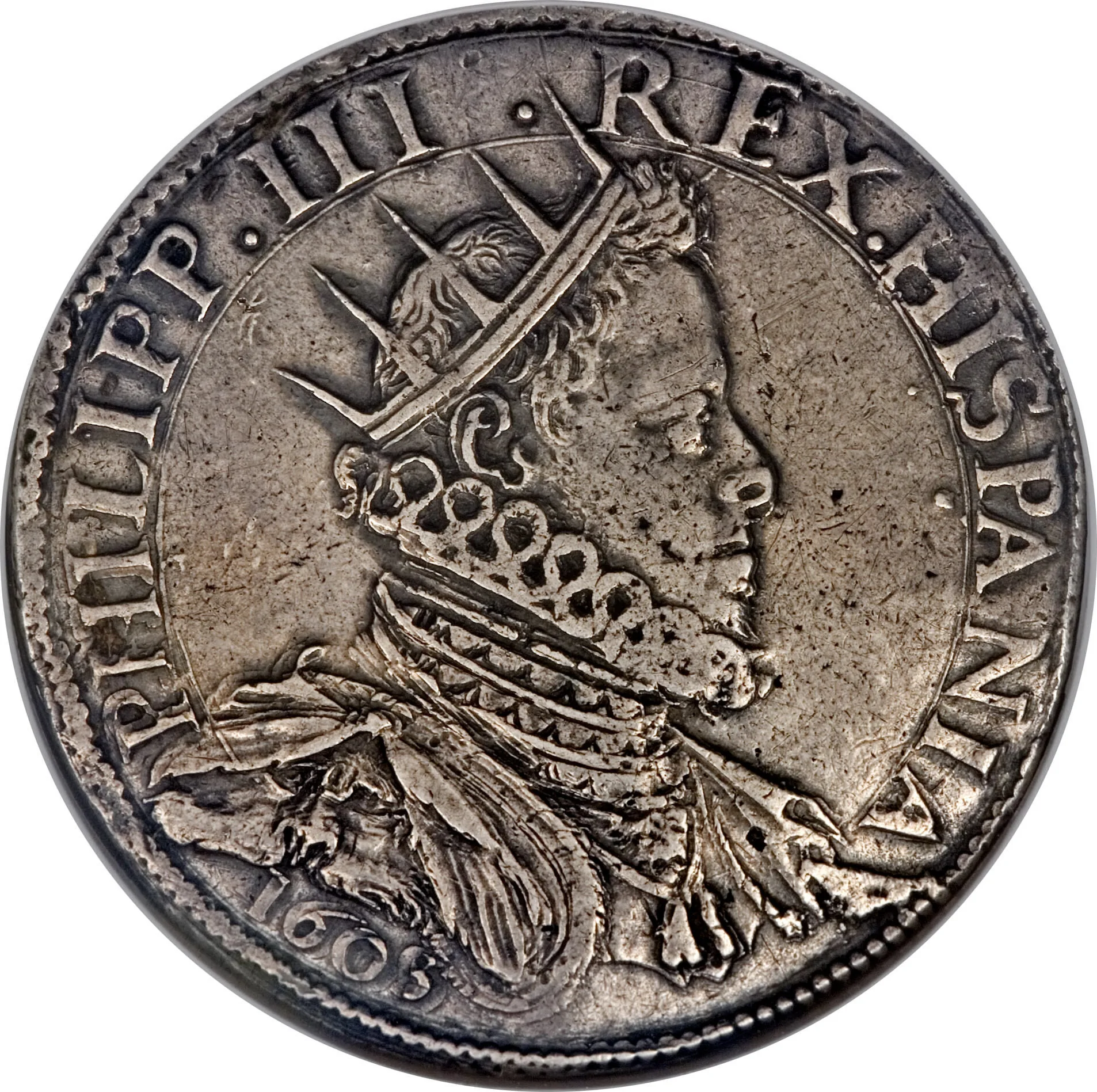
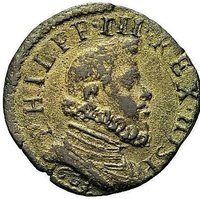
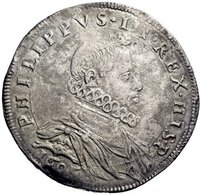
Bust of King Philip III of Spain facing right, crowned as Duke of Milan and wearing the Order of the Golden Fleece.
Inscription:
PHILIPP . III . REX . HISPANIA
1608
1608
Script: Latin
Reverse
Edge
Mints
| Name | Mark |
|---|---|
| Milan | — |
Mintings
| Year | Mint Mark | Mintage | Quality | Collection |
|---|---|---|---|---|
| 1602 | — | — | ||
| 1603 | — | — | ||
| 1608 | — | — |
Historical background
In 1602, Milan was a wealthy and strategically vital state within the Spanish Habsburg Empire, and its currency situation reflected both its economic importance and the complex monetary challenges of early modern Europe. The Duchy operated under a bimetallic system, centered on the gold scudo d’oro and the silver lira imperiale. However, the actual circulating medium was a chaotic mix of domestic and foreign coins, including Spanish reales, Genoese and Florentine gold pieces, and various low-denomination copper and billon coins for everyday trade. This proliferation created constant difficulties in exchange rates and valuation.
The primary issue was the chronic instability caused by the fluctuating market values of gold and silver, which often diverged from official mint ratios set by the authorities. This led to frequent episodes of Gresham’s Law, where "good" full-weight coins were hoarded or exported, leaving "bad" debased or worn coins in common circulation. Furthermore, the Spanish crown, frequently in need of funds for its military campaigns, periodically authorized the debasement of the copper sesino and other minor coinage struck in the Milanese mint. This practice eroded public trust and caused price inflation, particularly affecting the poor who used these coins for daily necessities.
To manage this chaos, Milan relied on the Ufficio del Fitto della Moneta, a public bank established in 1597. This institution played a crucial role by providing a stable unit of account for large transactions, clearing payments through book transfers, and attempting to regulate the exchange between different coin types. Thus, while the physical currency in one's hand was unreliable, Milan’s advanced financial institutions provided a necessary framework for commerce, attempting to mitigate the disorder inherent in the international monetary flows of the Spanish imperial economy.
The primary issue was the chronic instability caused by the fluctuating market values of gold and silver, which often diverged from official mint ratios set by the authorities. This led to frequent episodes of Gresham’s Law, where "good" full-weight coins were hoarded or exported, leaving "bad" debased or worn coins in common circulation. Furthermore, the Spanish crown, frequently in need of funds for its military campaigns, periodically authorized the debasement of the copper sesino and other minor coinage struck in the Milanese mint. This practice eroded public trust and caused price inflation, particularly affecting the poor who used these coins for daily necessities.
To manage this chaos, Milan relied on the Ufficio del Fitto della Moneta, a public bank established in 1597. This institution played a crucial role by providing a stable unit of account for large transactions, clearing payments through book transfers, and attempting to regulate the exchange between different coin types. Thus, while the physical currency in one's hand was unreliable, Milan’s advanced financial institutions provided a necessary framework for commerce, attempting to mitigate the disorder inherent in the international monetary flows of the Spanish imperial economy.
✨ Legendary