

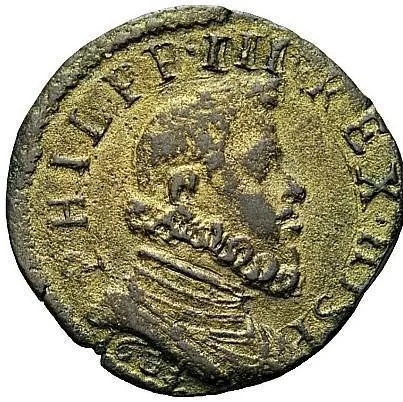
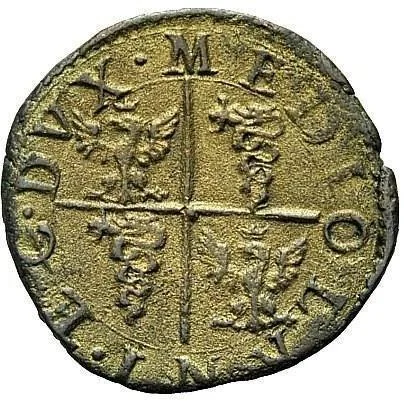
Italy
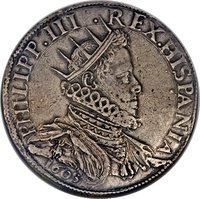
Obverse
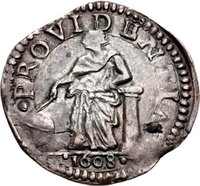
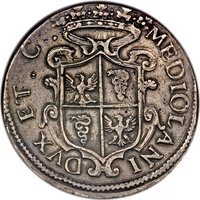
Reverse
Edge
Mints
| Name | Mark |
|---|---|
| Milan | — |
Mintings
| Year | Mint Mark | Mintage | Quality | Collection |
|---|---|---|---|---|
| 1600 | — | — | ||
| 1601 | — | — | ||
| 1602 | — | — | ||
| 1603 | — | — | ||
| 1606 | — | — | ||
| 1614 | — | — |
Historical background
In 1600, Milan was a major financial hub within the Spanish Empire, and its currency situation was complex and strained. The primary unit of account was the lira, divided into 20 soldi or 240 denari, but this was a money of account used for bookkeeping, not a physical coin. The actual circulating medium was a chaotic mix of physical coins, both domestic and foreign. The most important silver coin was the Milanese scudo, valued at 5-6 lire, but Spanish reales, Venetian ducats, and French écus also circulated freely, their values fluctuating based on their precious metal content and the credibility of the issuing state.
This period was marked by severe currency debasement. To finance its endless military campaigns, the Spanish Crown, which ruled the Duchy of Milan, frequently reduced the silver content in its coinage. This practice, combined with an influx of lower-quality foreign coins and counterfeit money, led to Gresham's Law in action: "bad money drives out good." People hoarded full-weight coins, melting them down or exporting them, while only the debased and foreign coins remained in daily circulation. This caused price inflation, commercial uncertainty, and frequent public outcry, as wages and contracts set in stable lire had to be paid with increasingly inferior physical coin.
Attempts at reform were sporadic and largely ineffective. The Milanese mint issued ordinances to fix exchange rates between the myriad of coins, but these official tariffs often failed to reflect market reality. Merchants and bankers, therefore, relied on complex agio tables (premium lists) to navigate daily transactions. Thus, Milan's monetary system in 1600 was a paradoxical blend of sophisticated financial practice and underlying instability, caught between the city's vibrant commercial needs and the fiscally desperate imperial policies of its Spanish rulers.
This period was marked by severe currency debasement. To finance its endless military campaigns, the Spanish Crown, which ruled the Duchy of Milan, frequently reduced the silver content in its coinage. This practice, combined with an influx of lower-quality foreign coins and counterfeit money, led to Gresham's Law in action: "bad money drives out good." People hoarded full-weight coins, melting them down or exporting them, while only the debased and foreign coins remained in daily circulation. This caused price inflation, commercial uncertainty, and frequent public outcry, as wages and contracts set in stable lire had to be paid with increasingly inferior physical coin.
Attempts at reform were sporadic and largely ineffective. The Milanese mint issued ordinances to fix exchange rates between the myriad of coins, but these official tariffs often failed to reflect market reality. Merchants and bankers, therefore, relied on complex agio tables (premium lists) to navigate daily transactions. Thus, Milan's monetary system in 1600 was a paradoxical blend of sophisticated financial practice and underlying instability, caught between the city's vibrant commercial needs and the fiscally desperate imperial policies of its Spanish rulers.
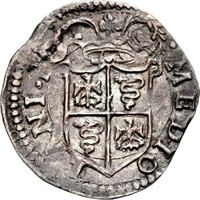
💎 Extremely Rare