

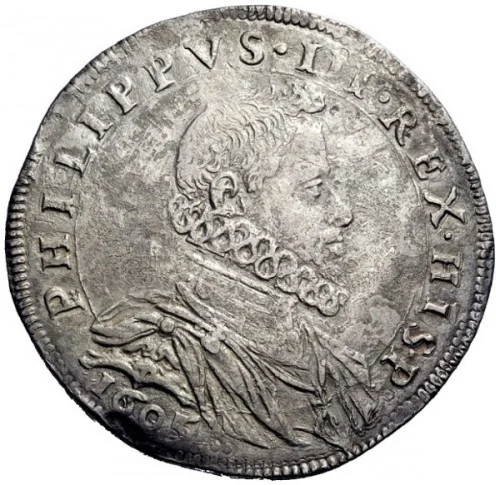

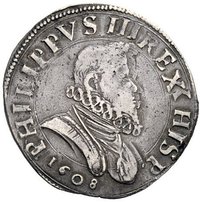
Obverse
Description:
Bust right, high collar, date below.
Inscription:
PHILIPPVS·III·REX·HISP
1605
1605
Script: Latin
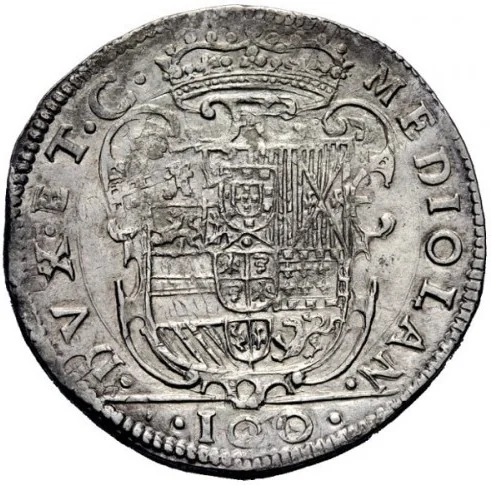
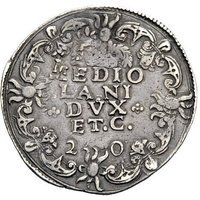
Reverse
Description:
Crowned baroque shield with many arms, '100' below.
Inscription:
MEDIOLAN· ·DVX·ET·C·
·100·
·100·
Script: Latin
Edge
Categories
| Object> Armour |
| Symbols> Coat of Arms |
Mints
| Name | Mark |
|---|---|
| Milan | — |
Mintings
| Year | Mint Mark | Mintage | Quality | Collection |
|---|---|---|---|---|
| 1604 | — | — | ||
| 1605 | — | — | ||
| 1606 | — | — | ||
| 1607 | — | — |
Historical background
In 1604, Milan was a pivotal financial hub within the Spanish Empire, but its currency situation was characterized by significant complexity and instability. The Duchy of Milan operated under a bimetallic system based on silver scudi and gold doppie, but daily transactions were dominated by a bewildering array of smaller, often debased, copper and billon (low-grade silver) coins, such as soldi and denari. The real power over currency, however, lay with the Spanish Crown in Madrid, which frequently mandated devaluations or the issuance of new, inferior coinage to finance its endless military campaigns across Europe. This created a chronic disconnect between the official, theoretical value of coins and their actual market value, leading to confusion, inflation, and widespread distrust.
The local authorities, including the Milanese Senate and the Maestri delle Entrate, struggled to manage the practical consequences. A primary issue was the severe shortage of "good" full-bodied silver coinage, as it was either hoarded or exported, leaving the circulating currency pool filled with worn and debased pieces. This phenomenon, known as Gresham's Law ("bad money drives out good"), crippled local commerce and complicated trade with other Italian states and Northern Europe. Merchants and bankers on the bustling Via dei Mercanti had to employ campsores (money-changers) and consult constantly updated tariffe (exchange lists) to navigate the daily fluctuations between dozens of different coins in circulation.
Ultimately, the monetary chaos of 1604 was a symptom of Milan's political subjugation. The Spanish Habsburgs treated the duchy's mint as a fiscal resource to be exploited, not a system to be stabilized for local prosperity. While proposals for reform were debated, any substantive change required approval from Madrid, which was rarely forthcoming if it conflicted with imperial revenue needs. Thus, Milanese society—from wealthy merchants to ordinary laborers—remained entangled in a fragile monetary web, where the value of the coin in one's hand was uncertain, undermining both economic confidence and the long-term vitality of the Lombard economy.
The local authorities, including the Milanese Senate and the Maestri delle Entrate, struggled to manage the practical consequences. A primary issue was the severe shortage of "good" full-bodied silver coinage, as it was either hoarded or exported, leaving the circulating currency pool filled with worn and debased pieces. This phenomenon, known as Gresham's Law ("bad money drives out good"), crippled local commerce and complicated trade with other Italian states and Northern Europe. Merchants and bankers on the bustling Via dei Mercanti had to employ campsores (money-changers) and consult constantly updated tariffe (exchange lists) to navigate the daily fluctuations between dozens of different coins in circulation.
Ultimately, the monetary chaos of 1604 was a symptom of Milan's political subjugation. The Spanish Habsburgs treated the duchy's mint as a fiscal resource to be exploited, not a system to be stabilized for local prosperity. While proposals for reform were debated, any substantive change required approval from Madrid, which was rarely forthcoming if it conflicted with imperial revenue needs. Thus, Milanese society—from wealthy merchants to ordinary laborers—remained entangled in a fragile monetary web, where the value of the coin in one's hand was uncertain, undermining both economic confidence and the long-term vitality of the Lombard economy.
✨ Legendary