

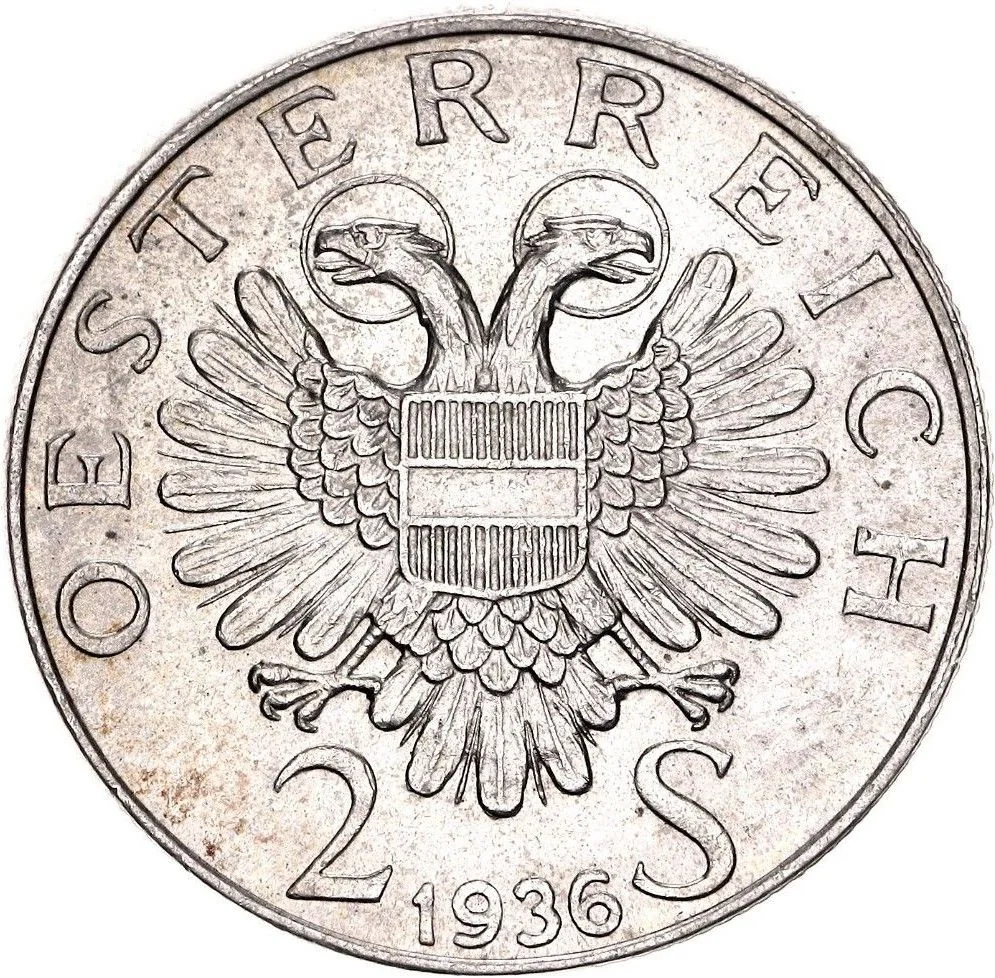
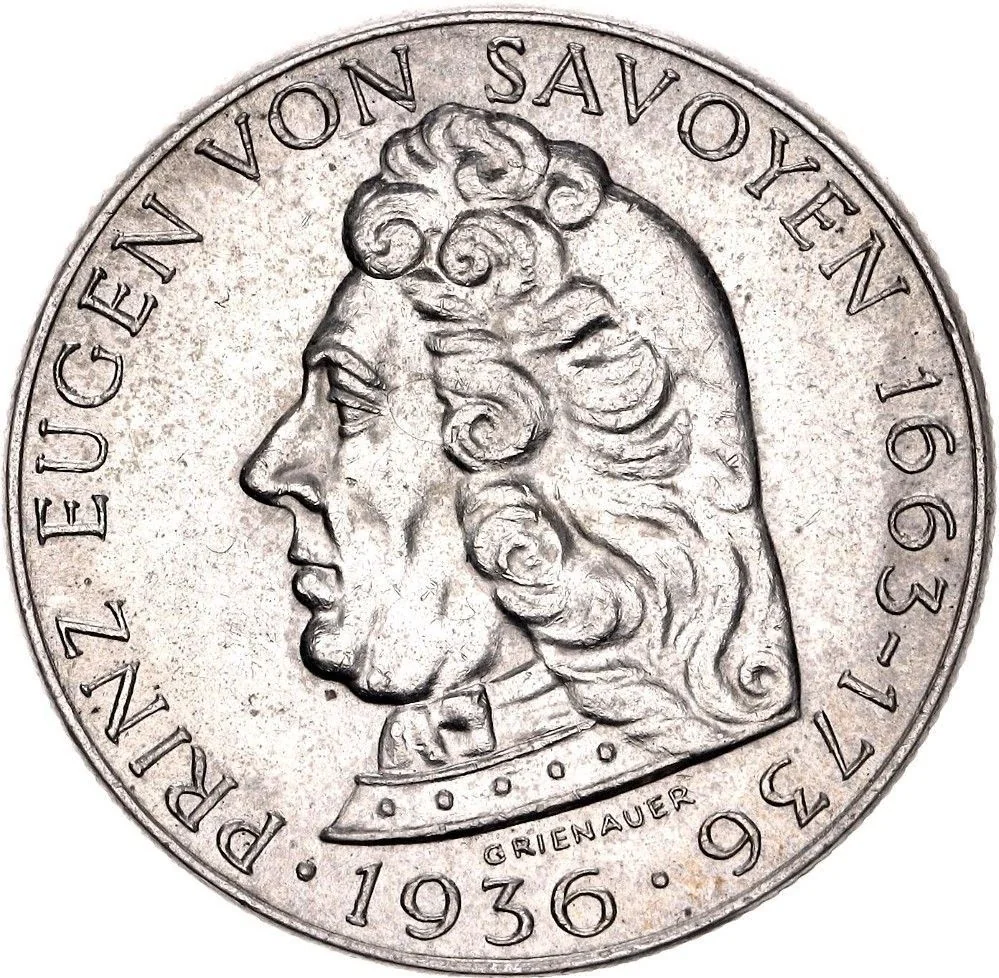
2 schilling (Prince Eugen of Savoyen) – Austria
Add to wishlist
Circulating commemorative coins
Commemoration: 200th Anniversary of the Death of Prince Eugen of Savoyen
Austria
Obverse
Reverse
Description:
Prince Eugen of Savoy, left profile.
Inscription:
PRINZ EUGEN VON SAVOYEN 1663 - 1736
GRIENAUER
1936
GRIENAUER
1936
Script: Latin
Engraver: Edwin Grienauer
Edge
Reeded
Categories
| Event> Death anniversary |
| Person> Military leader |
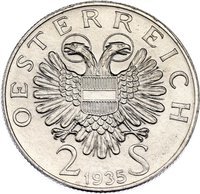
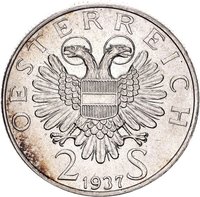
| Symbols> Coat of Arms |
| Symbol> Double-headed eagle |
Mints
| Name | Mark |
|---|---|
| Münze Österreich | — |
Mintings
| Year | Mint Mark | Mintage | Quality | Collection |
|---|---|---|---|---|
| 1936 | — | 500,000 | ||
| 1936 | — | — | Proof |
Historical background
In 1936, Austria's currency situation was precarious, directly tied to its political vulnerability and the lingering shadow of the Great Depression. The country operated under the Austrian Schilling (ÖS), introduced in 1925 to replace the hyperinflated Krone. However, Austria's economy remained fragile and heavily dependent on foreign trade, particularly with Germany. To maintain stability, the Schilling was pegged to gold and managed by the Austrian National Bank (Oesterreichische Nationalbank), but this required strict capital controls and was underpinned by significant foreign loans, most notably from the League of Nations.
The core of the monetary crisis was Austria's loss of confidence in the international financial markets and intense political pressure from Nazi Germany. Following the 1931 collapse of the Creditanstalt bank—an event that triggered financial panic across Europe—Austria had become reliant on short-term foreign credits. By 1936, with the rising threat of German annexation (Anschluss), capital flight intensified as investors and citizens sought safer havens. The government, under the authoritarian Ständestaat regime of Chancellor Kurt Schuschnigg, struggled to defend the Schilling's parity, burning through its limited gold and foreign currency reserves.
Ultimately, the currency's fate was decided by geopolitics rather than pure economics. To stave off immediate collapse and assert a semblance of independence from Berlin, Austria was forced into a de facto devaluation in alignment with its largest trading partner. In September 1936, Austria followed Germany's lead by devaluing the Schilling and pegging it to the weakened British Pound Sterling instead of gold, a move that provided temporary export relief but underscored its diminishing sovereignty. This monetary realignment was a stopgap measure; the Schilling and Austria's financial autonomy would be fully absorbed into the German Reichsmark following the Anschluss in March 1938.
The core of the monetary crisis was Austria's loss of confidence in the international financial markets and intense political pressure from Nazi Germany. Following the 1931 collapse of the Creditanstalt bank—an event that triggered financial panic across Europe—Austria had become reliant on short-term foreign credits. By 1936, with the rising threat of German annexation (Anschluss), capital flight intensified as investors and citizens sought safer havens. The government, under the authoritarian Ständestaat regime of Chancellor Kurt Schuschnigg, struggled to defend the Schilling's parity, burning through its limited gold and foreign currency reserves.
Ultimately, the currency's fate was decided by geopolitics rather than pure economics. To stave off immediate collapse and assert a semblance of independence from Berlin, Austria was forced into a de facto devaluation in alignment with its largest trading partner. In September 1936, Austria followed Germany's lead by devaluing the Schilling and pegging it to the weakened British Pound Sterling instead of gold, a move that provided temporary export relief but underscored its diminishing sovereignty. This monetary realignment was a stopgap measure; the Schilling and Austria's financial autonomy would be fully absorbed into the German Reichsmark following the Anschluss in March 1938.
🌱 Fairly Common