

3 sous – French Guiana
Add to wishlist
France
Context
Years: 1781–1846
Country: France
Issuer: French Guiana
Ruler: Louis XVI
Currency:
(1780—1818)
Demonetized: Yes
Material
References
KM: #
Numista: #20780
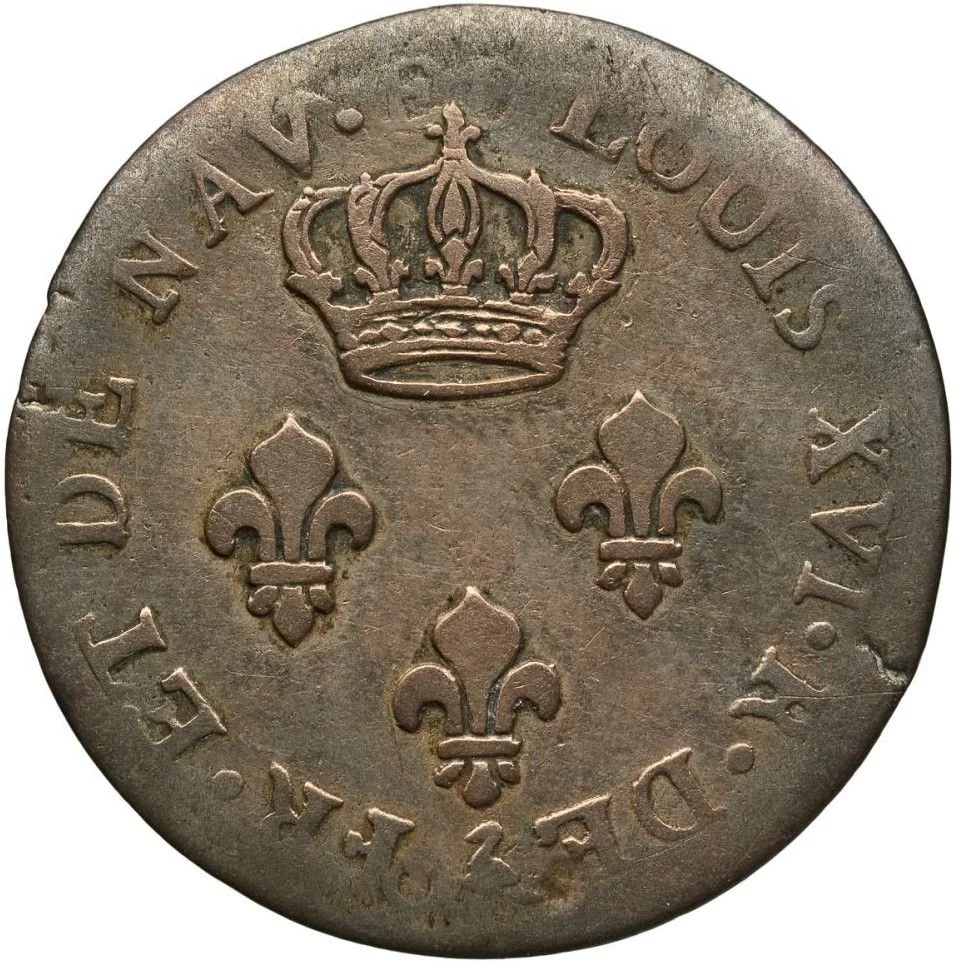
Obverse
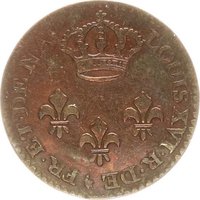
Description:
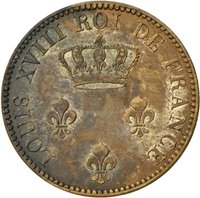
A crown atop three lis flowers.
Inscription:
LOUIS XVI R. DE FR. ET DE NAV.
Script: Latin
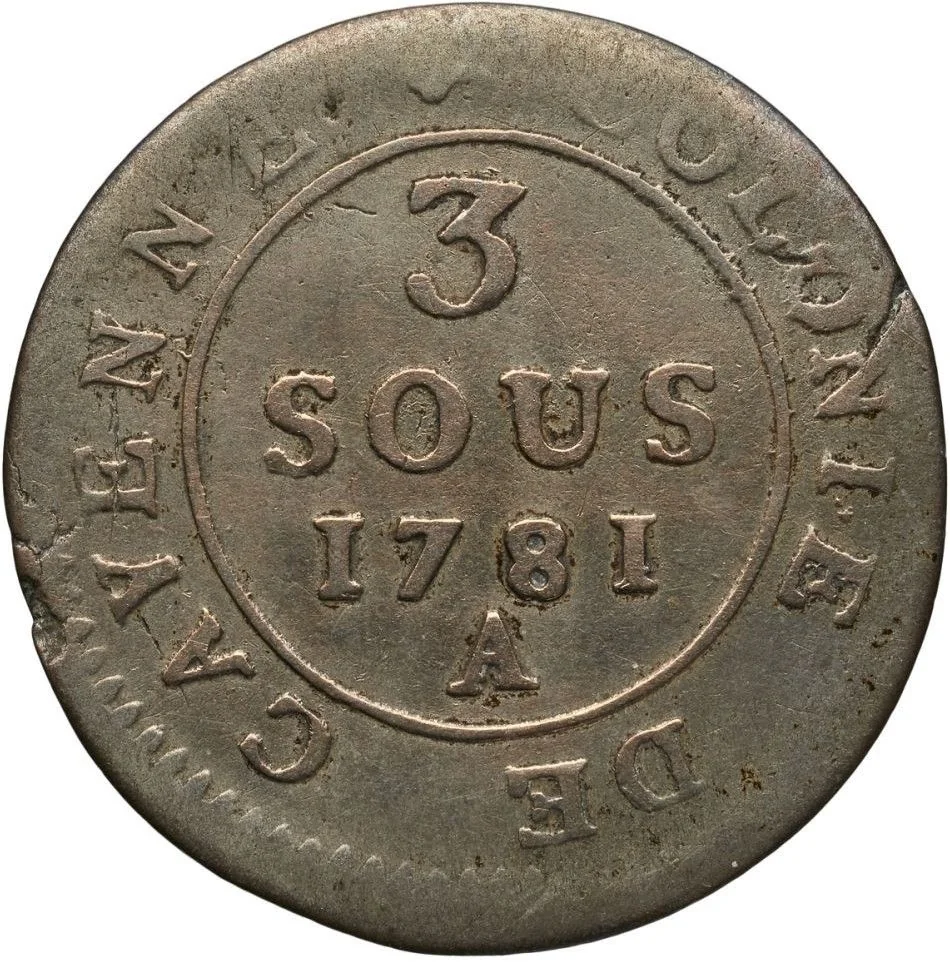
Reverse
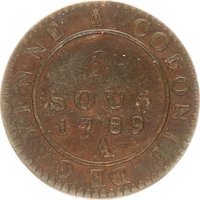
Description:
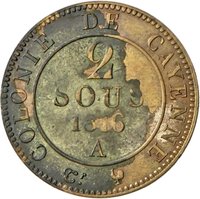
Value inside circle. COLONIE DE CAYENNE around edge.
Inscription:
3
SOUS
1781
A
COLONIE DE CAYENNE
SOUS
1781
A
COLONIE DE CAYENNE
Script: Latin
Edge
Plain
Mints
| Name | Mark |
|---|---|
| Monnaie de Paris | A |
Historical background
In 1781, French Guiana existed as a sparsely populated and economically struggling colony under the French Crown, and its currency situation was a direct reflection of its marginal status and the broader financial strains of the Ancien Régime. The colony operated primarily on a system of monetary scarcity, where official French coinage—livres, sous, and deniers—was in chronically short supply. This scarcity was due to the colony's persistent trade deficit, as it imported necessities like food and tools while exporting little beyond minor amounts of timber, cotton, and annatto dye, which failed to generate sufficient coin inflows.
To facilitate daily transactions, colonists relied heavily on commodity money and foreign coins. Common goods like cacao beans, sugar, and even nails were often used as informal barter currency. More significantly, due to extensive trade with neighboring Portuguese Brazil and Dutch Suriname, foreign coins—particularly Spanish pieces of eight (reales) and Portuguese réis—circulated widely and were often preferred for their reliable silver content. The French authorities periodically issued official exchange rates (cours) for these foreign coins in an attempt to bring order to the chaotic monetary environment, but these decrees had limited effect in practice.
This complex and unstable currency landscape was further strained by the global context of the American Revolutionary War (1775-1783), in which France was a key participant from 1778. The war diverted metropolitan attention and resources away from peripheral colonies like French Guiana, exacerbating the shortage of specie. Furthermore, the war increased the risk of British naval disruption to already-tenuous supply lines, making the import of even basic goods—and any accompanying coin—more difficult. Thus, in 1781, the colony's economy functioned on a precarious patchwork of scarce official currency, tangible commodities, and foreign coins, all set against a backdrop of imperial conflict and neglect.
To facilitate daily transactions, colonists relied heavily on commodity money and foreign coins. Common goods like cacao beans, sugar, and even nails were often used as informal barter currency. More significantly, due to extensive trade with neighboring Portuguese Brazil and Dutch Suriname, foreign coins—particularly Spanish pieces of eight (reales) and Portuguese réis—circulated widely and were often preferred for their reliable silver content. The French authorities periodically issued official exchange rates (cours) for these foreign coins in an attempt to bring order to the chaotic monetary environment, but these decrees had limited effect in practice.
This complex and unstable currency landscape was further strained by the global context of the American Revolutionary War (1775-1783), in which France was a key participant from 1778. The war diverted metropolitan attention and resources away from peripheral colonies like French Guiana, exacerbating the shortage of specie. Furthermore, the war increased the risk of British naval disruption to already-tenuous supply lines, making the import of even basic goods—and any accompanying coin—more difficult. Thus, in 1781, the colony's economy functioned on a precarious patchwork of scarce official currency, tangible commodities, and foreign coins, all set against a backdrop of imperial conflict and neglect.
✨ Legendary