

2 Sous – French Guiana
France
Context
Years: 1780–1790
Country: France 
Issuer: French Guiana
Ruler: Louis XVI
Currency:
(1780—1818)
Demonetized: Yes
Total mintage: 6,000,000
Material
References
KM: #Click to copy to clipboard1
Numista: #8454
Obverse
Description:
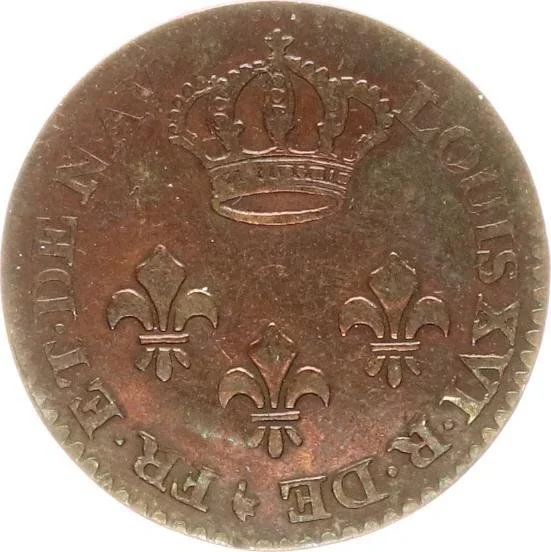
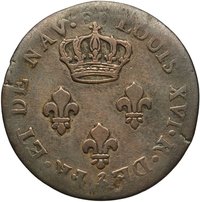
A royal crown with five arches atop three fleurs-de-lis.
Inscription:
LOUIS XVI R.DE FR ET DE NAV.
Script: Latin
Engraver: Pierre-Benjamin Duvivier
Reverse
Description:
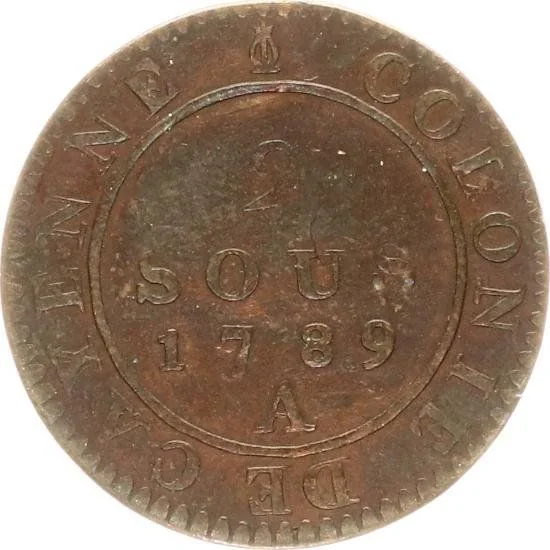
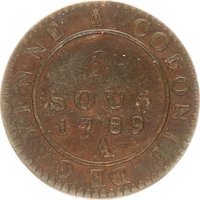
Value and date in a central circle, encircled by the issuing authority near the coin's edge within a grénetis.
Inscription:
COLONIE DE CAYENNE
2
SOUS
1789
A
2
SOUS
1789
A
Script: Latin
Engraver: Pierre-Benjamin Duvivier
Edge
Plain
Mints
| Name | Mark |
|---|---|
| Monnaie de Paris | A |
Mintings
Historical background
In 1780, French Guiana existed as a sparsely populated and economically struggling colony under the Ancien Régime, its primary function being that of a penal settlement and a modest source of tropical goods like sugar, cotton, and hardwoods. The currency situation was chaotic and reflected its peripheral status within the French empire. Officially, the colony operated on the French colonial livre, a currency distinct from the metropolitan French livre, but in practice, a severe shortage of official coinage was the defining feature of the monetary landscape.
This scarcity led to a reliance on a confusing multiplicity of alternative currencies. Spanish-American silver coins, particularly the Spanish dollar (piece of eight) and its fractional parts, circulated widely due to their reliability and intrinsic silver value, often serving as the de facto standard for larger transactions. For everyday trade, colonists and merchants also used commodity money such as cacao beans, a practice inherited from earlier periods. Furthermore, to alleviate the chronic cash shortage, local authorities and merchants frequently issued promissory notes and paper billets de caisse, but these were often of dubious value and limited acceptance, leading to frequent disputes and a general climate of monetary instability.
This dysfunctional system was exacerbated by France's involvement in the American Revolutionary War (1778-1783), which strained imperial finances and further disrupted already irregular shipments of specie and supplies to its colonies. The monetary chaos in French Guiana stifled economic development, discouraged settlement, and contributed to the colony's reputation as a failing venture. It was a system marked by improvisation and insufficiency, perfectly mirroring the colony's neglected position until well after the French Revolution.
This scarcity led to a reliance on a confusing multiplicity of alternative currencies. Spanish-American silver coins, particularly the Spanish dollar (piece of eight) and its fractional parts, circulated widely due to their reliability and intrinsic silver value, often serving as the de facto standard for larger transactions. For everyday trade, colonists and merchants also used commodity money such as cacao beans, a practice inherited from earlier periods. Furthermore, to alleviate the chronic cash shortage, local authorities and merchants frequently issued promissory notes and paper billets de caisse, but these were often of dubious value and limited acceptance, leading to frequent disputes and a general climate of monetary instability.
This dysfunctional system was exacerbated by France's involvement in the American Revolutionary War (1778-1783), which strained imperial finances and further disrupted already irregular shipments of specie and supplies to its colonies. The monetary chaos in French Guiana stifled economic development, discouraged settlement, and contributed to the colony's reputation as a failing venture. It was a system marked by improvisation and insufficiency, perfectly mirroring the colony's neglected position until well after the French Revolution.
🌱 Common