

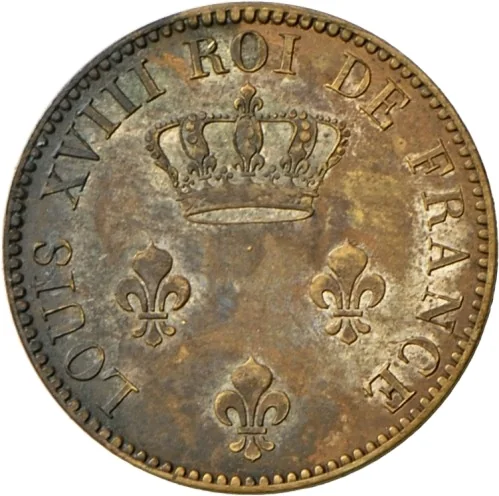
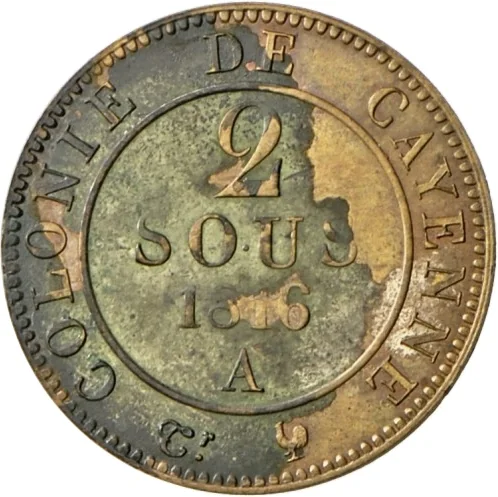
2 sous – French Guiana
Add to wishlist
France
Context
Year: 1816
Country: France
Issuer: French Guiana
Ruler: Louis XVIII
Currency:
(1780—1818)
Demonetized: Yes
Material
References
KM: #
Numista: #20781
Obverse
Reverse
Edge
Plain
Mints
| Name | Mark |
|---|---|
| Monnaie de Paris | A |
Mintings
| Year | Mint Mark | Mintage | Quality | Collection |
|---|---|---|---|---|
| 1816 | A | — |
Historical background
In 1816, French Guiana found itself in a complex monetary landscape, a direct legacy of the turbulent Napoleonic Wars and the recent restoration of the French monarchy. The territory, officially under French control again after the 1814 Treaty of Paris, was grappling with a severe shortage of official French currency (francs germinal). This scarcity was exacerbated by the colony's economic stagnation and the high costs associated with its infamous penal settlements, which drained metropolitan resources rather than generating local wealth.
Consequently, daily commerce relied heavily on a chaotic mix of foreign coins that circulated as legal tender. Spanish silver pesos (pieces of eight) and Portuguese gold moedas were particularly dominant, alongside residual Dutch guilders and British coins from neighboring colonies. This de facto system created constant challenges for merchants and administrators, who had to navigate fluctuating exchange rates and the varying weights and purities of the coins. The French colonial government, weak and underfunded, lacked the authority to standardize or replace this heterogeneous system.
Therefore, the currency situation in 1816 was one of pragmatic disorder. While the franc was the official unit of account for government and legal contracts, the physical money in people's hands was an international mosaic. This reality underscored French Guiana's position as a neglected outpost, integrated less with metropolitan France and more with the commercial and monetary currents of the Atlantic world and the surrounding Caribbean and South American regions.
Consequently, daily commerce relied heavily on a chaotic mix of foreign coins that circulated as legal tender. Spanish silver pesos (pieces of eight) and Portuguese gold moedas were particularly dominant, alongside residual Dutch guilders and British coins from neighboring colonies. This de facto system created constant challenges for merchants and administrators, who had to navigate fluctuating exchange rates and the varying weights and purities of the coins. The French colonial government, weak and underfunded, lacked the authority to standardize or replace this heterogeneous system.
Therefore, the currency situation in 1816 was one of pragmatic disorder. While the franc was the official unit of account for government and legal contracts, the physical money in people's hands was an international mosaic. This reality underscored French Guiana's position as a neglected outpost, integrated less with metropolitan France and more with the commercial and monetary currents of the Atlantic world and the surrounding Caribbean and South American regions.
✨ Legendary