

10 francs – Monaco
Add to wishlist
Monaco
Context
Years: 1989–2000
Issuer: Monaco
Ruler: Rainier III
Currency:
(1960—2001)
Demonetized: Yes
Total mintage: 2,271,000
Material
References
KM: #
Numista: #1232
Value
Exchange value: 10 MCF
Obverse
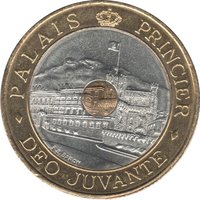
Description:
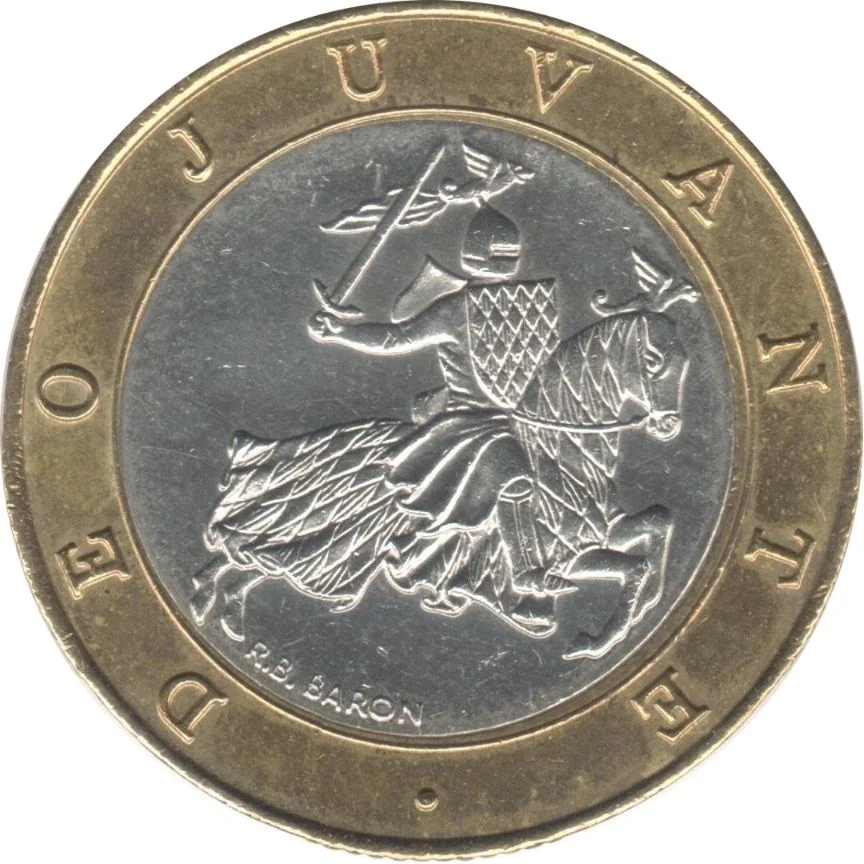
Armoured knight in circle, engraver's name below.
Inscription:
DEO JUVANTE
R.B. BARON
R.B. BARON
Translation:
With God's Help
R.B. Baron
R.B. Baron
Script: Latin
Engraver: Roger Bertrand Baron
Reverse
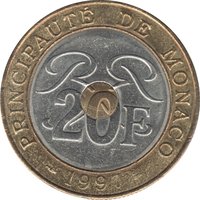
Description:
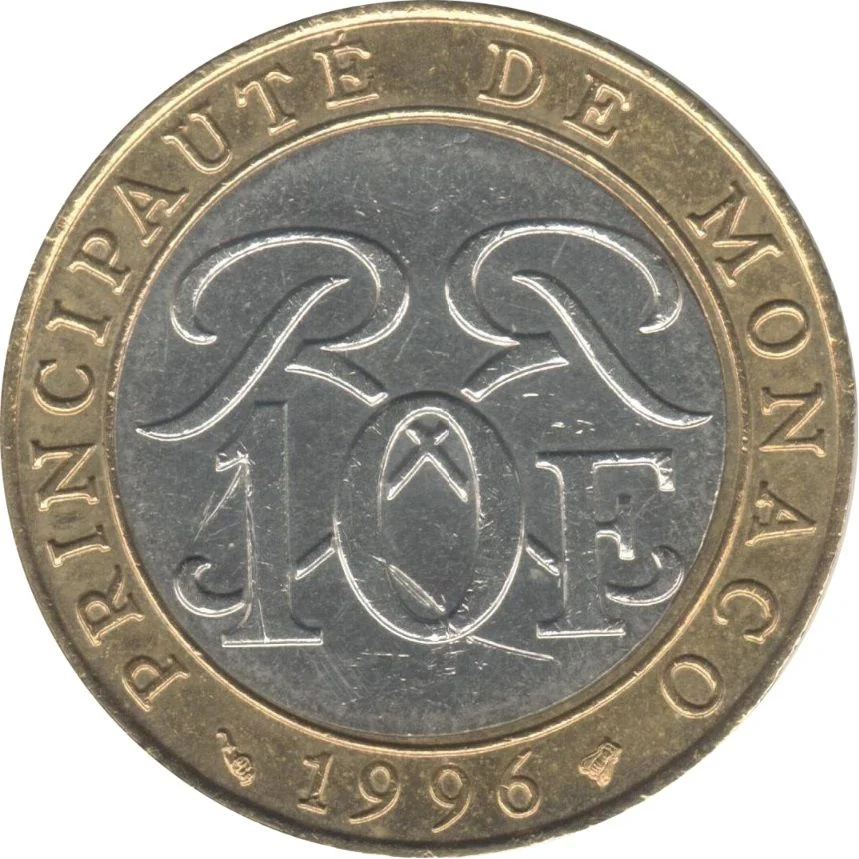
10 francs, "10 F" and monogram in circle, year below.
Inscription:
PRINCIPAUTÉ DE MONACO
RR
10F
1996
RR
10F
1996
Translation:
Principality of Monaco
RR
10 Francs
1996
RR
10 Francs
1996
Script: Latin
Language: French
Engraver: Roger Bertrand Baron
Edge
Segmented reeding
Categories
| Animal> Horse |
| Object> Cold weapons |
| Symbols> Coat of Arms |
| Symbols> Monogram |
Mints
| Name | Mark |
|---|---|
| Monnaie de Paris | — |
Mintings
| Year | Mint Mark | Mintage | Quality | Collection |
|---|---|---|---|---|
| 1989 | — | 3,000 | ||
| 1991 | — | 250,000 | ||
| 1992 | — | 250,000 | ||
| 1993 | — | 250,000 | ||
| 1994 | — | 250,000 | ||
| 1995 | — | 250,000 | ||
| 1995 | — | 30,000 | In sets | |
| 1996 | — | 250,000 | ||
| 1997 | — | 250,000 | ||
| 1998 | — | 250,000 | ||
| 2000 | — | 238,000 |
Historical background
In 1989, Monaco's currency situation was intrinsically linked to that of France, operating under a formal monetary agreement established in the 19th century. The principality did not issue its own independent currency but instead used the French franc as its sole legal tender. This arrangement was governed by a treaty from 1865, later reaffirmed in the 1963 Franco-Monégasque Treaty, which granted Monaco the right to mint its own franc coins. These Monegasque coins were legal tender within Monaco and had strict parity with their French counterparts, but they were minted in limited quantities primarily for collectors and ceremonial purposes, with French coins and banknotes dominating everyday circulation.
The economic context of the late 1980s was one of stability and prosperity for Monaco, with its currency peg to the French franc providing a reliable foundation for its banking, tourism, and luxury sectors. This stability was particularly important given Monaco's status as a tax haven and a hub for high-net-worth individuals. The fixed parity eliminated any exchange rate risk with its much larger neighbor, ensuring seamless financial transactions and reinforcing Monaco's integration into the French and broader European economic zone.
However, this period also represented the final years of the national franc, as discussions for European monetary union were already underway. While the European Monetary System (EMS) had been in place since 1979, the definitive plans for a single currency, which would culminate in the Maastricht Treaty of 1992, were gaining momentum. Consequently, Monaco's monetary authorities in 1989 were operating within a stable but soon-to-be-obsolete framework, with the future pointing toward an eventual adoption of the planned European single currency, a transition that would later be formalized in a new agreement with France in 2001.
The economic context of the late 1980s was one of stability and prosperity for Monaco, with its currency peg to the French franc providing a reliable foundation for its banking, tourism, and luxury sectors. This stability was particularly important given Monaco's status as a tax haven and a hub for high-net-worth individuals. The fixed parity eliminated any exchange rate risk with its much larger neighbor, ensuring seamless financial transactions and reinforcing Monaco's integration into the French and broader European economic zone.
However, this period also represented the final years of the national franc, as discussions for European monetary union were already underway. While the European Monetary System (EMS) had been in place since 1979, the definitive plans for a single currency, which would culminate in the Maastricht Treaty of 1992, were gaining momentum. Consequently, Monaco's monetary authorities in 1989 were operating within a stable but soon-to-be-obsolete framework, with the future pointing toward an eventual adoption of the planned European single currency, a transition that would later be formalized in a new agreement with France in 2001.
🌱 Very Common