

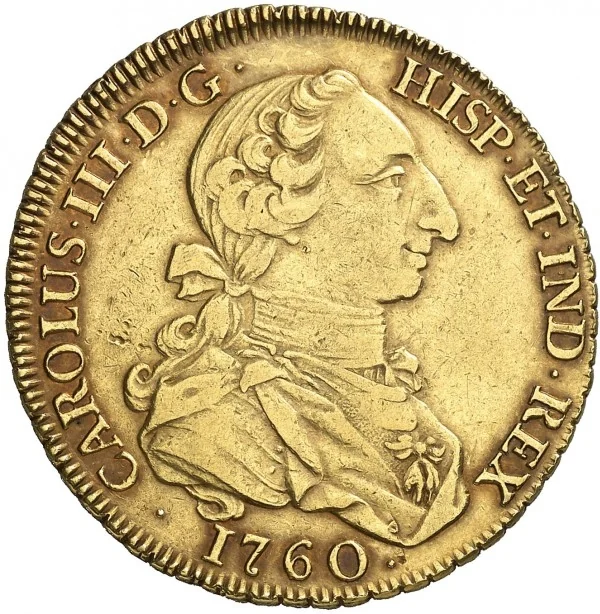
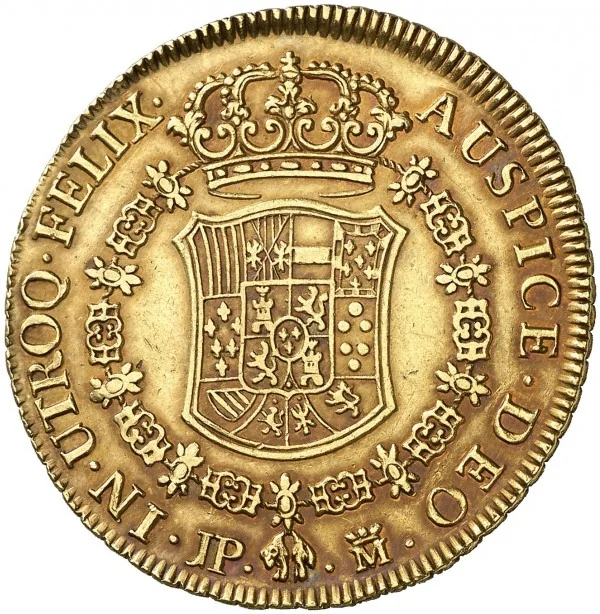
8 escudos – Spain
Add to wishlist
Spain
Context
Years: 1760–1762
Issuer: Spain
Ruler: Charles III
Currency:
(1497—1833)
Demonetized: Yes
Total mintage: 1,003
Material
References
KM: #
Numista: #107541
Value
Bullion value: $3803.70
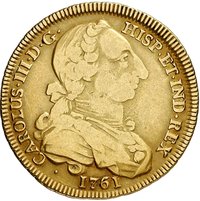
Obverse
Description:
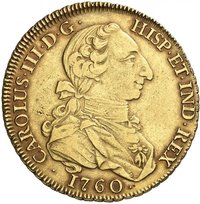
Armored bust of King Charles III facing right.
Inscription:
CAROLUS · III · D · G · HISP · ET · IND · REX
· 1760 ·
· 1760 ·
Script: Latin
Engraver: Tomás Francisco Prieto Martin
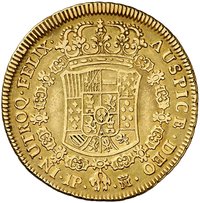
Reverse
Description:
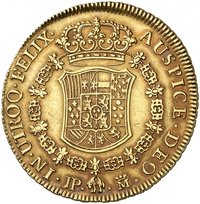
Crowned Spanish coat of arms with the Golden Fleece.
Inscription:
IN · UTROQ · FELIX · AUSPICE · DEO
· JP · · M ·
· JP · · M ·
Script: Latin
Engraver: Tomás Francisco Prieto Martin
Edge
Categories
| Person> Monarch |
| Symbols> Coat of Arms |
Mints
| Name | Mark |
|---|---|
| Royal Mint of Madrid | (M) |
| Royal Mint of Seville | (S) |
Mintings
| Year | Mint Mark | Mintage | Quality | Collection |
|---|---|---|---|---|
| 1760 | MJP | 1,003 | ||
| 1762 | SJV | — |
Historical background
In 1760, Spain's currency situation was complex and troubled, rooted in the legacy of its vast American empire. The primary coins in circulation were silver reales and gold escudos, minted from bullion shipped from colonies like Mexico and Peru. However, a chronic shortage of small-denomination coinage for everyday transactions plagued the economy, leading to the use of crude moneda de vellón (copper alloy coinage) and even token issues from cities and regions. This created a chaotic and inefficient monetary system where the value of coins was often determined by their metal content rather than their face value.
The fundamental problem was severe inflation and a distorted monetary supply, exacerbated by decades of royal financial mismanagement. To fund continuous warfare and state deficits, successive monarchs, including the current King Ferdinand VI and his soon-to-be successor Charles III, had repeatedly debased the vellón coinage. This involved reducing its silver content or arbitrarily raising its nominal value, a practice that eroded public trust and drove valuable full-bodied silver and gold coins out of circulation (Gresham's Law). The state's finances were further strained by massive debt, much of it held by foreign creditors.
Consequently, the Spanish economy in 1760 operated with a fragmented and unreliable currency, hindering domestic commerce and tax collection. While the influx of American silver made Spain theoretically wealthy, practical monetary chaos was the norm. This unstable environment would prompt the more reform-minded Charles III, upon his accession in 1759, to initiate serious monetary reforms later in his reign, most notably the creation of a unified national currency and the founding of the Banco de San Carlos in 1782 to manage state debt.
The fundamental problem was severe inflation and a distorted monetary supply, exacerbated by decades of royal financial mismanagement. To fund continuous warfare and state deficits, successive monarchs, including the current King Ferdinand VI and his soon-to-be successor Charles III, had repeatedly debased the vellón coinage. This involved reducing its silver content or arbitrarily raising its nominal value, a practice that eroded public trust and drove valuable full-bodied silver and gold coins out of circulation (Gresham's Law). The state's finances were further strained by massive debt, much of it held by foreign creditors.
Consequently, the Spanish economy in 1760 operated with a fragmented and unreliable currency, hindering domestic commerce and tax collection. While the influx of American silver made Spain theoretically wealthy, practical monetary chaos was the norm. This unstable environment would prompt the more reform-minded Charles III, upon his accession in 1759, to initiate serious monetary reforms later in his reign, most notably the creation of a unified national currency and the founding of the Banco de San Carlos in 1782 to manage state debt.
✨ Legendary