

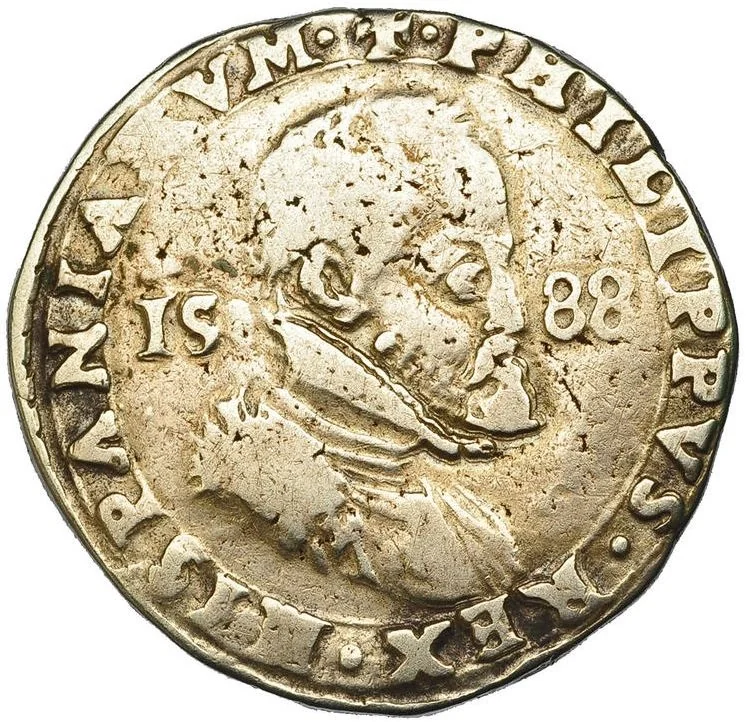
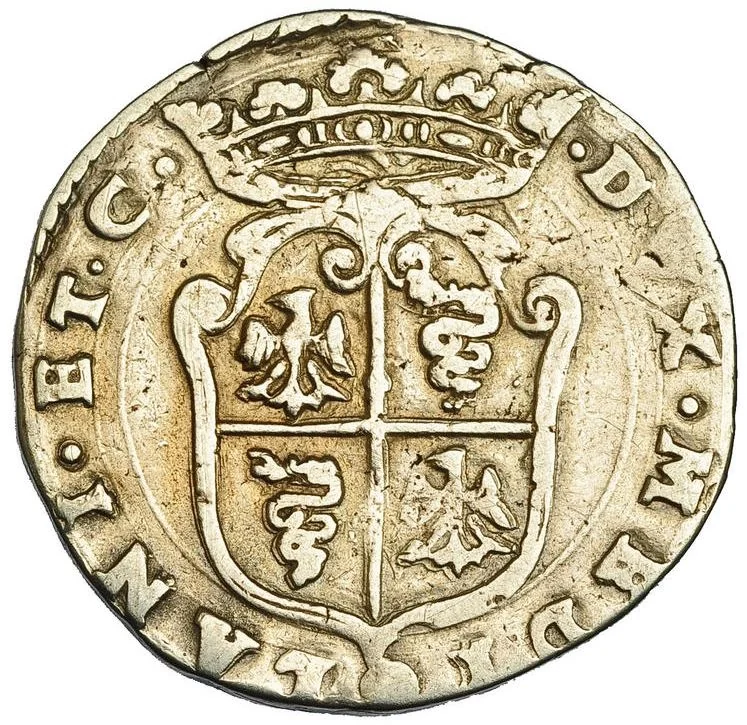

Obverse
Description:
Armored bust right divides date.
Inscription:
PHILIPPVS. REX. HISPANIARVM.
Script: Latin
Reverse
Edge
Mints
| Name | Mark |
|---|---|
| Milan | — |
Mintings
| Year | Mint Mark | Mintage | Quality | Collection |
|---|---|---|---|---|
| 1588 | — | — |
Historical background
In 1588, Milan was a wealthy and strategically vital dominion of the Spanish Habsburg Empire, functioning as a financial and military hub for Spain's European campaigns. The local currency system was a complex bimetallic structure, featuring gold scudi and silver lire and soldi (12 denari = 1 soldo; 20 soldi = 1 lira). However, this system was under severe strain due to the "Price Revolution"—a Europe-wide phenomenon of sustained inflation driven by influxes of silver from the New World—and the immense fiscal demands of Philip II's wars, including the ongoing conflict with England and the Dutch Revolt.
The Spanish crown frequently manipulated currency to raise short-term funds, a practice known as alterazione della moneta. This involved debasing the silver coinage by reducing its precious metal content while officially maintaining its face value, effectively a form of stealth taxation. In Milan, these manipulations created a chaotic monetary environment where the intrinsic value of coins diverged sharply from their nominal value, leading to Gresham's Law in action: "bad" debased coinage drove "good" full-weight coinage out of circulation, as people hoarded or exported the latter. This eroded public trust and disrupted commerce, as merchants and bankers struggled with unstable exchange rates and uncertain values.
Consequently, Milanese financiers and the city's thriving mercantile class operated within a dual reality: conducting large-scale international transactions using relatively stable gold scudi and bills of exchange, while the populace contended with a deteriorating silver currency for daily transactions. The situation in 1588 was thus one of underlying tension, where the economic prowess of the Duchy was being systematically undermined by imperial fiscal policy, sowing discontent and complicating the already arduous task of provisioning and funding the Spanish military machine from its Lombard stronghold.
The Spanish crown frequently manipulated currency to raise short-term funds, a practice known as alterazione della moneta. This involved debasing the silver coinage by reducing its precious metal content while officially maintaining its face value, effectively a form of stealth taxation. In Milan, these manipulations created a chaotic monetary environment where the intrinsic value of coins diverged sharply from their nominal value, leading to Gresham's Law in action: "bad" debased coinage drove "good" full-weight coinage out of circulation, as people hoarded or exported the latter. This eroded public trust and disrupted commerce, as merchants and bankers struggled with unstable exchange rates and uncertain values.
Consequently, Milanese financiers and the city's thriving mercantile class operated within a dual reality: conducting large-scale international transactions using relatively stable gold scudi and bills of exchange, while the populace contended with a deteriorating silver currency for daily transactions. The situation in 1588 was thus one of underlying tension, where the economic prowess of the Duchy was being systematically undermined by imperial fiscal policy, sowing discontent and complicating the already arduous task of provisioning and funding the Spanish military machine from its Lombard stronghold.
✨ Legendary