

Obverse
Description:
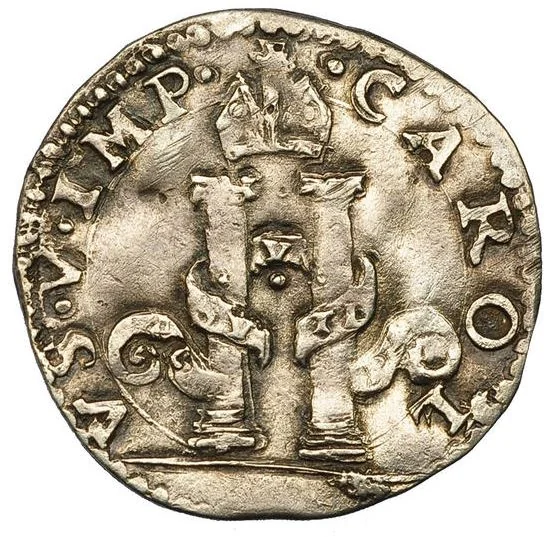
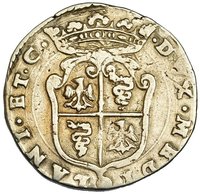
Two columns bound by a ribbon, crowned by an imperial crown.
Inscription:
CAROL - VS. V. IMP.
Script: Latin
Reverse
Edge
Categories
| Mythology |
Mints
| Name | Mark |
|---|---|
| Milan | — |
Mintings
| Year | Mint Mark | Mintage | Quality | Collection |
|---|---|---|---|---|
| — | — | — |
Historical background
In 1535, Milan found itself at a pivotal moment in its monetary history, caught between imperial authority and local economic strain. The Duchy of Milan was under the direct rule of the Holy Roman Emperor Charles V, following the death of the last Sforza duke. This political shift placed Milan firmly within the Habsburg financial orbit, meaning its currency was increasingly influenced by imperial policy and the vast flows of silver from the New World, though the full inflationary effects of that bullion were still building. The city remained a critical commercial and financial hub in Northern Italy, necessitating a complex and active system of exchange.
The circulating medium was a heterogeneous mix of coins, reflecting both Milan's legacy as a minting center and its current political subjugation. The primary local unit was the lira imperiale (divided into 20 soldi or 240 denari), but in practice, high-value trade was dominated by a plethora of foreign and domestic gold and large silver coins. These included the scudo d'oro (gold shield), the testone (a large silver coin), and various issues from other Italian states like Venice and Florence. Furthermore, the monetary system was complicated by the widespread use of moneta di conto (money of account) for bookkeeping, which often had a different value from the actual physical coins in circulation, leading to frequent adjustments and disputes.
This period was characterized by significant monetary instability and deliberate debasement. Facing the immense costs of his endless wars, Charles V and his governors frequently manipulated the currency to extract revenue. They would officially raise the value of certain coins (agio) or, more commonly, reduce the silver content in minted coins while ordering them to be accepted at their old face value. This practice, effectively a hidden tax, eroded public trust, disrupted local commerce, and fueled price inflation. Thus, for a merchant or citizen in Milan in 1535, daily transactions were an exercise in navigating a confusing array of coins whose metallic value and official valuation were in constant, state-manipulated flux.
The circulating medium was a heterogeneous mix of coins, reflecting both Milan's legacy as a minting center and its current political subjugation. The primary local unit was the lira imperiale (divided into 20 soldi or 240 denari), but in practice, high-value trade was dominated by a plethora of foreign and domestic gold and large silver coins. These included the scudo d'oro (gold shield), the testone (a large silver coin), and various issues from other Italian states like Venice and Florence. Furthermore, the monetary system was complicated by the widespread use of moneta di conto (money of account) for bookkeeping, which often had a different value from the actual physical coins in circulation, leading to frequent adjustments and disputes.
This period was characterized by significant monetary instability and deliberate debasement. Facing the immense costs of his endless wars, Charles V and his governors frequently manipulated the currency to extract revenue. They would officially raise the value of certain coins (agio) or, more commonly, reduce the silver content in minted coins while ordering them to be accepted at their old face value. This practice, effectively a hidden tax, eroded public trust, disrupted local commerce, and fueled price inflation. Thus, for a merchant or citizen in Milan in 1535, daily transactions were an exercise in navigating a confusing array of coins whose metallic value and official valuation were in constant, state-manipulated flux.
✨ Legendary