

1 Denier – Hungary
Hungary

Obverse
Description:
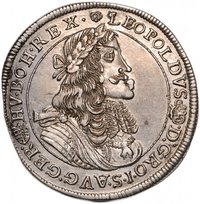
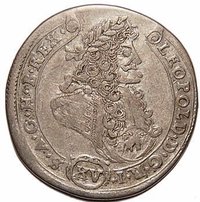
Crowned, curved Hungarian coat of arms splits the K B mintmark, with the crown breaking the circle. Surrounding inscription within a pearl border.
Inscription:
LEOP · D · G · R · I · S · A · G · H · B · REX ·
K B
K B
Reverse
Description:
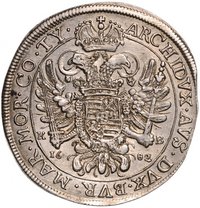
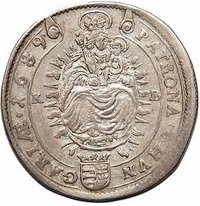
A non-radiant Madonna, crowned and holding the child, breaks through a pearl circle above the inscription and date.
Inscription:
PATRONA · HVNGA · 1688 ·
Edge
Plain
Mints
| Name | Mark |
|---|---|
| Kremnica | KB |
Mintings
| Year | Mint Mark | Mintage | Quality | Collection |
|---|---|---|---|---|
| 1684 | K | — | ||
| 1685 | K | — | ||
| 1686 | K | — | ||
| 1687 | K | — | ||
| 1688 | K | — | ||
| 1689 | K | — | ||
| 1690 | K | — | ||
| 1691 | K | — |
Historical background
In 1684, Hungary was a fractured and war-torn kingdom, its currency reflecting a century of political fragmentation. Since the 1526 Battle of Mohács, the territory was divided three ways: the Ottoman Empire controlled the central plains, the Habsburgs ruled a narrow "Royal Hungary" in the north and west, and the Principality of Transylvania in the east acted as a semi-independent vassal. This tripartite division meant there was no unified Hungarian monetary system. Instead, the region was a chaotic mosaic of circulating coins, including Habsburg thalers and kreuzers, Ottoman akçe and para, and various Transylvanian and older Hungarian issues, all fluctuating in value against one another.
The primary currency in the Habsburg-controlled territories was the silver thaler (or Tallér), a large coin used for major transactions and military payrolls. Everyday commerce relied on smaller silver kreuzers and copper denars. However, the ongoing Great Turkish War (1683-1699), a massive campaign to expel the Ottomans, placed enormous strain on this system. The Habsburg monarchy, under Leopold I, was financing a huge military effort, leading to inflationary pressures. To raise funds, authorities often debased the smaller subsidiary coins, increasing their copper content and reducing their silver value, which eroded public trust and caused price instability.
Furthermore, the war itself directly dictated monetary reality. As Imperial armies advanced into Ottoman-held Hungary in 1684, they brought their own currency and payment systems, while captured territories suddenly switched from Ottoman to Habsburg coinage. The need to pay soldiers and supply armies meant that large quantities of coin, often of varying quality from different German states, flooded into the warzone. Thus, the currency situation in 1684 was one of profound transition and disorder, shaped by deep historical divisions and the immediate, costly demands of a reconquest that would ultimately redefine the kingdom.
The primary currency in the Habsburg-controlled territories was the silver thaler (or Tallér), a large coin used for major transactions and military payrolls. Everyday commerce relied on smaller silver kreuzers and copper denars. However, the ongoing Great Turkish War (1683-1699), a massive campaign to expel the Ottomans, placed enormous strain on this system. The Habsburg monarchy, under Leopold I, was financing a huge military effort, leading to inflationary pressures. To raise funds, authorities often debased the smaller subsidiary coins, increasing their copper content and reducing their silver value, which eroded public trust and caused price instability.
Furthermore, the war itself directly dictated monetary reality. As Imperial armies advanced into Ottoman-held Hungary in 1684, they brought their own currency and payment systems, while captured territories suddenly switched from Ottoman to Habsburg coinage. The need to pay soldiers and supply armies meant that large quantities of coin, often of varying quality from different German states, flooded into the warzone. Thus, the currency situation in 1684 was one of profound transition and disorder, shaped by deep historical divisions and the immediate, costly demands of a reconquest that would ultimately redefine the kingdom.
💎 Extremely Rare