

15 kreuzers – Hungary
Add to wishlist
Hungary
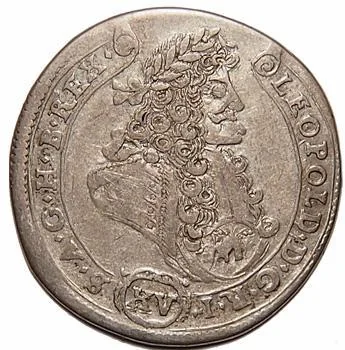
Obverse
Description:
Young laureate portrait facing right, with long straight hair. Bust overlaps top ribbon bearing face value (XV) and inscription.
Inscription:
LEOPOLD · D · G · R · I · (XV) S · A · G · H · B · REX ·
Script: Latin
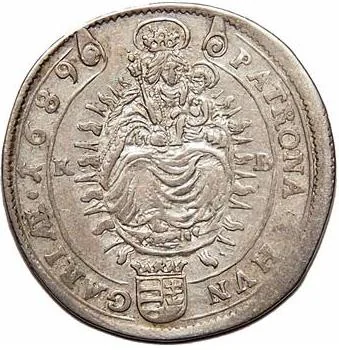
Reverse
Description:
Radiant Madonna crowned and holding child and scepter. Mintmark within scepter. Double-crowned Hungarian shield below, with ribbon inscription and date above.
Inscription:
PATRONA · HVNGARIÆ · 1689
K B
K B
Script: Latin
Edge
Plain
Mints
| Name | Mark |
|---|---|
| Kremnica | KB |
Historical background
In 1685, Hungary found itself in a complex and strained monetary situation, deeply entangled with the ongoing wars of reconquest against the Ottoman Empire. The Habsburg monarchy, ruling the Kingdom of Hungary, was financing a massive military campaign to reclaim territories lost for over 150 years. This immense expense was funded through heavy taxation and, crucially, the deliberate debasement of the silver coinage. The primary circulating coin, the silver tallér (thaler), was systematically minted with reduced silver content to create seigniorage profit for the imperial treasury, leading to widespread inflation and a loss of public trust in the currency.
The monetary landscape was further fragmented by the circulation of older, full-value coins alongside the new, debased issues, creating a chaotic multi-currency system. People hoarded the older, purer coins (like the lipcsei tallér from Leipzig), while the weaker new coins drove prices higher in a classic example of Gresham's Law ("bad money drives out good"). Additionally, various foreign coins, particularly Turkish akçe and Dutch leeuwendaalders, circulated in the recently liberated and still-contested regions, complicating trade and taxation. The Habsburg authorities struggled to impose a unified monetary standard across the war-torn kingdom.
This financial instability exacerbated the hardships of a population already suffering from warfare, displacement, and requisitions. The debasement acted as a hidden tax, eroding savings and disrupting economic recovery in the reclaimed territories. Consequently, the currency situation of 1685 was not merely a financial issue but a central factor in the strained relationship between the Hungarian estates and the Habsburg court, sowing seeds of economic grievance that would persist long after the military victories on the battlefield.
The monetary landscape was further fragmented by the circulation of older, full-value coins alongside the new, debased issues, creating a chaotic multi-currency system. People hoarded the older, purer coins (like the lipcsei tallér from Leipzig), while the weaker new coins drove prices higher in a classic example of Gresham's Law ("bad money drives out good"). Additionally, various foreign coins, particularly Turkish akçe and Dutch leeuwendaalders, circulated in the recently liberated and still-contested regions, complicating trade and taxation. The Habsburg authorities struggled to impose a unified monetary standard across the war-torn kingdom.
This financial instability exacerbated the hardships of a population already suffering from warfare, displacement, and requisitions. The debasement acted as a hidden tax, eroding savings and disrupting economic recovery in the reclaimed territories. Consequently, the currency situation of 1685 was not merely a financial issue but a central factor in the strained relationship between the Hungarian estates and the Habsburg court, sowing seeds of economic grievance that would persist long after the military victories on the battlefield.

💎 Very Rare