

1 Kreuzer – Hungary
Hungary

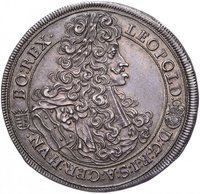
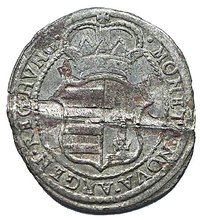
Obverse
Description:
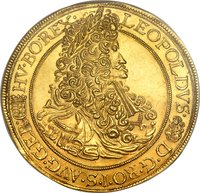
Laureate bust with long curls facing right, breaking the inner pearl circle. Inscription within the circle, with a veiled face in the center.
Inscription:
LEOPOLDUS . D .G . (1) . I . S . A . G . H . B . R .
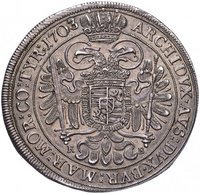
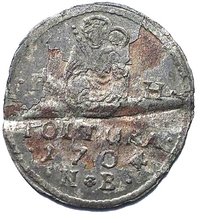
Reverse
Description:
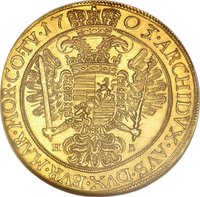
Radiant Madonna and child in mandorla, splitting the mint mark; small shield below, date divided above.
Inscription:
PATRONA · HUNGARIÆ · 17 03 ·
Edge
Plain
Mints
| Name | Mark |
|---|---|
| Baia Mare | NB |
Mintings
| Year | Mint Mark | Mintage | Quality | Collection |
|---|---|---|---|---|
| 1703 | N | — |
Historical background
In 1703, Hungary found itself in a complex and dire currency situation, deeply entangled with the political and military turmoil of the Rákóczi War of Independence (1703-1711). The conflict against Habsburg rule led by Prince Ferenc Rákóczi II created a fractured monetary landscape. The Habsburg authorities in Vienna controlled the official minting of coins, primarily high-quality silver thalers and copper denars, but the war disrupted regular minting operations and the flow of specie into the kingdom. This official coinage was often scarce within the war-torn country, particularly in territories held by the Kuruc (anti-Habsburg) forces.
To finance his rebellion, Rákóczi’s government resorted to issuing emergency currency, most notably the so-called "liberty thaler" (szabadság-tallér) and large quantities of debased copper coinage, often minted from melted-down church bells and cannons. These coins, produced at mints in territories under his control like Nagybánya, were intentionally struck with lower precious metal content than their face value. This practice, combined with the general economic devastation of the war, led to severe inflation and a loss of public trust in the currency. People hoarded older, full-value coins, further exacerbating the shortage of reliable money.
Consequently, the monetary system was one of chaos and multiplicity. In circulation simultaneously were older, full-weight Habsburg coins, new but debased Kuruc issues, and a variety of foreign coins from trade, particularly Turkish asper and German thalers. The value of money was highly unstable and varied greatly by region depending on which authority held power. This period represents a low point in Hungarian monetary history, where the coinage became a direct instrument of war finance, leading to economic hardship and a breakdown of the unified monetary system that would take decades to restore after the war's conclusion.
To finance his rebellion, Rákóczi’s government resorted to issuing emergency currency, most notably the so-called "liberty thaler" (szabadság-tallér) and large quantities of debased copper coinage, often minted from melted-down church bells and cannons. These coins, produced at mints in territories under his control like Nagybánya, were intentionally struck with lower precious metal content than their face value. This practice, combined with the general economic devastation of the war, led to severe inflation and a loss of public trust in the currency. People hoarded older, full-value coins, further exacerbating the shortage of reliable money.
Consequently, the monetary system was one of chaos and multiplicity. In circulation simultaneously were older, full-weight Habsburg coins, new but debased Kuruc issues, and a variety of foreign coins from trade, particularly Turkish asper and German thalers. The value of money was highly unstable and varied greatly by region depending on which authority held power. This period represents a low point in Hungarian monetary history, where the coinage became a direct instrument of war finance, leading to economic hardship and a breakdown of the unified monetary system that would take decades to restore after the war's conclusion.
Series: 1703 Hungary circulation coins

✨ Legendary