

½ ducat – Sweden
Add to wishlist
Sweden
Context
Year: 1747
Issuer: Sweden
Ruler: Frederick I
Currency:
(1719—1798)
Demonetized: Yes
Total mintage: 299
Material
References
KM: #
Numista: #185153
Value
Bullion value: $261.96
Obverse
Description:
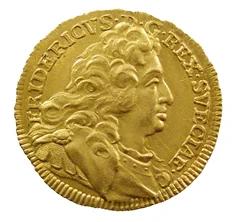
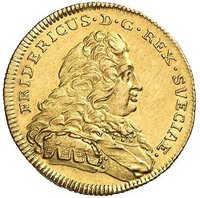
King Frederick I in profile, with curly hair and pearled armor, within a circular inscription.
Inscription:
FRIDERICVS·D·G·REX·SVECIÆ·
Script: Latin
Reverse
Description:
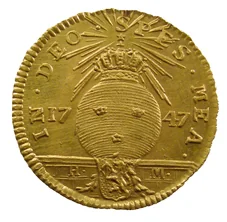
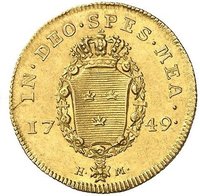
Swedish Three Crowns encircled by legend, with date and shield below.
Inscription:
IN·DEO·SPES·MEA·
17 47
H· M·
17 47
H· M·
Script: Latin
Edge
Categories
| Symbols> Coat of Arms |
Mints
| Name | Mark |
|---|---|
| Stockholm | — |
Mintings
| Year | Mint Mark | Mintage | Quality | Collection |
|---|---|---|---|---|
| 1747 | — | 299 |
Historical background
In 1747, Sweden was navigating a severe monetary crisis rooted in decades of war and financial mismanagement. Following the Great Northern War (1700–1721), the kingdom had turned to a depreciated copper-based currency system, which proved cumbersome and unstable. To finance further conflicts, like the Russo-Swedish War (1741–1743), the state resorted to issuing excessive amounts of paper money (sedlar) and heavily debased copper coinage, leading to rampant inflation and a profound loss of public confidence in the currency.
The situation reached a critical point in the mid-1740s, with the value of the Swedish daler plummeting and prices soaring. Different forms of money—silver, copper, and paper—circulated at wildly different and fluctuating values, causing chaos in trade and daily transactions. This monetary disorder severely strained the economy, hampered government finances, and created widespread social unrest, threatening the stability of the Hat Party government.
In response, a major monetary reform was being actively prepared in 1747. This effort, championed by politicians like Anders Johan von Höpken, would culminate in the historic decree of 1748. The reform established the Riksens Ständers Bank (precursor to the Riksbank) and introduced a new silver-based currency, the riksdaler specie, aiming to restore stability by tying money to a tangible silver standard and phasing out the discredited paper notes. Thus, 1747 represents the final, turbulent year of a broken system, immediately preceding a decisive shift toward modern monetary policy.
The situation reached a critical point in the mid-1740s, with the value of the Swedish daler plummeting and prices soaring. Different forms of money—silver, copper, and paper—circulated at wildly different and fluctuating values, causing chaos in trade and daily transactions. This monetary disorder severely strained the economy, hampered government finances, and created widespread social unrest, threatening the stability of the Hat Party government.
In response, a major monetary reform was being actively prepared in 1747. This effort, championed by politicians like Anders Johan von Höpken, would culminate in the historic decree of 1748. The reform established the Riksens Ständers Bank (precursor to the Riksbank) and introduced a new silver-based currency, the riksdaler specie, aiming to restore stability by tying money to a tangible silver standard and phasing out the discredited paper notes. Thus, 1747 represents the final, turbulent year of a broken system, immediately preceding a decisive shift toward modern monetary policy.
✨ Legendary