

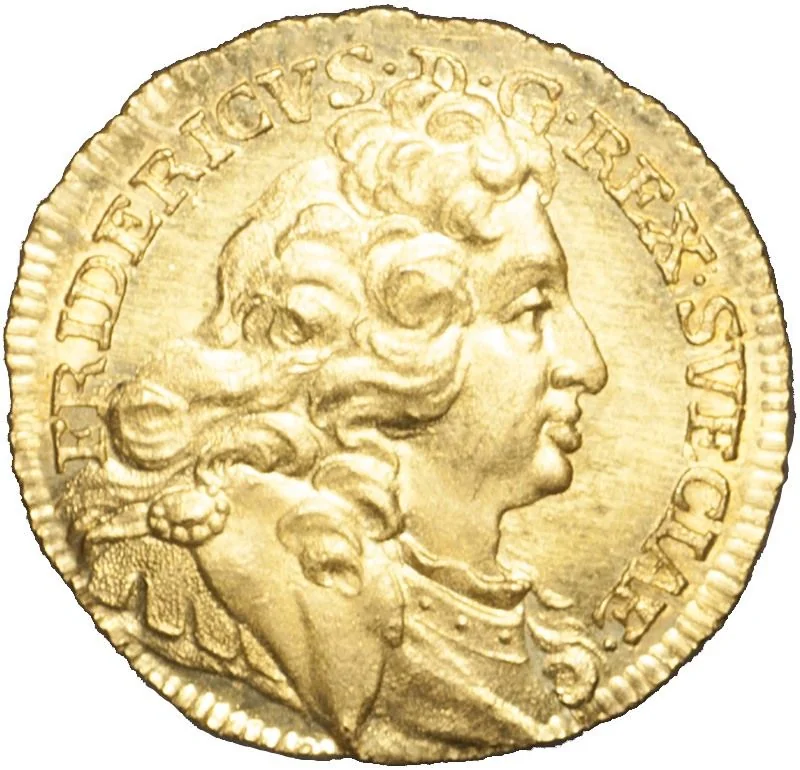
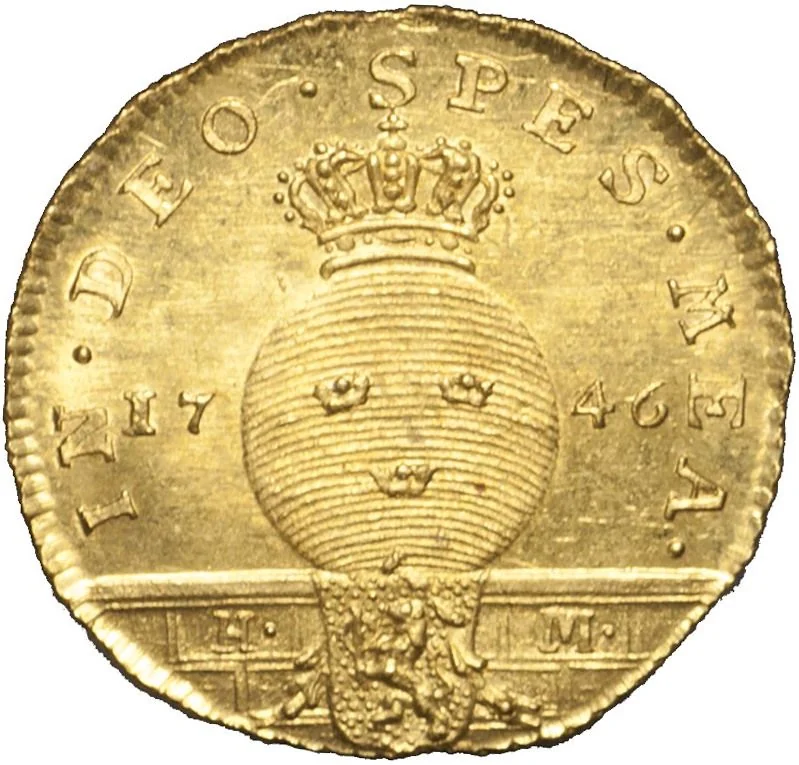
½ Ducat – Sweden
Sweden
Context
Year: 1746
Issuer: Sweden 
Ruler: Frederick I
Currency:
(1719—1798)
Demonetized: Yes
Total mintage: 211
Material
References
KM: #Click to copy to clipboard439
Numista: #185152
Value
Bullion value: $282.72
Obverse
Description:
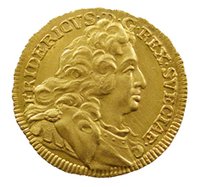
Bust of Frederick I facing right in pearled armor, curly hair framing the legend.
Inscription:
FRIDERICVS·D·G·REX·SVECIÆ·
Reverse
Description:
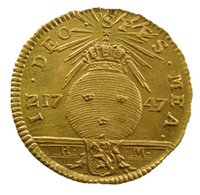
Swedish Three Crowns encircled by legend, with date and shield below.
Inscription:
IN·DEO·SPES·MEA·
17 46
H· M·
17 46
H· M·
Edge
Mints
| Name | Mark |
|---|---|
| Stockholm | — |
Mintings
| Year | Mint Mark | Mintage | Quality | Collection |
|---|---|---|---|---|
| 1746 | — | 211 |
Historical background
In 1746, Sweden was navigating a complex and precarious monetary situation, a direct legacy of the Great Northern War (1700–1721). To finance that protracted and ultimately disastrous conflict, the state had resorted to massive coin debasement and the issuance of low-quality copper plate money (plåtmynt). This created a chaotic system with two parallel currencies: a silver-based riksdaler and a bulky copper-based daler, whose values fluctuated wildly. The result was severe inflation, a loss of public trust in the currency, and a crippled economy struggling with heavy debt and a cumbersome medium of exchange.
The immediate background to 1746 was the failed monetary experiment of the "Age of Liberty's" Hat Party government. In the 1730s, to stimulate the economy and fund its revanchist war against Russia (the Hats' War, 1741–1743), the state-chartered Riksens Ständers Bank began issuing inconvertible paper notes called transportsedlar. These were not backed by silver but by government promises, and their over-issuance to cover war debts led to a sharp decline in their value relative to silver coin. By 1746, Sweden effectively had a triad of depreciating currencies—copper, paper, and debased silver—circulating simultaneously, causing confusion and hampering trade.
Consequently, 1746 fell within a period of urgent but contentious financial reform. The Hat Party, still in power, was grappling with the consequences of its policies. The paper money's depreciation was a pressing political issue, creating pressure to stabilize the currency and restore confidence. While a major recoinage and standardization (the myntrealisationen) would not be fully implemented until later, the debates and proposals of the mid-1740s, including those in the Riksdag of 1746–47, were crucial precursors. They set the stage for the eventual move toward a more unified and stable monetary system, though this would remain an unstable work-in-progress for decades.
The immediate background to 1746 was the failed monetary experiment of the "Age of Liberty's" Hat Party government. In the 1730s, to stimulate the economy and fund its revanchist war against Russia (the Hats' War, 1741–1743), the state-chartered Riksens Ständers Bank began issuing inconvertible paper notes called transportsedlar. These were not backed by silver but by government promises, and their over-issuance to cover war debts led to a sharp decline in their value relative to silver coin. By 1746, Sweden effectively had a triad of depreciating currencies—copper, paper, and debased silver—circulating simultaneously, causing confusion and hampering trade.
Consequently, 1746 fell within a period of urgent but contentious financial reform. The Hat Party, still in power, was grappling with the consequences of its policies. The paper money's depreciation was a pressing political issue, creating pressure to stabilize the currency and restore confidence. While a major recoinage and standardization (the myntrealisationen) would not be fully implemented until later, the debates and proposals of the mid-1740s, including those in the Riksdag of 1746–47, were crucial precursors. They set the stage for the eventual move toward a more unified and stable monetary system, though this would remain an unstable work-in-progress for decades.
✨ Legendary