

2 Ore – Sweden
Sweden
Context
Years: 1743–1750
Issuer: Sweden 
Ruler: Frederick I
Currency:
(1719—1798)
Demonetized: Yes
Total mintage: 1,820,100
Material
References
KM: #Click to copy to clipboard437
Numista: #28455
Obverse
Description:
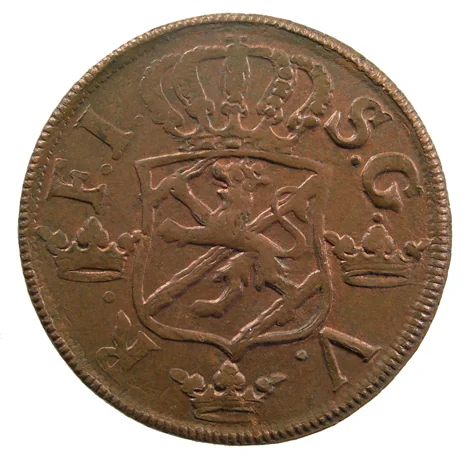
Shield with a rampant lion, crowned and flanked by Sweden's Three Crowns. Between them are the legend's initials.
Inscription:
F.I.S.G.V.R.
Script: Latin
Reverse
Description:
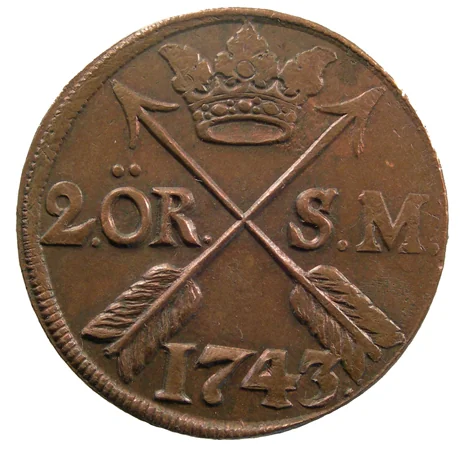
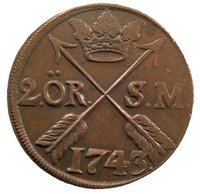
Crossed arrows divide the value, with Sweden's crown above and the date below.
Inscription:
2 ÖR. S.M.
1748
1748
Script: Latin
Edge
Oblique milled
Mints
| Name | Mark |
|---|---|
| Avesta | — |
Mintings
| Year | Mint Mark | Mintage | Quality | Collection |
|---|---|---|---|---|
| 1743 | — | 99,900 | ||
| 1744 | — | 48,600 | ||
| 1745 | — | 141,900 | ||
| 1746 | — | — | ||
| 1747 | — | 402,900 | ||
| 1748 | — | 460,800 | ||
| 1749 | — | 312,900 | ||
| 1750 | — | 353,100 |
Historical background
In 1743, Sweden's currency situation was defined by the ongoing consequences of the disastrous Great Northern War (1700–1721). To finance that prolonged conflict, the state had resorted to massive coinage debasement, flooding the economy with low-quality copper and silver coins. This led to severe inflation, a loss of public confidence in the currency, and a complex system where the intrinsic metal value of a coin often differed significantly from its official face value. The financial strain contributed to the "Age of Liberty" (1719–1772), a period where the Riksdag (parliament) held power, and currency policy became a contentious political issue between the competing Hat and Cap parties.
The dominant currency in circulation was the silver daler, but its value was unstable. Sweden operated on a bimetallic standard, with both silver and copper coins legally recognized. However, the relative scarcity of silver and the abundance of bulky copper daler coins (some weighing several kilograms) created practical and economic difficulties. A critical problem was the fluctuating exchange rate between the copper daler and the silver daler, which was not fixed and caused uncertainty in trade and contracts. The Hats, who held power in 1743, generally favored a weaker currency to stimulate exports and manufacturing, but this risked further inflationary pressure.
Despite these challenges, 1743 fell within a period of attempted stabilization. The government and the Riksdag were engaged in ongoing debates about monetary reform, seeking to restore confidence and simplify the chaotic system. While no single decisive reform was enacted that year, the discussions and policies of the era laid the groundwork for future changes. The fundamental struggle was to balance the state's need for revenue with the economy's need for a reliable medium of exchange, a task made exceedingly difficult by political factionalism and the deep-seated legacy of wartime finance.
The dominant currency in circulation was the silver daler, but its value was unstable. Sweden operated on a bimetallic standard, with both silver and copper coins legally recognized. However, the relative scarcity of silver and the abundance of bulky copper daler coins (some weighing several kilograms) created practical and economic difficulties. A critical problem was the fluctuating exchange rate between the copper daler and the silver daler, which was not fixed and caused uncertainty in trade and contracts. The Hats, who held power in 1743, generally favored a weaker currency to stimulate exports and manufacturing, but this risked further inflationary pressure.
Despite these challenges, 1743 fell within a period of attempted stabilization. The government and the Riksdag were engaged in ongoing debates about monetary reform, seeking to restore confidence and simplify the chaotic system. While no single decisive reform was enacted that year, the discussions and policies of the era laid the groundwork for future changes. The fundamental struggle was to balance the state's need for revenue with the economy's need for a reliable medium of exchange, a task made exceedingly difficult by political factionalism and the deep-seated legacy of wartime finance.
🌱 Fairly Common