

½ Ducat – Sweden
Sweden
Context
Year: 1741
Issuer: Sweden 
Ruler: Frederick I
Currency:
(1719—1798)
Demonetized: Yes
Total mintage: 188
Material
References
KM: #Click to copy to clipboard435
Numista: #185149
Value
Bullion value: $282.72
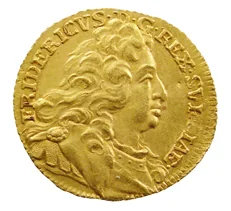
Obverse
Description:
Bust of Frederick I facing right in pearled armor, curly hair framing the legend.
Inscription:
FRIDERICVS·D·G·REX·SVECIÆ·
Script: Latin
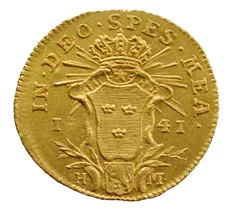
Reverse
Description:
Shield with three crowns divides date within sprigs. Value and mintmark below. Outer legend.
Inscription:
IN·DEO·SPES·MEA·
1741
H· M·
1741
H· M·
Script: Latin
Edge
Categories
| Symbols> Coat of Arms |
Mints
| Name | Mark |
|---|---|
| Stockholm | — |
Mintings
| Year | Mint Mark | Mintage | Quality | Collection |
|---|---|---|---|---|
| 1741 | — | 188 |
Historical background
In 1741, Sweden was embroiled in the War of the Austrian Succession (the "Hats' Russian War" in Swedish context), a conflict that placed immense strain on the nation's finances. To fund its military ambitions, the government, dominated by the pro-war "Hats" party, resorted to the large-scale printing of paper money known as riksdaler riksgälds. This currency was issued by the Riksens Ständers Bank (the precursor to the Riksbank) but was not backed by silver, functioning instead as a form of war credit based on the state's promise to pay. The result was a classic and rapid inflationary spiral, as the volume of paper money in circulation dramatically increased while its real value plummeted.
The currency situation was a direct continuation of the financial instability that had plagued Sweden since the Great Northern War earlier in the century. The silver-based riksdaler specie remained the official standard, but the proliferation of devalued paper created a chaotic dual-system. Prices for goods and services soared when paid for in paper money, causing hardship for the general population, particularly fixed-income earners and soldiers whose pay was in the depreciating notes. Public confidence in the paper currency eroded, and its exchange rate against silver coinage fell sharply on the open market.
This monetary crisis was a central political issue, fiercely criticized by the opposition "Caps" party, who advocated for peace and fiscal restraint. The inflationary financing of 1741, while providing short-term war funds, severely weakened the Swedish economy. It set the stage for further devaluations and economic difficulties in the following years, culminating in the 1747 decision to formally devalue the riksgälds against the silver specie, a recognition of the deep depreciation that the war-driven money printing had caused.
The currency situation was a direct continuation of the financial instability that had plagued Sweden since the Great Northern War earlier in the century. The silver-based riksdaler specie remained the official standard, but the proliferation of devalued paper created a chaotic dual-system. Prices for goods and services soared when paid for in paper money, causing hardship for the general population, particularly fixed-income earners and soldiers whose pay was in the depreciating notes. Public confidence in the paper currency eroded, and its exchange rate against silver coinage fell sharply on the open market.
This monetary crisis was a central political issue, fiercely criticized by the opposition "Caps" party, who advocated for peace and fiscal restraint. The inflationary financing of 1741, while providing short-term war funds, severely weakened the Swedish economy. It set the stage for further devaluations and economic difficulties in the following years, culminating in the 1747 decision to formally devalue the riksgälds against the silver specie, a recognition of the deep depreciation that the war-driven money printing had caused.
✨ Legendary