

10 Ore – Sweden
Sweden
Context
Years: 1739–1751
Issuer: Sweden 
Ruler: Frederick I
Currency:
(1719—1798)
Demonetized: Yes
Total mintage: 3,780,428
References
KM: #Click to copy to clipboard425
Numista: #64677
Obverse
Description:
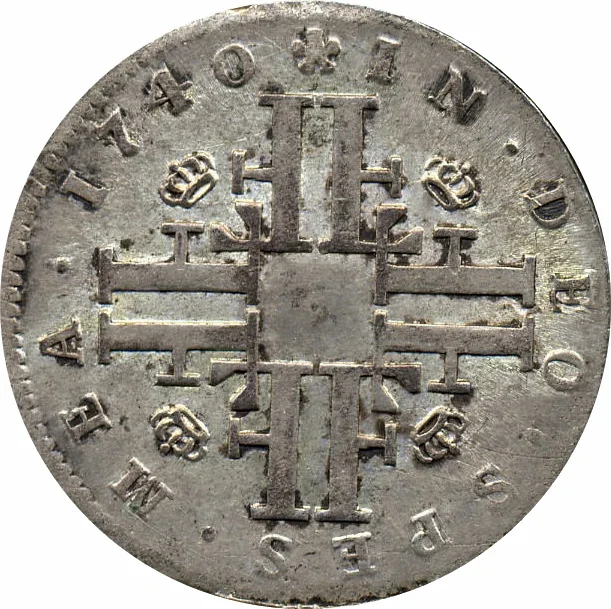
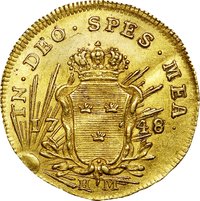
Cruciform "F" monogram of Frederick I. Four diagonal crowns. Rim legend with motto and date.
Inscription:
• IN • DEO • SPES • MEA • 1740 *
Script: Latin
Reverse
Description:
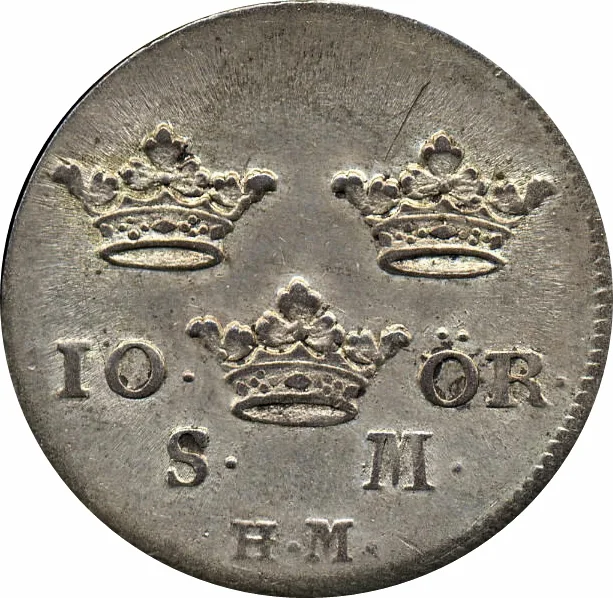
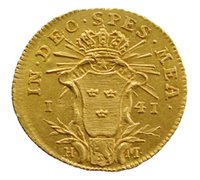
Three Crowns divide value. Mintmark below.
Inscription:
IO · Ö ·
S · M ·
H · M ·
S · M ·
H · M ·
Script: Latin
Edge
Mints
| Name | Mark |
|---|---|
| Stockholm | — |
Mintings
| Year | Mint Mark | Mintage | Quality | Collection |
|---|---|---|---|---|
| 1739 | — | 1,150,235 | ||
| 1740 | — | 1,336,605 | ||
| 1741 | — | 442,828 | ||
| 1742 | — | 133,862 | ||
| 1743 | — | 129,433 | ||
| 1744 | — | 43,149 | ||
| 1745 | — | 271,657 | ||
| 1750 | — | 227,490 | ||
| 1751 | — | 45,169 |
Historical background
In 1739, Sweden was operating under a complex and strained monetary system, a legacy of its period as a great power in the 17th century. The official currency was the silver riksdaler, but decades of war financing had led to the heavy debasement of the circulating coinage. The state had repeatedly issued lower-quality copper and silver coins, while also producing cumbersome plåtmynt – large copper plate money that could weigh up to 20 kilograms – to back the currency based on Sweden's vast copper reserves. This resulted in a dual system with a fixed exchange rate between copper and silver that rarely reflected market reality, causing widespread confusion and inefficiency.
The situation was further complicated by the first experiments with paper money. In 1661, Stockholm's Palmstruchska bank had issued Europe's first banknotes, leading to a crash. By 1739, the state-run Riksens Ständers Bank (precursor to the Sveriges Riksbank) was in operation, but fiduciary banknotes were not yet a trusted or dominant medium. The economy relied heavily on physical specie, which was in short supply and of inconsistent quality. This monetary instability hampered trade, both domestic and international, as merchants struggled with uncertain valuations and a lack of small change for everyday transactions.
Economically, the year fell within the relatively peaceful "Age of Liberty" (1719-1772), a period of parliamentary rule following the death of King Charles XII. The government, led by the Hat Party, was increasingly focused on mercantilist policies and rebuilding the economy. However, the archaic and debased currency system was a significant obstacle to modernization and economic growth. The pressures of this unsustainable system would ultimately contribute to the 1745 decision to abandon the silver standard for the riksdaler, moving to a fiat-based system where banknotes were no longer redeemable for silver—a controversial but formative step in Swedish financial history.
The situation was further complicated by the first experiments with paper money. In 1661, Stockholm's Palmstruchska bank had issued Europe's first banknotes, leading to a crash. By 1739, the state-run Riksens Ständers Bank (precursor to the Sveriges Riksbank) was in operation, but fiduciary banknotes were not yet a trusted or dominant medium. The economy relied heavily on physical specie, which was in short supply and of inconsistent quality. This monetary instability hampered trade, both domestic and international, as merchants struggled with uncertain valuations and a lack of small change for everyday transactions.
Economically, the year fell within the relatively peaceful "Age of Liberty" (1719-1772), a period of parliamentary rule following the death of King Charles XII. The government, led by the Hat Party, was increasingly focused on mercantilist policies and rebuilding the economy. However, the archaic and debased currency system was a significant obstacle to modernization and economic growth. The pressures of this unsustainable system would ultimately contribute to the 1745 decision to abandon the silver standard for the riksdaler, moving to a fiat-based system where banknotes were no longer redeemable for silver—a controversial but formative step in Swedish financial history.
💎 Extremely Rare