

1 Carlin – Bologna
Italy
Context
Years: 1736–1737
Country: Italy 
Issuer: Bologna
Ruler: Clement XII
Currency:
(1534—1835)
Demonetized: Yes
Material
References
KM: #Click to copy to clipboard208
Numista: #183615
Value
Bullion value: $3.13
Obverse
Description:
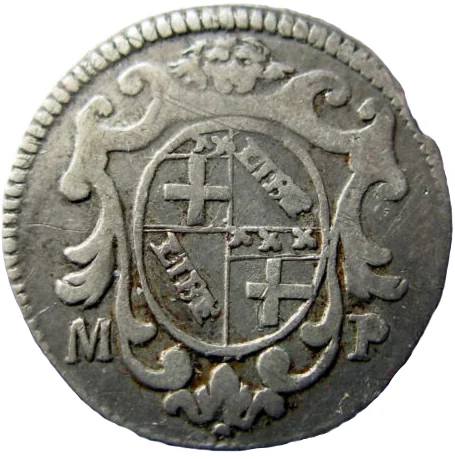
Oval Bologna shield, unframed and without inscription.
Inscription:
LIBE
MP
MP
Script: Latin
Engraver: Matteo Pignoni
Reverse
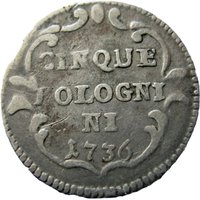
Description:
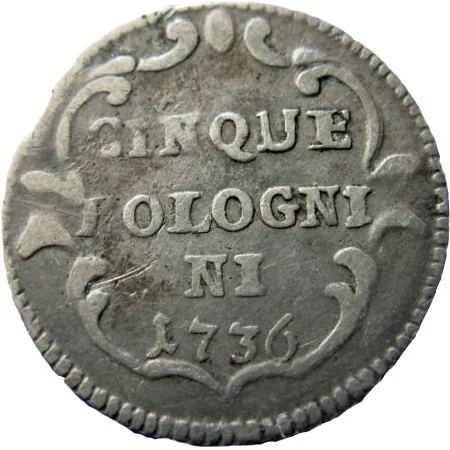
Value, date in leaf cartouche
Inscription:
CINQUE
BOLOGNI
NI
1736
BOLOGNI
NI
1736
Script: Latin
Engraver: Matteo Pignoni
Edge
Plain
Mints
| Name | Mark |
|---|---|
| Bologna | — |
Mintings
| Year | Mint Mark | Mintage | Quality | Collection |
|---|---|---|---|---|
| 1736 | — | — | ||
| 1737 | — | — |
Historical background
In 1736, Bologna’s currency situation was a complex tapestry reflecting its political subordination within the Papal States while retaining local monetary traditions. Officially, the city operated under the papal monetary system, with the standard silver Scudo Romano (Roman Scudo) and its subsidiary coins like the Grosso and Baiocco serving as the anchor. However, Bologna also minted its own distinct coins at the historic Zecca (mint), notably the Bolognino and the Lira Bolognese, which circulated widely for everyday local trade. This created a dual reality where papal decrees set broad standards, but Bolognese commerce relied heavily on its own familiar denominations.
The system was further complicated by the circulation of a multitude of foreign coins, a common feature across pre-unification Italy. Venetian Ducats, Florentine Florins, and various Spanish and Austrian silver coins all flowed through Bologna’s markets, their value subject to fluctuating exchange rates and periodic papal edicts. This proliferation required money changers (campsores) to be essential figures in the marketplace, assessing the weight and fineness of countless coins. For merchants and citizens, this meant transactions were rarely straightforward, often involving calculations to convert between local, papal, and foreign monetary units.
Economically, this period was one of relative stability for Bologna’s currency, without the severe debasement crises seen in earlier centuries. The papal authorities, under Pope Clement XII, generally maintained a consistent silver standard. However, the inherent complexity and multiplicity of coins in circulation posed a persistent challenge to commerce, creating opportunities for fraud and friction in trade. Thus, Bologna’s monetary landscape in 1736 was characterized by a layered sovereignty—papal authority superimposed on local minting prerogatives, all set within a wider Italian and European context of heterogeneous metallic currency.
The system was further complicated by the circulation of a multitude of foreign coins, a common feature across pre-unification Italy. Venetian Ducats, Florentine Florins, and various Spanish and Austrian silver coins all flowed through Bologna’s markets, their value subject to fluctuating exchange rates and periodic papal edicts. This proliferation required money changers (campsores) to be essential figures in the marketplace, assessing the weight and fineness of countless coins. For merchants and citizens, this meant transactions were rarely straightforward, often involving calculations to convert between local, papal, and foreign monetary units.
Economically, this period was one of relative stability for Bologna’s currency, without the severe debasement crises seen in earlier centuries. The papal authorities, under Pope Clement XII, generally maintained a consistent silver standard. However, the inherent complexity and multiplicity of coins in circulation posed a persistent challenge to commerce, creating opportunities for fraud and friction in trade. Thus, Bologna’s monetary landscape in 1736 was characterized by a layered sovereignty—papal authority superimposed on local minting prerogatives, all set within a wider Italian and European context of heterogeneous metallic currency.

✨ Legendary