

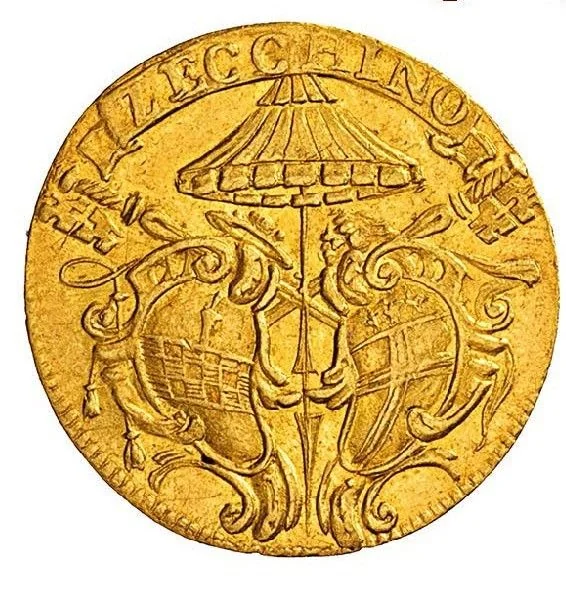
1 Zecchino – Bologna
Italy
Context
Years: 1737–1738
Country: Italy 
Issuer: Bologna
Ruler: Clement XII
Currency:
(1534—1835)
Demonetized: Yes
Material
References
KM: #Click to copy to clipboard212
Numista: #365176
Value
Bullion value: $570.45
Obverse
Reverse
Description:
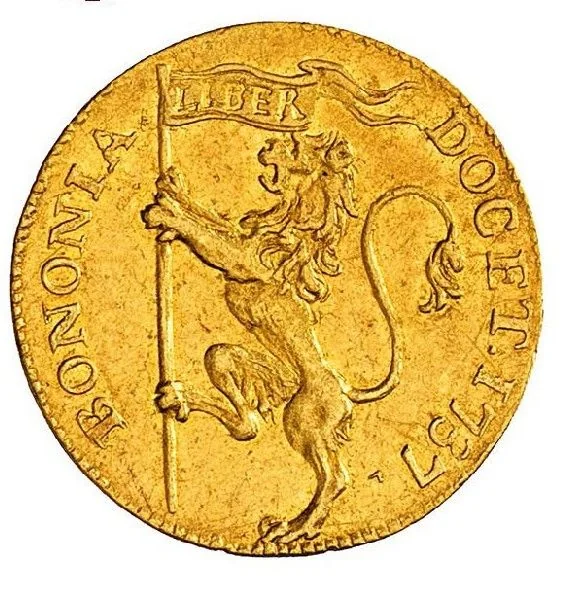
Rampant lion holding leftward banner.
Inscription:
BONONIA DOCET 1737
LIBER
LIBER
Script: Latin
Edge
Mints
| Name | Mark |
|---|---|
| Bologna | — |
Mintings
| Year | Mint Mark | Mintage | Quality | Collection |
|---|---|---|---|---|
| 1737 | — | — | ||
| 1738 | — | — |
Historical background
In 1737, Bologna existed within a complex monetary landscape typical of the Italian peninsula prior to unification. The city was part of the Papal States, and while the official currency was the Papal scudo (divided into 100 baiochi or 10 giuli), daily commerce was dominated by a bewildering array of physical coins. These included not only papal issues from the mint in Rome but also older, worn local coins from Bologna's mint (which had closed in 1702), and a significant circulation of foreign specie, particularly silver reales from Spain and zecchini (sequins) from Venice. This created a system where the nominal value of a coin (its legal value set by decree) often differed from its intrinsic market value based on metal content, leading to constant confusion and arbitrage.
The situation was further complicated by the widespread use of moneta di conto—money of account. The most important of these was the lira bolognese, a virtual currency used for bookkeeping, contracts, and setting prices. One scudo was officially valued at a fixed rate of 2.5 lire bolognesi. However, the actual value of physical coins in relation to this accounting unit fluctuated based on official edicts and market pressures. Authorities, including the Senato di Bologna and papal legates, periodically issued gridas (proclamations) to adjust the exchange rates between various circulating coins and the lira, attempting to stabilize commerce and state finances, but with mixed success.
This fragmented system posed significant challenges for merchants, who needed specialized manuals to navigate exchange rates, and for the general populace, who were vulnerable to debasement and fraud. The year 1737 falls within a period of relative monetary stability under Pope Clement XII, following earlier 17th-century crises. Nevertheless, the underlying fragility of a system reliant on multiple metallic currencies and arbitrary re-tariffing remained, reflecting Bologna's position as a subject city within a larger sovereign entity, lacking control over its own minting and deeply integrated into broader European trade and monetary flows.
The situation was further complicated by the widespread use of moneta di conto—money of account. The most important of these was the lira bolognese, a virtual currency used for bookkeeping, contracts, and setting prices. One scudo was officially valued at a fixed rate of 2.5 lire bolognesi. However, the actual value of physical coins in relation to this accounting unit fluctuated based on official edicts and market pressures. Authorities, including the Senato di Bologna and papal legates, periodically issued gridas (proclamations) to adjust the exchange rates between various circulating coins and the lira, attempting to stabilize commerce and state finances, but with mixed success.
This fragmented system posed significant challenges for merchants, who needed specialized manuals to navigate exchange rates, and for the general populace, who were vulnerable to debasement and fraud. The year 1737 falls within a period of relative monetary stability under Pope Clement XII, following earlier 17th-century crises. Nevertheless, the underlying fragility of a system reliant on multiple metallic currencies and arbitrary re-tariffing remained, reflecting Bologna's position as a subject city within a larger sovereign entity, lacking control over its own minting and deeply integrated into broader European trade and monetary flows.
✨ Legendary