

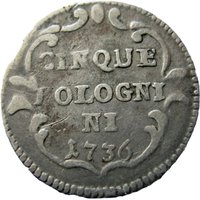
4 Bolognini – Bologna
Italy
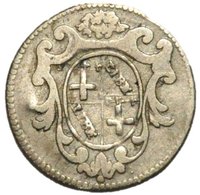
Obverse
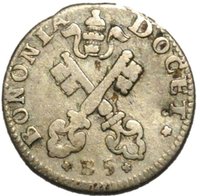
Reverse
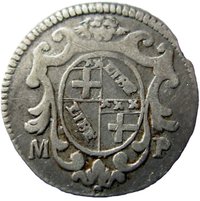
Edge
Categories
| Person> Monarch |
| Person> Religious figure |
| Object> Hat |
| Religion> Religious objects |
Mints
| Name | Mark |
|---|---|
| Bologna | — |
Mintings
| Year | Mint Mark | Mintage | Quality | Collection |
|---|---|---|---|---|
| 1735 | — | — | ||
| 1736 | — | — |
Historical background
In 1735, Bologna existed within a complex monetary landscape typical of the Italian peninsula, caught between local tradition, regional authority, and imperial power. Officially, the city was part of the Papal States, governed by a legate appointed by Pope Clement XII. However, the true political and economic heavyweight was the Holy Roman Empire, as the nearby Duchy of Milan (under Austrian Habsburg control) exerted immense commercial influence. Consequently, Bologna operated on a bimetallic system but with a proliferation of actual physical coins. The primary accounting unit was the Bolognese Lira (lira bolognese), divided into 20 soldi or 240 denari, but this was largely a notational tool for bookkeeping and contracts rather than a commonly minted coin.
The circulation was a tangible reflection of political fragmentation. In daily use, people handled a bewildering variety of physical currency. Papal coinage, such as the giulio and paolo, circulated alongside Imperial coins from Milan, like the sesino and soldino. Furthermore, due to extensive trade, coins from other Italian states (Venetian ducats, Florentine lire) and even foreign silver pieces like Spanish reales were also present and accepted, their value subject to constant negotiation. This created a perpetual need for money-changers (banchi di cambio) whose expertise was essential to assess the weight, metal content, and wear of each coin to determine its current value in the Bolognese system.
This monetary heterogeneity posed significant challenges for commerce and governance. Fluctuations in the relative value of gold and silver, coupled with the varying quality of coins in circulation, led to frequent official attempts to fix exchange rates (tariffe) by the papal authorities. These edicts, however, often struggled against market realities and the economic pull of Habsburg Milan. The situation inherently favored merchants and financiers with the knowledge to navigate this system, while complicating tax collection and creating opportunities for clipping and counterfeiting, placing a burden on the general populace whose smaller transactions were most vulnerable to instability and devaluation.
The circulation was a tangible reflection of political fragmentation. In daily use, people handled a bewildering variety of physical currency. Papal coinage, such as the giulio and paolo, circulated alongside Imperial coins from Milan, like the sesino and soldino. Furthermore, due to extensive trade, coins from other Italian states (Venetian ducats, Florentine lire) and even foreign silver pieces like Spanish reales were also present and accepted, their value subject to constant negotiation. This created a perpetual need for money-changers (banchi di cambio) whose expertise was essential to assess the weight, metal content, and wear of each coin to determine its current value in the Bolognese system.
This monetary heterogeneity posed significant challenges for commerce and governance. Fluctuations in the relative value of gold and silver, coupled with the varying quality of coins in circulation, led to frequent official attempts to fix exchange rates (tariffe) by the papal authorities. These edicts, however, often struggled against market realities and the economic pull of Habsburg Milan. The situation inherently favored merchants and financiers with the knowledge to navigate this system, while complicating tax collection and creating opportunities for clipping and counterfeiting, placing a burden on the general populace whose smaller transactions were most vulnerable to instability and devaluation.
✨ Legendary