

2 Ducats – Sweden
Sweden
Context
Years: 1702–1704
Issuer: Sweden 
Ruler: Charles XII
Currency:
(1665—1715)
Demonetized: Yes
Total mintage: 2,295
References
KM: #Click to copy to clipboard332
Numista: #182922
Value
Bullion value: $1132.59
Obverse
Description:
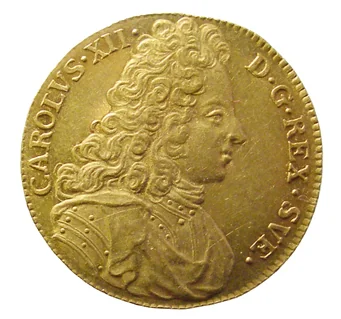
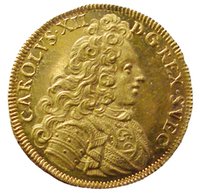
Carl XII bust right within encircling legend.
Inscription:
CAROLVS·XII· D·G·REX·SVE·
Script: Latin
Reverse
Description:
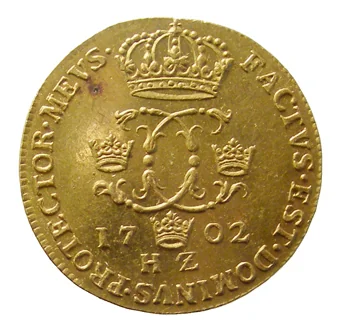
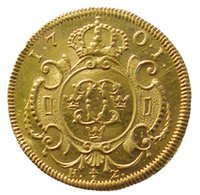
Monogram with three Swedish crowns inside legend circle. Date and mintmark below.
Inscription:
FACTVSC·EST·DOMINVS·PROTECTOR·MEVS·
17 02
H Z
17 02
H Z
Script: Latin
Edge
Mints
| Name | Mark |
|---|---|
| Stockholm | — |
Mintings
| Year | Mint Mark | Mintage | Quality | Collection |
|---|---|---|---|---|
| 1702 | — | 964 | ||
| 1704 | — | 1,331 |
Historical background
In 1702, Sweden found itself in the midst of the Great Northern War (1700–1721), a conflict that placed immense strain on the nation's finances and monetary system. King Charles XII was primarily focused on military campaigns in Poland and the Baltics, funding his ambitious war effort through heavy taxation, foreign loans, and the systematic exploitation of occupied territories. However, these sources were insufficient, leading to a growing reliance on the Stockholm Banco (the precursor to the Riksbank), which began issuing excessive amounts of credit notes without adequate metallic backing.
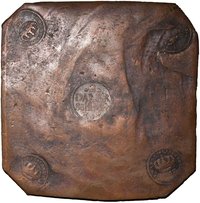
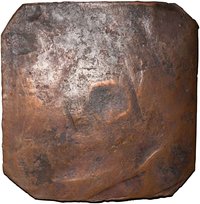
The currency situation was inherently unstable, built upon a foundation laid decades earlier. Following the Great Copper Mountain's decline, Sweden had adopted a bimetallic system based on silver and copper, with large, cumbersome copper plate money (plåtmynt) in circulation. The establishment of the Stockholm Banco in 1656 had introduced Europe's first regular banknotes, but a prior collapse in the 1660s due to over-issuance had already demonstrated the system's fragility. By 1702, the pressures of war were exacerbating these vulnerabilities, as the government required more means of payment to sustain its armies abroad, leading to inflationary pressures and a creeping distrust in the value of the circulating paper credit notes.
Consequently, while a full-scale monetary crisis was still a few years away (culminating in a 1715 currency devaluation and the collapse of the note system in 1716), the seeds were being sown in 1702. The Riksdag (parliament) and the king's advisors were aware of the looming financial dangers, but the immediate demands of the war took precedence. The currency was thus on a precarious path, its stability sacrificed to fund Charles XII's military ambitions, setting the stage for significant economic hardship and monetary reform in the subsequent decades.
The currency situation was inherently unstable, built upon a foundation laid decades earlier. Following the Great Copper Mountain's decline, Sweden had adopted a bimetallic system based on silver and copper, with large, cumbersome copper plate money (plåtmynt) in circulation. The establishment of the Stockholm Banco in 1656 had introduced Europe's first regular banknotes, but a prior collapse in the 1660s due to over-issuance had already demonstrated the system's fragility. By 1702, the pressures of war were exacerbating these vulnerabilities, as the government required more means of payment to sustain its armies abroad, leading to inflationary pressures and a creeping distrust in the value of the circulating paper credit notes.
Consequently, while a full-scale monetary crisis was still a few years away (culminating in a 1715 currency devaluation and the collapse of the note system in 1716), the seeds were being sown in 1702. The Riksdag (parliament) and the king's advisors were aware of the looming financial dangers, but the immediate demands of the war took precedence. The currency was thus on a precarious path, its stability sacrificed to fund Charles XII's military ambitions, setting the stage for significant economic hardship and monetary reform in the subsequent decades.

✨ Legendary