

½ Ducat – Sweden
Sweden
Context

References
KM: #Click to copy to clipboard331
Numista: #183192
Value
Bullion value: $283.85
Obverse
Description:
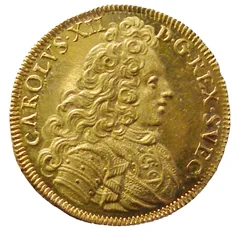
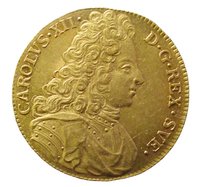
Armored bust of Carl XII facing right within circular legend.
Inscription:
CAROLVS·XII D·G·REX·SVEC·
Script: Latin
Reverse
Description:
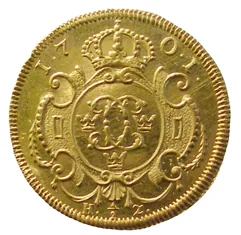
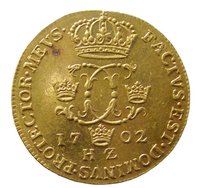
Double C monogram in crowned cartouche with Sweden's three crowns. Date above, value and mintmark below.
Inscription:
1·7 0·1.
H. ½ Z.
H. ½ Z.
Script: Latin
Edge
Mints
| Name | Mark |
|---|---|
| Stockholm | — |
Mintings
| Year | Mint Mark | Mintage | Quality | Collection |
|---|---|---|---|---|
| 1701 | — | — |
Historical background
In 1701, Sweden was embroiled in the Great Northern War (1700–1721), a conflict that placed immense financial strain on the state. King Charles XII’s ambitious military campaigns across Poland, Saxony, and the Baltic required vast and continuous funding. The traditional Swedish monetary system, based on silver, was pushed to its limits as the crown resorted to drastic measures to finance the war, including heavy taxation, borrowing, and the confiscation of church bells and copper to be minted into coinage.
The primary currency in circulation was the silver daler, but its value was increasingly unstable. To meet expenses, the government began issuing large quantities of low-weight copper coins and heavily debased silver coins, a process known as "coin clipping." This effectively reduced the precious metal content while maintaining the face value, leading to a hidden form of inflation. The public, aware of the declining intrinsic value, grew distrustful of the currency, and the disparity between official and market values caused significant economic disruption.
Consequently, Sweden in 1701 was experiencing a classic wartime currency crisis. The monetary system was under severe stress, with a proliferation of debased coinage eroding public confidence and purchasing power. This inflationary pressure, coupled with the diversion of resources to the military, strained the domestic economy, setting the stage for more severe financial difficulties as the protracted war continued to drain the royal treasury.
The primary currency in circulation was the silver daler, but its value was increasingly unstable. To meet expenses, the government began issuing large quantities of low-weight copper coins and heavily debased silver coins, a process known as "coin clipping." This effectively reduced the precious metal content while maintaining the face value, leading to a hidden form of inflation. The public, aware of the declining intrinsic value, grew distrustful of the currency, and the disparity between official and market values caused significant economic disruption.
Consequently, Sweden in 1701 was experiencing a classic wartime currency crisis. The monetary system was under severe stress, with a proliferation of debased coinage eroding public confidence and purchasing power. This inflationary pressure, coupled with the diversion of resources to the military, strained the domestic economy, setting the stage for more severe financial difficulties as the protracted war continued to drain the royal treasury.
✨ Legendary