

4 Thalers – Hungary
Hungary

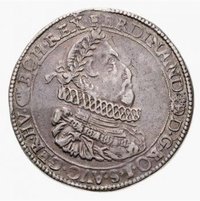
Obverse
Description:
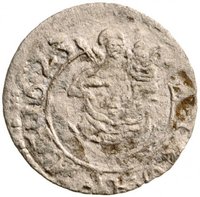
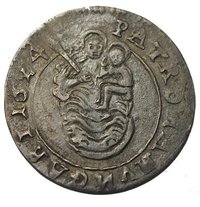
Right-facing laureate bust with curls, necklace, and Golden Fleece ring; behind neck, crowned double Hungarian shield; on right, Madonna on crescent.
Inscription:
FERDINAND D · G · RO · I · S · AVG · GER · HVN BOH · REX
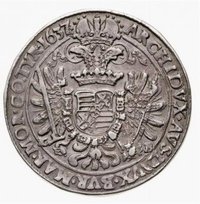
Reverse
Description:
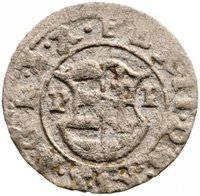
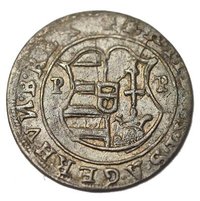
Imperial double-headed eagle with sword and scepter, holding a quartered shield (Árpád stripes, Bohemian lion twice, Árpád stripes) with an inescutcheon of Austrian and Burgundian arms. Mintmark below.
Inscription:
ARCHIDVX · AVS · DVX · BVR · MAR · MOR · CO · TYR · 1623 ·
K B
K B
Edge
Plain
Mints
| Name | Mark |
|---|---|
| Kremnica | KB |
Mintings
| Year | Mint Mark | Mintage | Quality | Collection |
|---|---|---|---|---|
| 1623 | K-B | — | ||
| 1631 | K-B | — |
Historical background
In 1623, Hungary’s currency situation was chaotic and deeply unstable, a direct consequence of its division between the Habsburg-ruled Royal Hungary in the west and north, the Ottoman-occupied central territories, and the semi-independent Principality of Transylvania in the east. This political fragmentation led to a circulation of multiple, competing coinages. The Habsburg authorities in Vienna minted and circulated imperial thalers and silver denars for Royal Hungary, while Ottoman akçes and, increasingly, Dutch lion thalers and other European trade coins flowed in the occupied and border regions. Transylvania also issued its own coinage, further complicating the monetary landscape.
The core problem was severe debasement. To finance continuous warfare against the Ottomans and the Thirty Years' War, the Habsburg government frequently reduced the silver content in the coins minted for Hungary, notably in the silver denars produced by the mining towns of Upper Hungary (modern Slovakia). This led to a classic "bad money drives out good" scenario (Gresham's Law), where sound foreign thalers were hoarded or exported, leaving the populace with ever-worsening domestic coinage. The resulting inflation eroded both public trust and the real value of wages and taxes, causing widespread economic hardship and social grievance.
This monetary crisis was not merely economic but also a significant political flashpoint. The Hungarian estates, particularly the nobility, repeatedly protested the debasement as a violation of their rights and a burden on the country. Their grievances over coinage were a staple of Diets (parliamentary assemblies) and contributed to the growing tension between the Habsburg monarchy and the Hungarian political nation. Thus, in 1623, the currency situation was a symptom of Hungary’s fractured sovereignty and a key source of internal conflict, undermining both economic stability and political cohesion within the kingdom.
The core problem was severe debasement. To finance continuous warfare against the Ottomans and the Thirty Years' War, the Habsburg government frequently reduced the silver content in the coins minted for Hungary, notably in the silver denars produced by the mining towns of Upper Hungary (modern Slovakia). This led to a classic "bad money drives out good" scenario (Gresham's Law), where sound foreign thalers were hoarded or exported, leaving the populace with ever-worsening domestic coinage. The resulting inflation eroded both public trust and the real value of wages and taxes, causing widespread economic hardship and social grievance.
This monetary crisis was not merely economic but also a significant political flashpoint. The Hungarian estates, particularly the nobility, repeatedly protested the debasement as a violation of their rights and a burden on the country. Their grievances over coinage were a staple of Diets (parliamentary assemblies) and contributed to the growing tension between the Habsburg monarchy and the Hungarian political nation. Thus, in 1623, the currency situation was a symptom of Hungary’s fractured sovereignty and a key source of internal conflict, undermining both economic stability and political cohesion within the kingdom.
Series: 1623 Hungary circulation coins

✨ Legendary