

1 Rupee – Mughal Empire
India
Context
Years: 1675–1707
Country: India 
Issuer: Mughal Empire
Ruler: Aurangzeb
Currency:
(1540—1842)
Demonetized: Yes
Material
References
KM: #Click to copy to clipboard300.82
Numista: #107131
Value
Bullion value: $32.40
Obverse
Description:
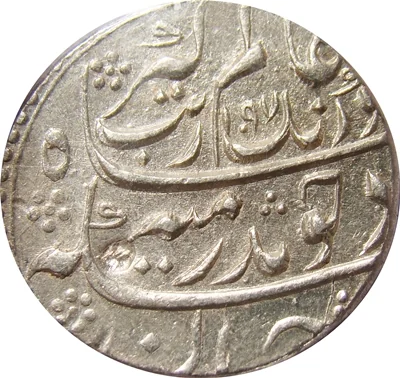
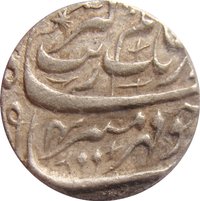
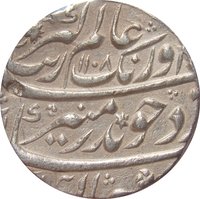
“Badr Munir” couplet, Hijri date.
Reverse
Description:
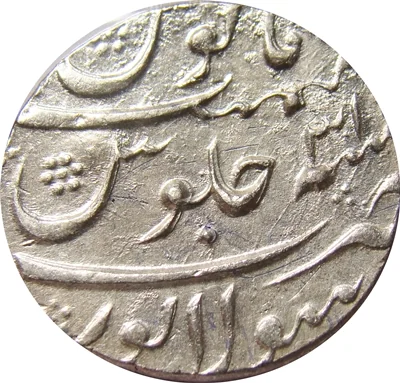
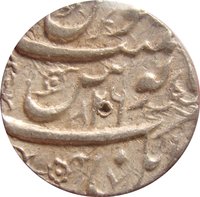
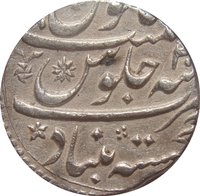
Sana julus zarb Sholapur, regnal year.
Edge
Mintings
| Year | Mint Mark | Mintage | Quality | Collection |
|---|---|---|---|---|
| 1675 | — | — | ||
| 1676 | — | — | ||
| 1678 | — | — | ||
| 1679 | — | — | ||
| 1680 | — | — | ||
| 1681 | — | — | ||
| 1682 | — | — | ||
| 1683 | — | — | ||
| 1684 | — | — | ||
| 1685 | — | — | ||
| 1686 | — | — | ||
| 1687 | — | — | ||
| 1689 | — | — | ||
| 1690 | — | — | ||
| 1697 | — | — | ||
| 1700 | — | — | ||
| 1702 | — | — | ||
| 1703 | — | — | ||
| 1704 | — | — | ||
| 1705 | — | — | ||
| 1706 | — | — | ||
| 1707 | — | — |
Historical background
In 1675, the Mughal Empire under Emperor Aurangzeb was at the zenith of its territorial expansion, and its currency system reflected a sophisticated and stable monetary economy. The backbone of this system was the silver rupee, a high-purity coin minted from imported New World silver, which served as the primary unit for revenue assessment, large trade, and state expenditure. Alongside it circulated the gold mohur, used for hoarding and high-value transactions, and a range of smaller copper dams and paisas that facilitated everyday bazaar trade for the common populace. This trimetallic system, centrally controlled through a network of imperial mints (sikkas), was remarkably uniform across the subcontinent, fostering immense internal and external commerce.
However, this apparent stability was under growing strain. Aurangzeb’s prolonged and costly military campaigns in the Deccan, particularly against the Maratha Confederacy, were draining the imperial treasury. While not yet causing a catastrophic debasement, the state's financial pressures were leading to increased taxation and the re-minting of older coins to extract seigniorage. Furthermore, the vast empire relied on a complex web of money changers (sarrafs) and bankers, who not only facilitated exchange but also began to extend credit, subtly shifting financial power away from pure state control. The uniformity of the currency also masked regional variations, as older local coins and foreign currencies like Spanish rials still circulated in port cities.
Thus, the currency situation in 1675 was one of robust institutional strength showing early signs of fiscal stress. The system efficiently served the world's largest economy of the time, enabling the grandeur of the Mughal court and the flourishing of trade. Yet, the relentless cost of Aurangzeb's imperial ambitions was slowly stretching the financial fabric, a pressure that would, in the decades following his death, contribute to the gradual fragmentation of both the empire's polity and its once-unified monetary space.
However, this apparent stability was under growing strain. Aurangzeb’s prolonged and costly military campaigns in the Deccan, particularly against the Maratha Confederacy, were draining the imperial treasury. While not yet causing a catastrophic debasement, the state's financial pressures were leading to increased taxation and the re-minting of older coins to extract seigniorage. Furthermore, the vast empire relied on a complex web of money changers (sarrafs) and bankers, who not only facilitated exchange but also began to extend credit, subtly shifting financial power away from pure state control. The uniformity of the currency also masked regional variations, as older local coins and foreign currencies like Spanish rials still circulated in port cities.
Thus, the currency situation in 1675 was one of robust institutional strength showing early signs of fiscal stress. The system efficiently served the world's largest economy of the time, enabling the grandeur of the Mughal court and the flourishing of trade. Yet, the relentless cost of Aurangzeb's imperial ambitions was slowly stretching the financial fabric, a pressure that would, in the decades following his death, contribute to the gradual fragmentation of both the empire's polity and its once-unified monetary space.
💎 Extremely Rare