

1 Rupee – Mughal Empire
India
Context
Years: 1672–1689
Country: India 
Issuer: Mughal Empire
Ruler: Aurangzeb
Currency:
(1540—1842)
Demonetized: Yes
Material
References
KM: #Click to copy to clipboard300.109
Numista: #146459
Value
Bullion value: $32.97
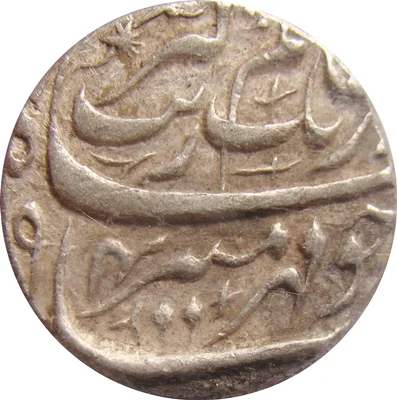
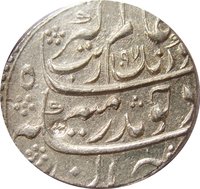
Obverse
Description:
Mihr Munir couplet, dated AH.
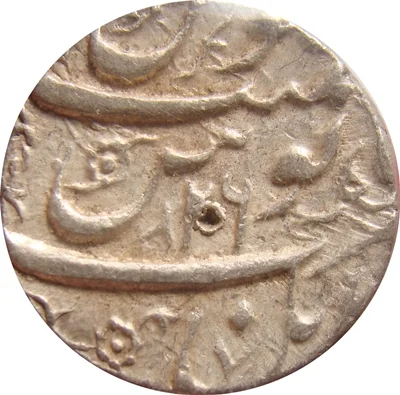
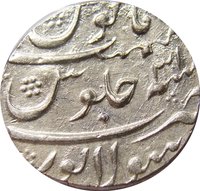
Reverse
Description:
Kabul, no epithet. Regnal year.
Edge
Mints
| Name | Mark |
|---|---|
| Kabul | — |
Mintings
| Year | Mint Mark | Mintage | Quality | Collection |
|---|---|---|---|---|
| 1672 | — | — | ||
| 1673 | — | — | ||
| 1675 | — | — | ||
| 1677 | — | — | ||
| 1683 | — | — | ||
| 1689 | — | — |
Historical background
In 1672, the Mughal Empire's currency system was a well-established bimetallic standard, centered on the silver rupee and the gold mohur, with a vast network of mints ensuring uniformity across the subcontinent. The reign of Emperor Aurangzeb Alamgir (1658-1707) was a period of immense territorial expansion and military expenditure, placing significant demands on the imperial treasury. To finance his campaigns, particularly in the Deccan, Aurangzeb maintained strict control over the mints, ensuring the high purity of coins, which bore his regnal title and the Hijri year of minting. The system was highly regulated, with the dam, a copper coin, serving as the common denominator for smaller, everyday transactions.
However, this apparent stability faced underlying pressures. The empire's voracious demand for silver, the primary monetary metal, created a persistent vulnerability as it relied heavily on imports of bullion, especially from the New World via European traders. Any disruption to this flow could strain the economy. Furthermore, while the imperial coinage was prestigious, in practice a complex mosaic of local and regional currencies, including older Mughal issues and coins from autonomous provinces, also circulated, particularly in rural areas. This period also saw the increasing economic influence of European trading companies, whose own gold and silver coins began to enter the financial ecosystem, foreshadowing future shifts in monetary power.
Therefore, the currency situation in 1672 was one of robust imperial design straining under the weight of geopolitical ambition. The system was administratively sound and facilitated both grand imperial finance and vast commercial networks, yet it was inherently dependent on external silver and was beginning to encounter the early, subtle pressures of globalization. Aurangzeb's focus on military conquest, while initially supported by this efficient system, would ultimately stretch imperial resources, contributing to the long-term financial strains that later Mughal rulers would face.
However, this apparent stability faced underlying pressures. The empire's voracious demand for silver, the primary monetary metal, created a persistent vulnerability as it relied heavily on imports of bullion, especially from the New World via European traders. Any disruption to this flow could strain the economy. Furthermore, while the imperial coinage was prestigious, in practice a complex mosaic of local and regional currencies, including older Mughal issues and coins from autonomous provinces, also circulated, particularly in rural areas. This period also saw the increasing economic influence of European trading companies, whose own gold and silver coins began to enter the financial ecosystem, foreshadowing future shifts in monetary power.
Therefore, the currency situation in 1672 was one of robust imperial design straining under the weight of geopolitical ambition. The system was administratively sound and facilitated both grand imperial finance and vast commercial networks, yet it was inherently dependent on external silver and was beginning to encounter the early, subtle pressures of globalization. Aurangzeb's focus on military conquest, while initially supported by this efficient system, would ultimately stretch imperial resources, contributing to the long-term financial strains that later Mughal rulers would face.
✨ Legendary