

1 Thaler – Hungary
Hungary
Context
Years: 1767–1780
Issuer: Hungary 
Ruler: Maria Theresa
Currency:
(1754—1857)
Demonetized: Yes
Total mintage: 112,000
Material
References
KM: #Click to copy to clipboard386
Numista: #18112
Value
Bullion value: $66.90
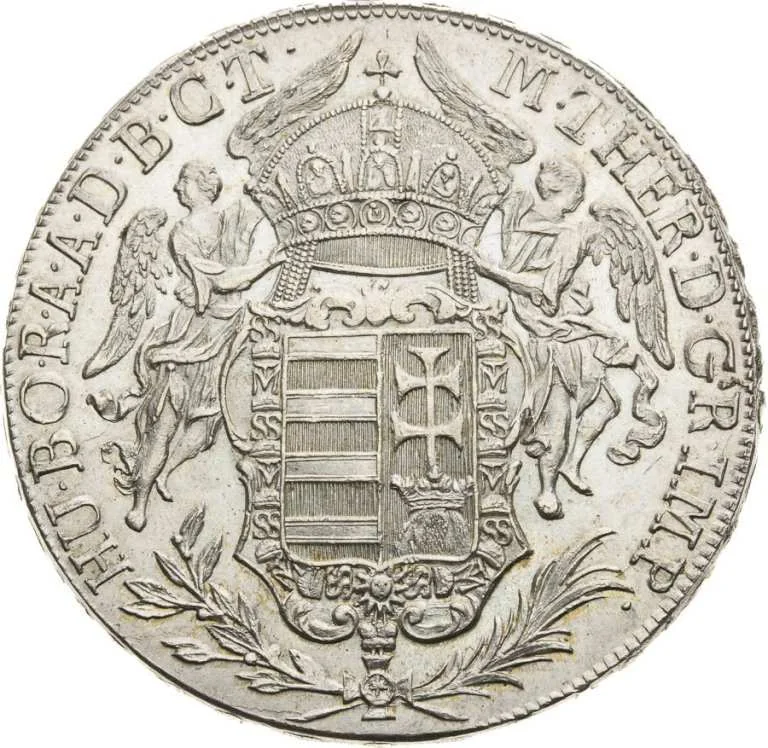
Obverse
Description:
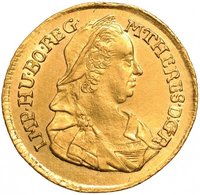
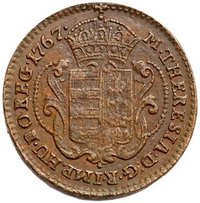
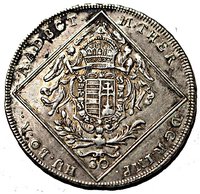
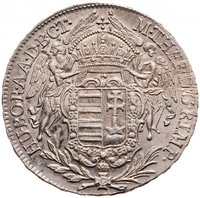
Crowned Hungarian coat of arms with angel supporters. The crown divides the top legend: "Maria Theresia, Dei Gratia Romanorum Imperatrix, Hungariae Bohemiaeque Regina, Archidux Austriae, Dux Burgundiae, Comes Tyrolis."
Inscription:
M · THER · D · G ·R · IMP · HU · BO · R · A · A · D · B · C · T ·
Script: Latin
Reverse
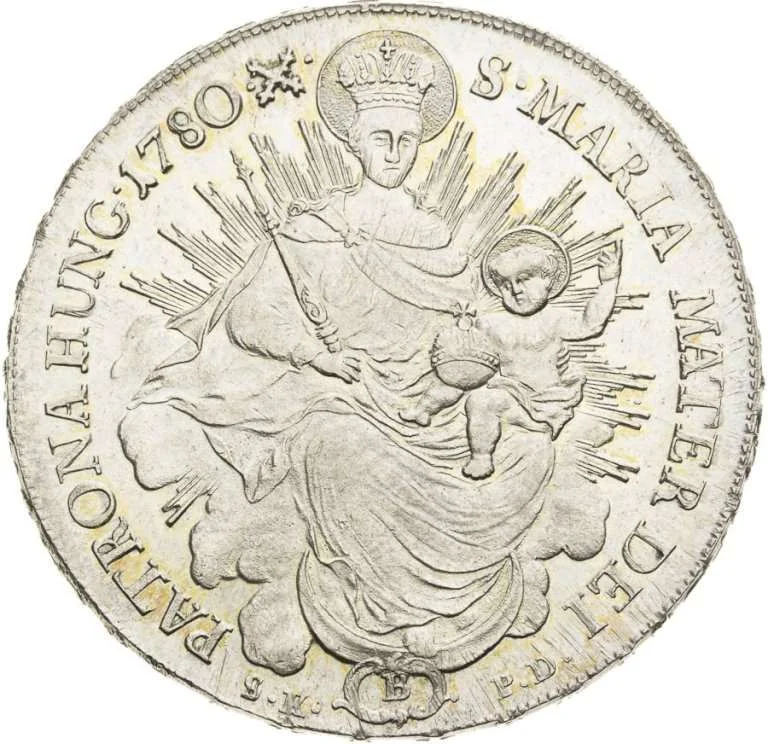
Description:
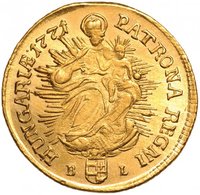
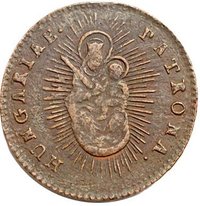
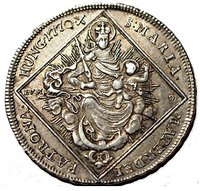
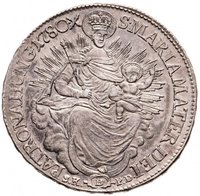
Radiant Madonna and child, legend from 1 o'clock. Mint letters below.
Inscription:
S · MARIA · MATER · DEI · PATRONA · HUNG · 1779 · X ·
S K (B) P D
S K (B) P D
Script: Latin
Edge
Inscripted
Legend:
IUSTITIA ET CLEMENTIA
Mints
| Name | Mark |
|---|---|
| Kremnica | — |
Mintings
| Year | Mint Mark | Mintage | Quality | Collection |
|---|---|---|---|---|
| 1767 | K | 25,000 | ||
| 1768 | K | 43,000 | ||
| 1769 | K | 44,000 | ||
| 1770 | K | — | ||
| 1771 | K | — | ||
| 1772 | K | — | ||
| 1773 | K | — | ||
| 1775 | K | — | ||
| 1776 | K | — | ||
| 1777 | B | — | ||
| 1778 | B | — | ||
| 1779 | B | — | ||
| 1780 | B | — |
Historical background
In 1767, the currency situation in the Kingdom of Hungary, then part of the Habsburg Monarchy, was characterized by significant instability and complexity, a legacy of the costly Seven Years' War (1756-1763). The state treasury was deeply depleted, leading the Viennese court to engage in the debasement of coinage. The primary circulating coin, the silver Conventionsthaler, was officially valued at 1.5 Gulden (or Forints), but the government began minting and over-issuing a debased silver coin called the Laubthaler (or "leaf thaler") and its fractional Poltura coins. These were officially tariffed at par with older, finer coins, but their intrinsic silver content was lower, causing public distrust and driving older, full-value coins out of circulation—a classic example of Gresham's Law.
This monetary manipulation created a chaotic dual-system in practice. While accounts were kept in the stable Convention currency (Conventionsmünze), everyday transactions were conducted in the depreciating Laub currency (Laubmünze). The resulting discrepancy between the nominal and intrinsic value of coins led to widespread confusion, price inflation in certain sectors, and hardship for the population, particularly those on fixed incomes or paying taxes. The situation severely disrupted commerce, as merchants and peasants alike struggled with the fluctuating and unreliable value of the money they received.
The year 1767 falls within the period of administrative reforms under Empress Maria Theresa, and the currency crisis was a pressing economic issue demanding resolution. In response to the growing turmoil, the Habsburg government would move to formally devalue the Laub currency later in the same year, officially reducing its value relative to the Convention standard. This was a stopgap measure, however, preceding a more comprehensive but equally controversial monetary reform in 1769/1770, which aimed to standardize the coinage and stabilize the finances of the Monarchy at the expense of further devaluation.
This monetary manipulation created a chaotic dual-system in practice. While accounts were kept in the stable Convention currency (Conventionsmünze), everyday transactions were conducted in the depreciating Laub currency (Laubmünze). The resulting discrepancy between the nominal and intrinsic value of coins led to widespread confusion, price inflation in certain sectors, and hardship for the population, particularly those on fixed incomes or paying taxes. The situation severely disrupted commerce, as merchants and peasants alike struggled with the fluctuating and unreliable value of the money they received.
The year 1767 falls within the period of administrative reforms under Empress Maria Theresa, and the currency crisis was a pressing economic issue demanding resolution. In response to the growing turmoil, the Habsburg government would move to formally devalue the Laub currency later in the same year, officially reducing its value relative to the Convention standard. This was a stopgap measure, however, preceding a more comprehensive but equally controversial monetary reform in 1769/1770, which aimed to standardize the coinage and stabilize the finances of the Monarchy at the expense of further devaluation.
Series: 1767 Hungary circulation coins
⭐ Rare