

24 skilling – Danish West Indies
Add to wishlist
United States
Context
Years: 1763–1765
Country: United States
Issuer: Danish West Indies
Ruler: Frederick V
Currency:
(1740—1849)
Demonetized: Yes
Total mintage: 231,000
Material
References
KM: #
Numista: #17459
Value
Bullion value: $8.29
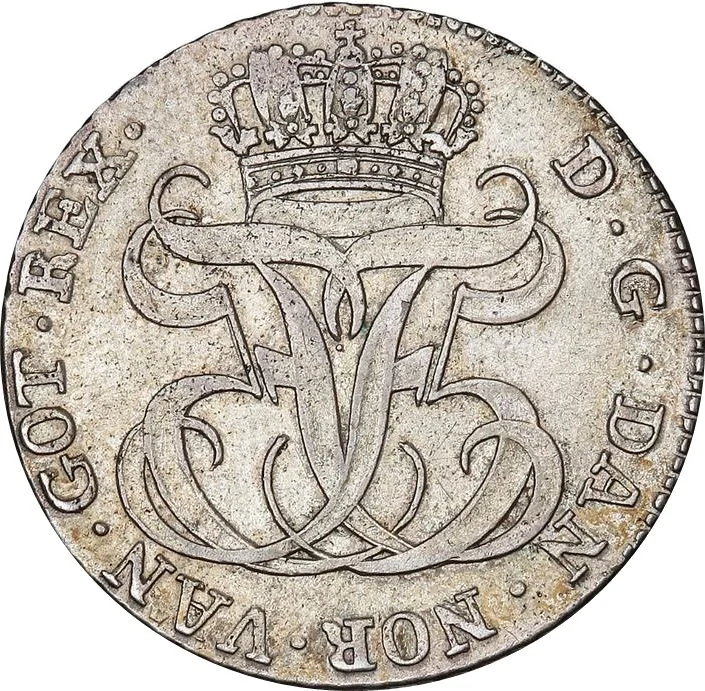
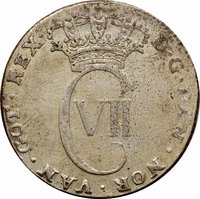
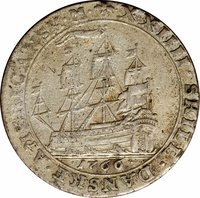
Obverse
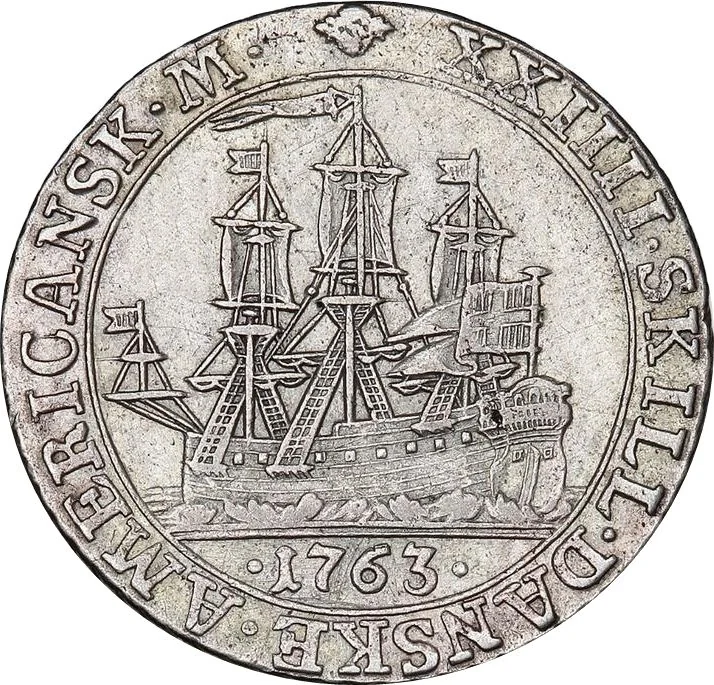
Reverse
Description:
Ship sailing left inside a circle, date below. Legend around the rim.
Inscription:
XXIIII SKILL.DANSK.AMERIKANSK.M 1764
Script: Latin
Edge
Plain
Categories
| Symbol> Flag |
| Transportation> Watercraft |
| Symbol> Crown |
| Symbols> Monogram |
Mints
| Name | Mark |
|---|---|
| Royal Danish Mint | — |
Mintings
| Year | Mint Mark | Mintage | Quality | Collection |
|---|---|---|---|---|
| 1763 | — | 64,000 | ||
| 1764 | — | 136,000 | ||
| 1765 | — | 31,000 |
Historical background
In 1763, the Danish West Indies (St. Thomas, St. John, and from 1733, St. Croix) operated within a complex and chronically unstable monetary environment typical of Caribbean plantation colonies. The official currency was the Danish rigsdaler, but it was scarce and often remained in the hands of the colonial administration and a few large merchants. The real lifeblood of everyday transactions was a chaotic mix of foreign coinage, primarily Spanish pieces of eight and their fractional parts (reales), alongside Portuguese, Dutch, and French coins. This proliferation of specie created constant confusion over exchange rates and values, hampering commerce and colonial accounting.
The core economic problem was a persistent trade imbalance. The colonies exported sugar, cotton, and rum, but needed to import virtually all manufactured goods, provisions, and enslaved laborers. This meant that the limited hard currency received for exports was quickly paid out to foreign traders and ship captains, causing specie to constantly drain from the islands. To facilitate local trade in the absence of sufficient coin, planters and merchants relied heavily on book credit and issued promissory notes. More critically, the economy depended on the use of "currency commodities," most notably enslaved people and raw sugar, which were used as de facto units of value and even collateral for debts.
Recognizing this dysfunctional system, the Danish authorities made attempts at regulation. They periodically published proclamation rates, fixing the value of the myriad foreign coins in relation to the rigsdaler, but these official rates often failed to reflect market realities. By 1763, despite these efforts, the monetary system remained fragmented and unreliable. This instability would eventually lead to more direct action, culminating in the establishment of the Danish West Indian Nationalbank in 1784 and the later creation of a distinct colonial daler to impose order, though with limited success.
The core economic problem was a persistent trade imbalance. The colonies exported sugar, cotton, and rum, but needed to import virtually all manufactured goods, provisions, and enslaved laborers. This meant that the limited hard currency received for exports was quickly paid out to foreign traders and ship captains, causing specie to constantly drain from the islands. To facilitate local trade in the absence of sufficient coin, planters and merchants relied heavily on book credit and issued promissory notes. More critically, the economy depended on the use of "currency commodities," most notably enslaved people and raw sugar, which were used as de facto units of value and even collateral for debts.
Recognizing this dysfunctional system, the Danish authorities made attempts at regulation. They periodically published proclamation rates, fixing the value of the myriad foreign coins in relation to the rigsdaler, but these official rates often failed to reflect market realities. By 1763, despite these efforts, the monetary system remained fragmented and unreliable. This instability would eventually lead to more direct action, culminating in the establishment of the Danish West Indian Nationalbank in 1784 and the later creation of a distinct colonial daler to impose order, though with limited success.
💎 Very Rare