

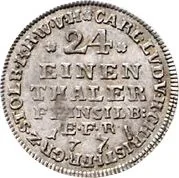
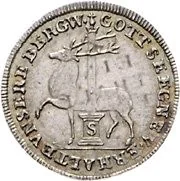
1⁄24 thaler – ERR: County of Stolberg-StolbergandCounty of Stolberg-Rossla
Add to wishlist
Context
Year: 1771
Currency:
Demonetized: Yes
References
KM: #
Numista: #168980
Obverse
Reverse
Edge
Mints
| Name | Mark |
|---|---|
| Stolberg, Harz | — |
Mintings
| Year | Mint Mark | Mintage | Quality | Collection |
|---|---|---|---|---|
| 1771 | — | — |
Historical background
In 1771, the currency situation in the County of Stolberg-Stolberg and the County of Stolberg-Rossla was complex, reflecting the fragmented political landscape of the Holy Roman Empire. Both counties, though ruled by different branches of the same family, operated within a broader monetary system dominated by the regional power of Electoral Saxony. The official currency in circulation was the Saxon Reichsthaler, divided into 24 Groschen, each of 12 Pfennige. This alignment with Saxony provided a degree of stability and facilitated trade with their powerful neighbor.
However, the practical reality was one of monetary confusion. Alongside Saxon coinage, various other German imperial and regional coins circulated, their values fluctuating based on metallic content and proclamation. The counts had limited minting rights, and any locally issued minor coinage (such as Kreuzer or Gutegroschen) would have been supplementary and of lower value. This created a daily challenge for merchants and subjects, who had to constantly assess and convert between different coins, a process complicated by frequent debasements elsewhere.
Ultimately, the monetary sovereignty of the Stolberg counties was constrained. Their economies were integrated into the Saxon sphere, and they lacked the power to set independent monetary policy. The year 1771 fell within a period of relative stability before the upheavals of the Napoleonic era, but the system was inherently cumbersome. The currency situation, therefore, was characterized by a de facto Saxon standard overlain with a mosaic of circulating foreign coins, requiring constant calculation and trust in an era before uniform national currency.
However, the practical reality was one of monetary confusion. Alongside Saxon coinage, various other German imperial and regional coins circulated, their values fluctuating based on metallic content and proclamation. The counts had limited minting rights, and any locally issued minor coinage (such as Kreuzer or Gutegroschen) would have been supplementary and of lower value. This created a daily challenge for merchants and subjects, who had to constantly assess and convert between different coins, a process complicated by frequent debasements elsewhere.
Ultimately, the monetary sovereignty of the Stolberg counties was constrained. Their economies were integrated into the Saxon sphere, and they lacked the power to set independent monetary policy. The year 1771 fell within a period of relative stability before the upheavals of the Napoleonic era, but the system was inherently cumbersome. The currency situation, therefore, was characterized by a de facto Saxon standard overlain with a mosaic of circulating foreign coins, requiring constant calculation and trust in an era before uniform national currency.

✨ Legendary