

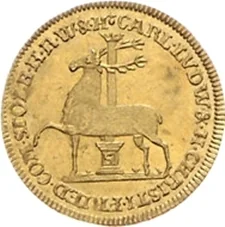
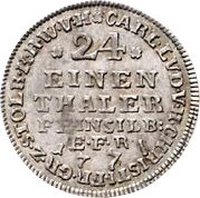
Obverse
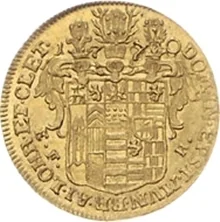
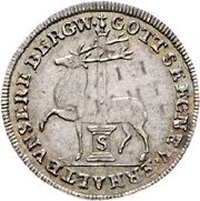
Reverse
Edge
Mints
| Name | Mark |
|---|---|
| Stolberg, Harz | — |
Mintings
| Year | Mint Mark | Mintage | Quality | Collection |
|---|---|---|---|---|
| 1770 | — | — |
Historical background
In the late 18th century, the currency situation in the small, neighboring counties of Stolberg-Stolberg and Stolberg-Rossla was complex and fragmented, reflecting the broader monetary disarray of the Holy Roman Empire. Both counties, ruled by different branches of the House of Stolberg, lacked the sovereign right to mint their own coins. Consequently, they operated within a monetary environment dominated by the currencies of larger neighboring states. The most influential of these was the Reichsthaler of the Kingdom of Saxony, whose economic weight made it a de facto standard for larger transactions and accounting in the region. This created a dependency on external minting authorities and subjected local commerce to the monetary policies of more powerful entities.
Daily economic life in the two counties relied on a confusing circulation of various smaller coins. Alongside Saxon Groschen and Pfennigs, coins from other neighboring principalities, such as those from Electoral Mainz or the Ernestine duchies, commonly passed through the hands of merchants and peasants. This proliferation of different issues, each with varying metallic content and value, necessitated constant exchange calculations and fostered uncertainty. The situation was further complicated by the circulation of debased minor coins and the occasional influx of foreign currency from trade, making a unified or stable local monetary system impossible.
While sharing this challenging monetary landscape, subtle differences likely existed between Stolberg-Stolberg and Stolberg-Rossla due to their distinct administrative centers and slightly varied economic ties. However, neither county could exert meaningful control over its currency. Their shared reality was one of monetary passivity, navigating a system imposed by external powers. This fragmentation would persist until the sweeping reforms of the 19th century, beginning with the dissolution of the Holy Roman Empire in 1806 and the subsequent integration of the Stolberg territories into larger German states with unified currencies.
Daily economic life in the two counties relied on a confusing circulation of various smaller coins. Alongside Saxon Groschen and Pfennigs, coins from other neighboring principalities, such as those from Electoral Mainz or the Ernestine duchies, commonly passed through the hands of merchants and peasants. This proliferation of different issues, each with varying metallic content and value, necessitated constant exchange calculations and fostered uncertainty. The situation was further complicated by the circulation of debased minor coins and the occasional influx of foreign currency from trade, making a unified or stable local monetary system impossible.
While sharing this challenging monetary landscape, subtle differences likely existed between Stolberg-Stolberg and Stolberg-Rossla due to their distinct administrative centers and slightly varied economic ties. However, neither county could exert meaningful control over its currency. Their shared reality was one of monetary passivity, navigating a system imposed by external powers. This fragmentation would persist until the sweeping reforms of the 19th century, beginning with the dissolution of the Holy Roman Empire in 1806 and the subsequent integration of the Stolberg territories into larger German states with unified currencies.
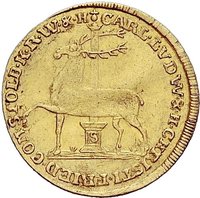
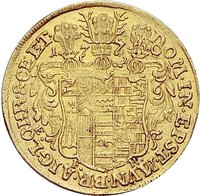
✨ Legendary