

1⁄48 thaler – ERR: County of Stolberg-StolbergandCounty of Stolberg-Rossla
Add to wishlist
Context
Years: 1777–1791
Currency:
Demonetized: Yes
References
KM: #
Numista: #177032
Obverse
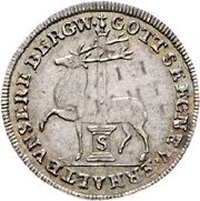
Description:
Stag fled the column.
Designer and engraver: Ernst Friedrich Rupstein
Reverse
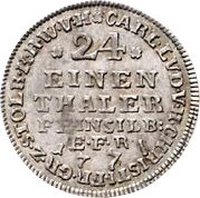
Description:
Value, date.
Designer and engraver: Ernst Friedrich Rupstein
Edge
Mints
| Name | Mark |
|---|---|
| Stolberg, Harz | — |
Mintings
| Year | Mint Mark | Mintage | Quality | Collection |
|---|---|---|---|---|
| 1777 | — | — | ||
| 1791 | — | — |
Historical background
In 1777, the currency situation in the Counties of Stolberg-Stolberg and Stolberg-Rossla was complex, shaped by their political fragmentation and economic integration into the wider Holy Roman Empire. Both counties, ruled by separate branches of the House of Stolberg, were not sovereign states but imperial estates (Reichsstände), which limited their authority to issue their own full-bodied coinage. Consequently, the monetary landscape was dominated by the circulation of numerous external currencies, particularly the large silver Reichsthaler and its fractional Groschen units from neighboring and regional powers like Electoral Saxony and Brandenburg-Prussia. These coins served as the primary medium for larger transactions and trade.
Locally, the counts did exercise the right to mint smaller denomination Scheidemünzen (divisionary coinage), such as Kreuzers and Pfennigs. However, these coins, made from less valuable metals like copper or billon, were intended only for local daily exchange and were not legal tender beyond the counties' borders. This practice was fraught with risk, as the temptation to debase this coinage to generate seigniorage revenue could lead to inflation and loss of public trust, a common problem across the Empire's minor territories.
Ultimately, the monetary system in both Stolbergs in 1777 was characterized by dependency and multiplicity. Residents and merchants had to navigate a confusing array of coins with fluctuating values, relying on published exchange tables (Kursbücher). The lack of a unified, authoritative currency reflected the broader decentralized nature of the Holy Roman Empire, where economic functionality often depended on the stable coinage of larger, more powerful neighbors, while local issuers supplemented the system with often problematic small change.
Locally, the counts did exercise the right to mint smaller denomination Scheidemünzen (divisionary coinage), such as Kreuzers and Pfennigs. However, these coins, made from less valuable metals like copper or billon, were intended only for local daily exchange and were not legal tender beyond the counties' borders. This practice was fraught with risk, as the temptation to debase this coinage to generate seigniorage revenue could lead to inflation and loss of public trust, a common problem across the Empire's minor territories.
Ultimately, the monetary system in both Stolbergs in 1777 was characterized by dependency and multiplicity. Residents and merchants had to navigate a confusing array of coins with fluctuating values, relying on published exchange tables (Kursbücher). The lack of a unified, authoritative currency reflected the broader decentralized nature of the Holy Roman Empire, where economic functionality often depended on the stable coinage of larger, more powerful neighbors, while local issuers supplemented the system with often problematic small change.

✨ Legendary