Logo Title
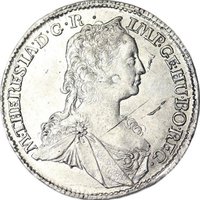
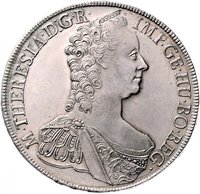
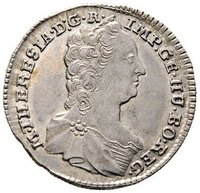
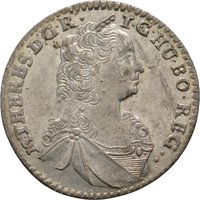
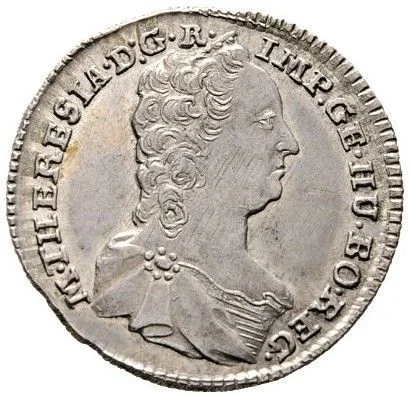
obverse
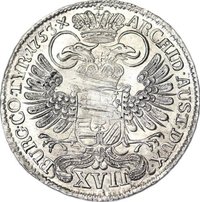
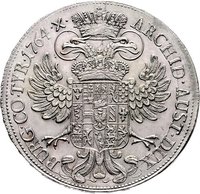
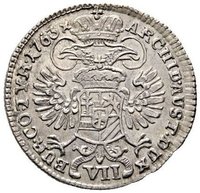
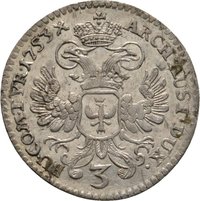
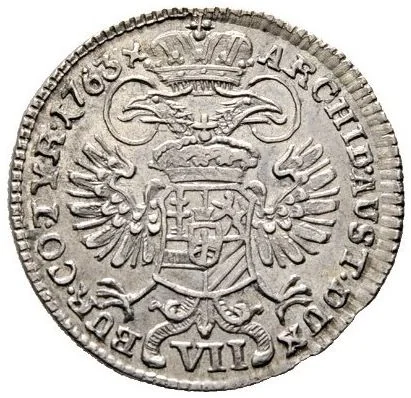
reverse
H. D. Rauch
Context
Years: 1751–1763
Country: Austria Country flag
Currency:
Demonetized: Yes
Material
Diameter: 24 mm
Weight: 3.25 g
Shape: Round
Composition: Billon (42% Silver)
References
KM: #Click to copy to clipboard1805
Numista: #167946

Obverse

Description:
Right-facing portrait, legend begins at 8 o'clock.
Inscription:
M THERESIA D G R IMP GE HU BO REG
Script: Latin

Reverse

Description:
Imperial eagle with fourfold arms and a central Tyrol shield, value in Roman numerals below.
Inscription:
ARCHID AUST DUX BUR CO TYR 1763X

VII
Script: Latin

Edge

Plain

Mints

NameMark
Hall

Mintings

YearMint MarkMintageQualityCollection
1751
1752
1753
1754
1760
1761
1762
1763

Historical background

In 1751, the County of Tyrol, a strategic Alpine territory of the Habsburg Monarchy, operated within a complex and fragmented monetary landscape. The region did not have a uniform, exclusive currency but was part of the broader Austrian monetary system, where the standard unit was the Conventionsthaler. However, Tyrol's economy was heavily influenced by its proximity to the German states and Italian principalities, leading to a circulation of diverse coins including Reichsthalers, Kreuzers, and even Venetian ducats. This multiplicity of coins, each with varying metallic content and value, created chronic confusion and hindered trade, a common problem across Europe before standardization.

The Habsburg state was actively attempting to impose order through monetary conventions, most notably the Conventionsmünzfuß of 1750/1753, which standardized the silver content of the Conventionsthaler across the monarchy. In Tyrol, the official currency was thus reckoned in Gulden (florins), each divided into 60 Kreuzer, with 2 Gulden equal to 1 Conventionsthaler. Despite this official framework, the practical reality in market towns like Innsbruck and Bolzano was one of calculation chaos, as merchants and citizens constantly had to assess and exchange a bewildering array of domestic and foreign coins, often at fluctuating rates.

This situation placed a significant burden on commerce and administration within the county. The Habsburg authorities recognized that monetary instability could lead to economic weakness and reduced state revenue from the strategically vital Tyrolean transit trade. Therefore, the period around 1751 was one of transition and enforcement, as Vienna sought to strengthen the use of its standardized Convention currency within Tyrol, aiming to suppress the circulation of inferior foreign coins and simplify the monetary system to better integrate the county's economy into the imperial whole and facilitate tax collection.

Series: 1751 County of Tyrol circulation coins

17 Kreuzer obverse
17 Kreuzer reverse
17 Kreuzer
1751-1763
1 Thaler obverse
1 Thaler reverse
1 Thaler
1751-1753
1 Thaler obverse
1 Thaler reverse
1 Thaler
1751-1765
7 Kreuzer obverse
7 Kreuzer reverse
7 Kreuzer
1751-1763
Legendary