

10 Florins – Hungary
Hungary

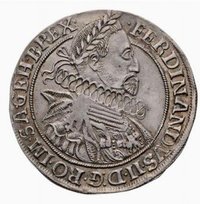
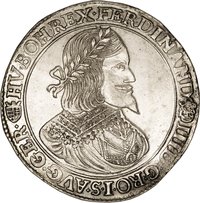
Obverse
Description:
Right-facing laureate bust with curls, necklace, and Golden Fleece ring; behind neck, crowned double Hungarian shield; on right, Madonna on crescent.
Inscription:
FERDINAND D · G · RO · I · S · AVG · GER · HVN BOH · REX
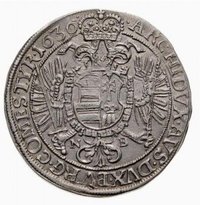
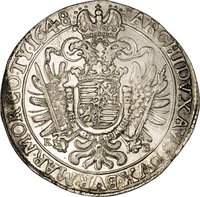
Reverse
Description:
Imperial double-headed eagle with sword and scepter, holding a quartered shield (Árpád stripes, Bohemian lion twice, Árpád stripes) with an inescutcheon of Austrian and Burgundian arms. Mintmark below.
Inscription:
ARCHIDVX · AVS · DVX · BVR · MAR · MOR · CO · TYR · 1636 ·
K B
K B
Edge
Plain
Mints
| Name | Mark |
|---|---|
| Kremnica | KB |
Mintings
| Year | Mint Mark | Mintage | Quality | Collection |
|---|---|---|---|---|
| 1637 | K-B | — |
Historical background
In 1637, Hungary existed as a fractured kingdom, divided into three parts: Royal Hungary under Habsburg rule in the west and north, Ottoman-occupied central Hungary, and the semi-independent Principality of Transylvania in the east. This political fragmentation directly caused a chaotic and multi-layered currency situation. The Habsburgs minted silver thalers and smaller denars in Royal Hungary, while the Ottomans circulated their own silver akçe and gold sultani. Furthermore, a flood of debased copper coinage, known as krajcár, was intentionally introduced by the Habsburg court in Vienna to finance its ongoing wars in the Thirty Years' War, leading to severe inflation and economic hardship within their territory.
The circulation of these diverse coins knew no borders, creating a complex and unstable monetary environment across the entire region. Merchants and peasants alike had to navigate a bewildering array of coins with fluctuating metallic values and exchange rates. The pervasive Habsburg copper small coinage was particularly disruptive, as its face value drastically exceeded its intrinsic metal worth, driving good silver money out of circulation (Gresham's Law) and eroding public trust. This "coinage exploitation" was a blunt fiscal instrument for Vienna, extracting resources from Hungary to fund conflicts elsewhere.
Consequently, the year 1637 fell within a prolonged period of monetary disorder that stifled trade and burdened the population. In Royal Hungary, estates and cities frequently protested the debilitating influx of copper coins, but with limited success. Meanwhile, in Transylvania and Ottoman-held areas, different but parallel systems of coinage and valuation operated, though they were also affected by the region-wide competition between debased and sound money. This turbulent background set the stage for future economic crises and continued to exacerbate the tensions between the Hungarian estates and their Habsburg sovereigns.
The circulation of these diverse coins knew no borders, creating a complex and unstable monetary environment across the entire region. Merchants and peasants alike had to navigate a bewildering array of coins with fluctuating metallic values and exchange rates. The pervasive Habsburg copper small coinage was particularly disruptive, as its face value drastically exceeded its intrinsic metal worth, driving good silver money out of circulation (Gresham's Law) and eroding public trust. This "coinage exploitation" was a blunt fiscal instrument for Vienna, extracting resources from Hungary to fund conflicts elsewhere.
Consequently, the year 1637 fell within a prolonged period of monetary disorder that stifled trade and burdened the population. In Royal Hungary, estates and cities frequently protested the debilitating influx of copper coins, but with limited success. Meanwhile, in Transylvania and Ottoman-held areas, different but parallel systems of coinage and valuation operated, though they were also affected by the region-wide competition between debased and sound money. This turbulent background set the stage for future economic crises and continued to exacerbate the tensions between the Hungarian estates and their Habsburg sovereigns.
✨ Legendary