

1 Thaler – Hungary
Hungary
Context
Years: 1638–1659
Issuer: Hungary 
Ruler: Ferdinand III
Currency:
(1526—1754)
Demonetized: Yes
Total mintage: 2,671,000
Material
References
KM: #Click to copy to clipboard107
Numista: #33905
Value
Bullion value: $73.22
Obverse
Description:
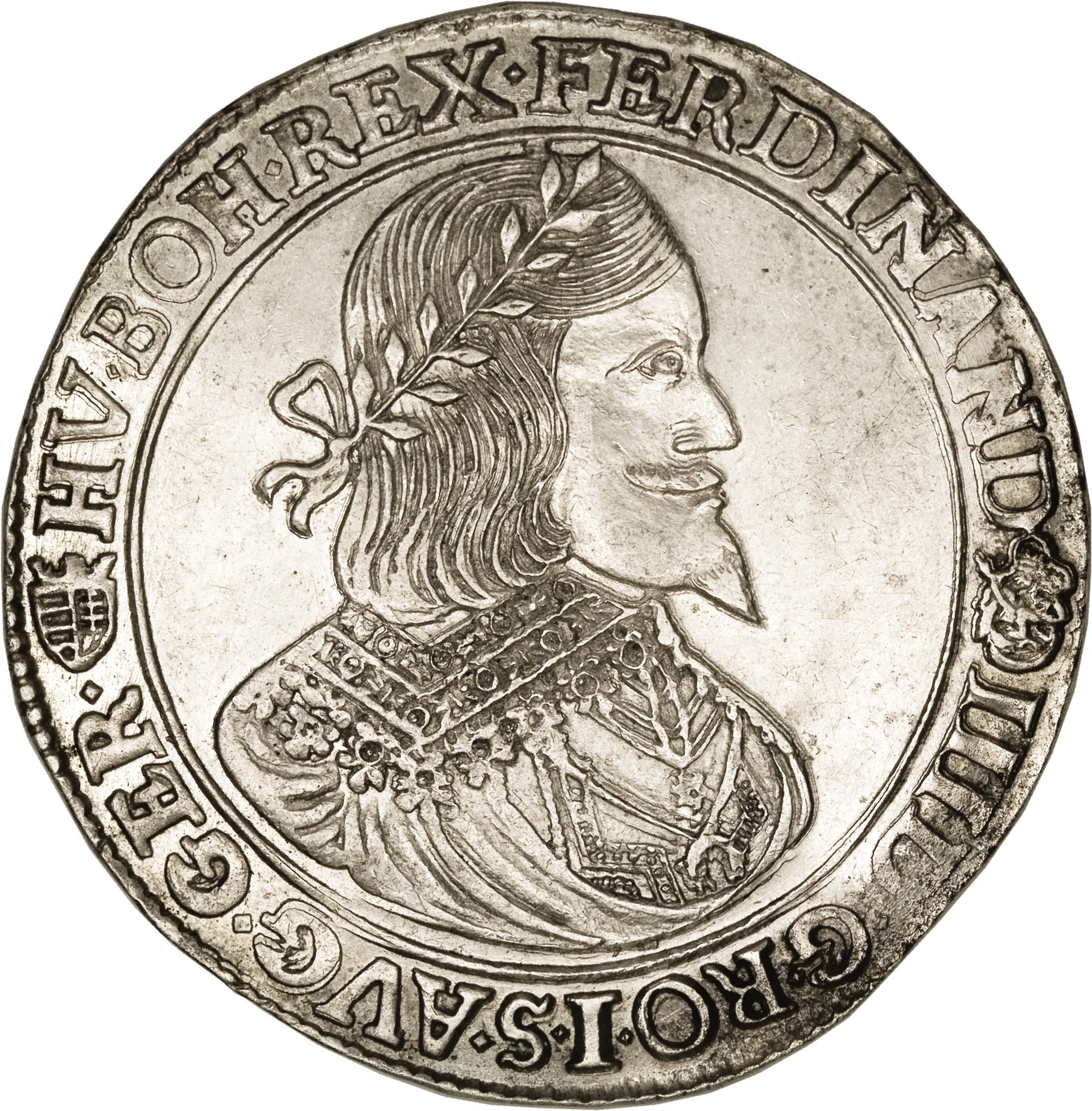
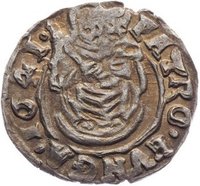
Right-facing laureate bust with curls, necklace, and Golden Fleece ring; behind neck, crowned double Hungarian shield; on right, Madonna on crescent.
Inscription:
FERDINAND III · D : G · RO · I · S · AVG · GER HV · BO · REX ·
Script: Latin
Reverse
Description:
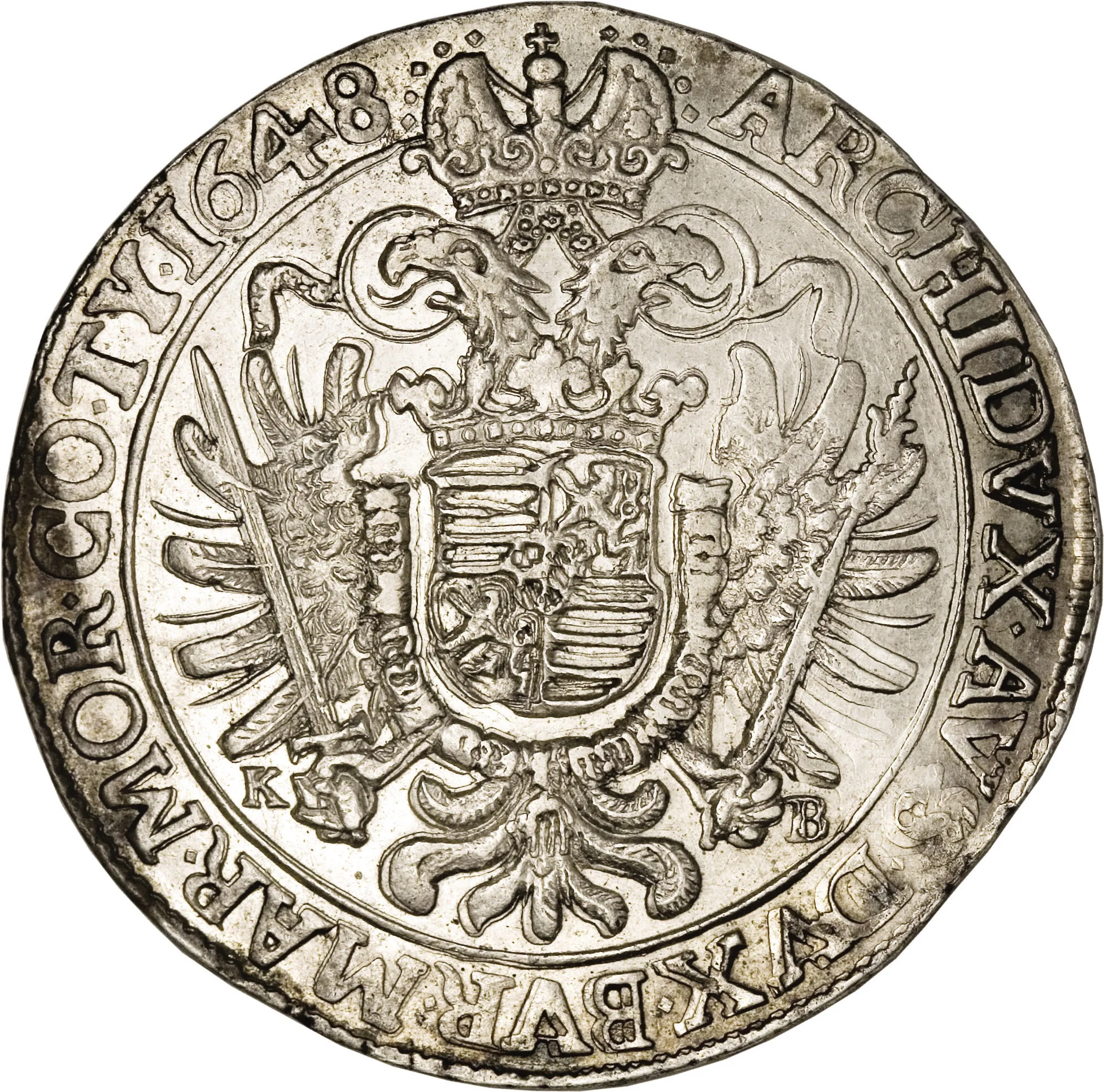
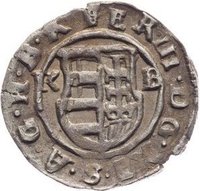
Imperial double-headed eagle with sword and scepter, holding a quartered shield (Árpád stripes, Bohemian lion twice, Árpád stripes) with an inescutcheon of Austrian and Burgundian arms. Mintmark below.
Inscription:
ARCHIDVX · AVS · DVX · BVR · MAR · MOR · CO · TYR · 1648 ·
Script: Latin
Edge
Plain
Mints
| Name | Mark |
|---|---|
| Kremnica | KB |
Mintings
| Year | Mint Mark | Mintage | Quality | Collection |
|---|---|---|---|---|
| 1638 | K-B | 22,000 | ||
| 1639 | K-B | 13,000 | ||
| 1640 | K-B | 24,000 | ||
| 1641 | K-B | 59,000 | ||
| 1642 | K-B | 29,000 | ||
| 1643 | K-B | 30,000 | ||
| 1644 | K-B | — | ||
| 1645 | K-B | — | ||
| 1646 | K-B | — | ||
| 1647 | K-B | — | ||
| 1648 | K-B | 140,000 | ||
| 1649 | K-B | 261,000 | ||
| 1650 | K-B | 281,000 | ||
| 1651 | K-B | 305,000 | ||
| 1652 | K-B | — | ||
| 1653 | K-B | 367,000 | ||
| 1654 | K-B | 385,000 | ||
| 1655 | K-B | — | ||
| 1656 | K-B | 390,000 | ||
| 1657 | K-B | 365,000 | ||
| 1658 | K-Bv | — | ||
| 1659 | K-Bv | — |
Historical background
In 1638, Hungary existed as a fractured kingdom divided into three parts: Royal Hungary under Habsburg rule, Ottoman-occupied central Hungary, and the semi-independent Principality of Transylvania. This political fragmentation directly dictated a chaotic and multi-layered currency situation. The Habsburgs, ruling from Pressburg (Bratislava), introduced their own silver thaler (or forint) and copper krajcár from mints in Körmöcbánya (Kremnica), aiming to standardize the economy of their territory. However, these coins competed not only with older, worn Hungarian denars but also with a flood of foreign coins, particularly lightweight Polish and Dutch groszy and stuivers, which circulated widely due to intense trade and military activity.
Simultaneously, the Ottoman-occupied regions saw the heavy circulation of Turkish silver akçe and gold sultani, though their value was often degraded due to the Porte's own fiscal strains. Most disruptive, however, was the massive influx of cheap, small-denomination copper coinage from Transylvania. Under Prince György Rákóczi I, the Transylvanian mints at Nagybánya (Baia Mare) and Szeben (Sibiu) engaged in deliberate currency debasement, producing vast quantities of low-value copper coins to finance the principality's military and administrative costs. These coins, known as poltura, flooded all Hungarian territories, driving better-quality silver coins out of circulation (Gresham's Law).
Consequently, the year 1638 fell within a period of severe monetary instability and price inflation, often called the "age of copper currency." The coexistence of Habsburg, Ottoman, Transylvanian, and various European coins, all with fluctuating intrinsic values, created a bewildering and inefficient monetary environment. This chaos hampered commerce, eroded trust, and placed a heavy burden on the peasantry and soldiers who were often paid in the most debased coinage, reflecting the broader economic distress of a country serving as a perpetual battlefield and contested zone between empires.
Simultaneously, the Ottoman-occupied regions saw the heavy circulation of Turkish silver akçe and gold sultani, though their value was often degraded due to the Porte's own fiscal strains. Most disruptive, however, was the massive influx of cheap, small-denomination copper coinage from Transylvania. Under Prince György Rákóczi I, the Transylvanian mints at Nagybánya (Baia Mare) and Szeben (Sibiu) engaged in deliberate currency debasement, producing vast quantities of low-value copper coins to finance the principality's military and administrative costs. These coins, known as poltura, flooded all Hungarian territories, driving better-quality silver coins out of circulation (Gresham's Law).
Consequently, the year 1638 fell within a period of severe monetary instability and price inflation, often called the "age of copper currency." The coexistence of Habsburg, Ottoman, Transylvanian, and various European coins, all with fluctuating intrinsic values, created a bewildering and inefficient monetary environment. This chaos hampered commerce, eroded trust, and placed a heavy burden on the peasantry and soldiers who were often paid in the most debased coinage, reflecting the broader economic distress of a country serving as a perpetual battlefield and contested zone between empires.

💎 Extremely Rare