

1 Thaler – Hungary
Hungary

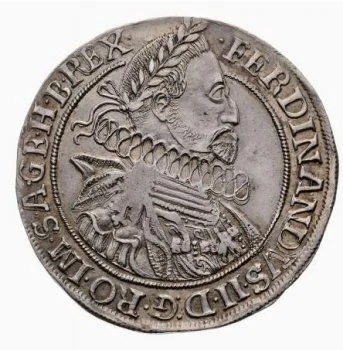
Obverse
Description:
Laureate bust right with curls, necklace, and Golden Fleece ring. Portrait extends beyond inner circle; armor has floral decoration.
Inscription:
FERDINANDVS · II · D · G · R · I · S · AVG · GER · HVN · BOH · REX *
Script: Latin
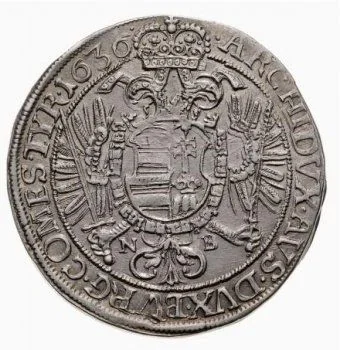
Reverse
Description:
Imperial double-headed eagle with sword and scepter, bearing the uncrowned Hungarian coat of arms (Árpád stripes, double cross on triple hill) without a central shield. Mintmark at eagle's feet.
Inscription:
ARCHIDVX · AVS · DVX · BVRG · COMES · TYR · 1636 ·
N B
N B
Script: Latin
Edge
Plain
Mints
| Name | Mark |
|---|---|
| Baia Mare | NB |
Mintings
| Year | Mint Mark | Mintage | Quality | Collection |
|---|---|---|---|---|
| 1636 | N-B | — |
Historical background
In 1636, Hungary existed as a divided kingdom, a reality that directly shaped its chaotic currency situation. The central territories were under Habsburg rule, the east was the Principality of Transylvania (often an Ottoman vassal), and the south was under direct Ottoman control. This tripartite division meant there was no unified Hungarian monetary policy. Instead, the region became a battleground for circulating currencies, primarily the silver thaler from the Habsburg mints (like those of Körmöcbánya), the Hungarian denarius (a debased silver coin), and various Ottoman coins like the akçe. The ongoing Fifteen Years' War (1591-1606) and subsequent conflicts had devastated the economy, leading to severe currency debasement to fund military expenses.
The Habsburg rulers, particularly Ferdinand II (1619–1637), repeatedly debased the silver coinage to pay for the costs of the Thirty Years' War and conflicts with the Ottomans. This resulted in a drastic decline in the precious metal content of the coins minted in Royal Hungary, such as the so-called krajcár. The official response was the attempted enforcement of valorisation laws, which set arbitrary exchange rates between older, purer coins and the new, weaker ones. However, these laws were largely ineffective in practice, creating a confusing multi-tier system where coins traded not by face value but by their actual weight and silver content, a process known as "agio."
Consequently, the monetary landscape was one of profound instability and complexity. Merchants and the populace faced constant uncertainty, hoarding older, purer coins and driving good money out of circulation—a manifestation of Gresham's Law. Prices fluctuated wildly, and barter became a necessary alternative in many areas, especially the war-ravaged countryside. This currency chaos stifled trade, deepened economic hardship, and weakened the authority of the Habsburg crown in its own realm, as both local estates and ordinary subjects suffered from the inflationary effects of the debased coinage.
The Habsburg rulers, particularly Ferdinand II (1619–1637), repeatedly debased the silver coinage to pay for the costs of the Thirty Years' War and conflicts with the Ottomans. This resulted in a drastic decline in the precious metal content of the coins minted in Royal Hungary, such as the so-called krajcár. The official response was the attempted enforcement of valorisation laws, which set arbitrary exchange rates between older, purer coins and the new, weaker ones. However, these laws were largely ineffective in practice, creating a confusing multi-tier system where coins traded not by face value but by their actual weight and silver content, a process known as "agio."
Consequently, the monetary landscape was one of profound instability and complexity. Merchants and the populace faced constant uncertainty, hoarding older, purer coins and driving good money out of circulation—a manifestation of Gresham's Law. Prices fluctuated wildly, and barter became a necessary alternative in many areas, especially the war-ravaged countryside. This currency chaos stifled trade, deepened economic hardship, and weakened the authority of the Habsburg crown in its own realm, as both local estates and ordinary subjects suffered from the inflationary effects of the debased coinage.

✨ Legendary