

5 Florins – Hungary
Hungary

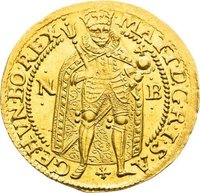
Obverse
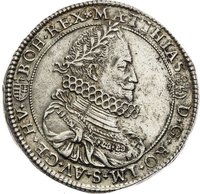
Description:
Laureate head of Matthias facing right, wearing Golden Fleece necklace.
Inscription:
MATTHIAS · D · G · RO · I · S · AV · GE · HVN · BO · R *
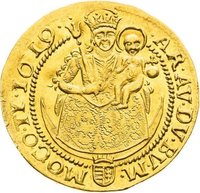
Reverse
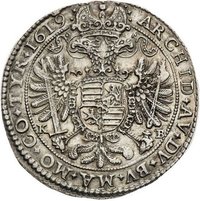
Description:
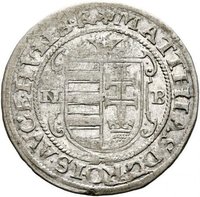
The crowned Hungarian coat of arms in a cartouche divides the mintmark.
Inscription:
AR · AV · DVX · BVR · MAR · MO · CO · TY · 1617
Edge
Plain
Mints
| Name | Mark |
|---|---|
| Baia Mare | NB |
Mintings
| Year | Mint Mark | Mintage | Quality | Collection |
|---|---|---|---|---|
| 1617 | N-B | — |
Historical background
In 1617, the Kingdom of Hungary was in the midst of a severe and prolonged currency crisis, a direct consequence of the Ottoman-Habsburg wars that had fractured the realm. The country was divided into three parts: Royal Hungary under Habsburg rule, the Ottoman-occupied central territories, and the semi-independent Principality of Transylvania. This political fragmentation led to a chaotic monetary landscape, with at least three different minting authorities—the Habsburgs, the Transylvanian princes, and the Ottoman Empire—issuing coins that circulated simultaneously, often at wildly fluctuating values.
The core of the crisis was the systematic debasement of silver coinage, particularly the denarius (denar). To finance continuous military campaigns, the Habsburg treasury in Vienna, which controlled the Körmöcbánya (Kremnica) mint, repeatedly reduced the silver content of coins struck for Hungary. By 1617, the silver content of these coins had fallen to a mere fraction of their nominal value, leading to rampant inflation and a loss of public trust. People hoarded older, purer coins, driving them out of circulation—a classic example of Gresham’s Law where "bad money drives out good."
This monetary instability severely disrupted the Hungarian economy, crippling trade and imposing a hidden tax on the population, especially the peasantry. The crisis also became a major point of political contention between the Habsburg monarchy and the Hungarian estates, who saw the debasement as a violation of their rights and a cause of widespread economic hardship. The currency chaos of 1617 was therefore not merely a financial issue but a key symptom of the deeper political and military conflicts that defined 17th-century Hungary.
The core of the crisis was the systematic debasement of silver coinage, particularly the denarius (denar). To finance continuous military campaigns, the Habsburg treasury in Vienna, which controlled the Körmöcbánya (Kremnica) mint, repeatedly reduced the silver content of coins struck for Hungary. By 1617, the silver content of these coins had fallen to a mere fraction of their nominal value, leading to rampant inflation and a loss of public trust. People hoarded older, purer coins, driving them out of circulation—a classic example of Gresham’s Law where "bad money drives out good."
This monetary instability severely disrupted the Hungarian economy, crippling trade and imposing a hidden tax on the population, especially the peasantry. The crisis also became a major point of political contention between the Habsburg monarchy and the Hungarian estates, who saw the debasement as a violation of their rights and a cause of widespread economic hardship. The currency chaos of 1617 was therefore not merely a financial issue but a key symptom of the deeper political and military conflicts that defined 17th-century Hungary.
Series: 1617 Hungary circulation coins

✨ Legendary