

1 Denier – Hungary
Hungary
Context
Years: 1619–1625
Issuer: Hungary 
Ruler: Ferdinand II
Currency:
(1526—1754)
Demonetized: Yes
Total mintage: 38,805,000
Material
Diameter: 14 mm
Weight: 0.56 g
Shape: Irregular round
Alignment: Coin alignment
flip
References
KM: #Click to copy to clipboard63
Numista: #36391
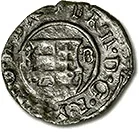
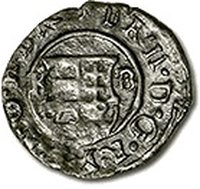
Obverse
Description:
Curved Hungarian shield divides mintmark.
Inscription:
FER · II · D · G · R · I · S · A · G · H · B · R ·
K B
K B
Script: Latin
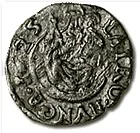
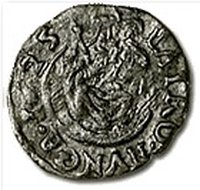
Reverse
Description:
Crowned Madonna holding child and cross, standing on a crescent; dated legend.
Inscription:
PATRO · HVNGA · 1625
Script: Latin
Edge
Plain
Mints
| Name | Mark |
|---|---|
| Kremnica | KB |
Mintings
| Year | Mint Mark | Mintage | Quality | Collection |
|---|---|---|---|---|
| 1619 | K-B | 21,490,000 | ||
| 1620 | K-B | 17,315,000 | ||
| 1621 | K-B | — | ||
| 1622 | K-B | — | ||
| 1623 | K-B | — | ||
| 1624 | K-B | — | ||
| 1625 | K-B | — |
Historical background
In 1619, Hungary existed as a multi-ethnic kingdom divided into three parts: Royal Hungary under Habsburg rule, Ottoman-occupied central Hungary, and the semi-independent Principality of Transylvania. This political fragmentation was mirrored in its monetary chaos. The kingdom lacked a unified, stable currency, with various domestic and foreign coins circulating simultaneously. The primary official coin was the silver tallér (thaler), but the everyday currency for most transactions was the small silver denár (denarius), which had been severely debased over decades. The Habsburg government, perpetually short of funds due to ongoing wars with the Ottomans and internal conflicts, repeatedly reduced the silver content of these coins to fund military campaigns, leading to rampant inflation and a loss of public trust.
The monetary situation was further complicated by the circulation of large quantities of foreign coins, particularly Turkish akçe in occupied territories and high-quality Dutch thalers and German Reichsthalers in royal territories. These foreign coins, often with higher intrinsic silver value, drove the better Hungarian coins out of circulation, in line with Gresham's Law ("bad money drives out good"). This created a complex and unreliable exchange environment where the value of money was in constant flux, harming trade and ordinary people whose wages and savings were eroded. The Habsburg authorities' attempts to fix exchange rates by decree were largely ineffective against market forces.
This currency instability was not merely an economic issue but a deeply political one. It fueled widespread discontent among the Hungarian estates and nobility against Habsburg fiscal policies. The debasement was seen as a unilateral exploitation by Vienna, contributing to the rising tensions that would soon erupt into open rebellion under leaders like Gabriel Bethlen, Prince of Transylvania. Bethlen, who allied with Protestant anti-Habsburg forces during the Thirty Years' War, even issued his own stable currency in Transylvania, providing a stark contrast to the Habsburg coinage and strengthening his political position. Thus, in 1619, Hungary's currency crisis was a key symptom of the kingdom's deeper struggle over sovereignty, control, and economic survival.
The monetary situation was further complicated by the circulation of large quantities of foreign coins, particularly Turkish akçe in occupied territories and high-quality Dutch thalers and German Reichsthalers in royal territories. These foreign coins, often with higher intrinsic silver value, drove the better Hungarian coins out of circulation, in line with Gresham's Law ("bad money drives out good"). This created a complex and unreliable exchange environment where the value of money was in constant flux, harming trade and ordinary people whose wages and savings were eroded. The Habsburg authorities' attempts to fix exchange rates by decree were largely ineffective against market forces.
This currency instability was not merely an economic issue but a deeply political one. It fueled widespread discontent among the Hungarian estates and nobility against Habsburg fiscal policies. The debasement was seen as a unilateral exploitation by Vienna, contributing to the rising tensions that would soon erupt into open rebellion under leaders like Gabriel Bethlen, Prince of Transylvania. Bethlen, who allied with Protestant anti-Habsburg forces during the Thirty Years' War, even issued his own stable currency in Transylvania, providing a stark contrast to the Habsburg coinage and strengthening his political position. Thus, in 1619, Hungary's currency crisis was a key symptom of the kingdom's deeper struggle over sovereignty, control, and economic survival.

⭐ Rare