

2 Thalers – Hungary
Hungary

Obverse
Description:
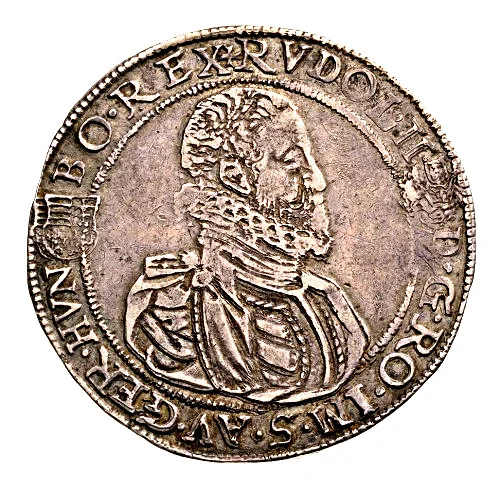
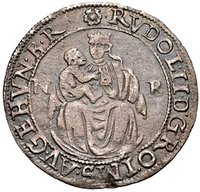
Armored bust facing right in ruffled collar, with pearl ring inscription. Smaller Hungarian coat of arms behind neck; Madonna and child on crescent to the right.
Inscription:
+ RVDOL·II· - D·G·RO·IM·S·AV·GER·HVN· - BOE·REX
Script: Latin
Reverse
Description:
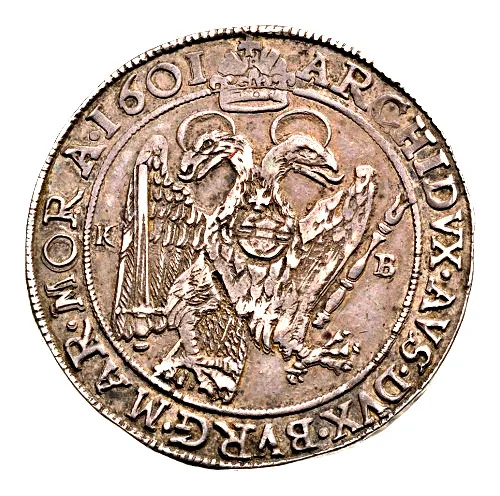
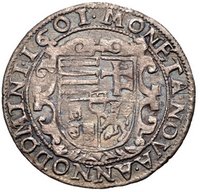
Double-headed Habsburg eagle with crown, holding a sword and scepter, and bearing the Hungarian Orb on its chest.
Inscription:
* ARCHIDVX · AVS · DVX · BVRG · MAR · MORA · 1601 *
K B
K B
Script: Latin
Edge
Plain
Mints
| Name | Mark |
|---|---|
| Kremnica | KB |
Mintings
| Year | Mint Mark | Mintage | Quality | Collection |
|---|---|---|---|---|
| 1599 | K | — | ||
| 1601 | K | — |
Historical background
In 1599, Hungary existed as a fractured and war-torn kingdom, its monetary situation a direct reflection of its political chaos. The realm was divided into three parts: Royal Hungary under Habsburg rule in the west and north, the Ottoman-occupied central region, and the semi-independent Principality of Transylvania in the east. This tripartite division meant there was no unified Hungarian currency system. Instead, the region was a monetary crossroads where Habsburg thalers, Ottoman akçes, and various Transylvanian and older Hungarian coins all circulated, their values fluctuating based on political and military fortunes rather than a central authority.
The primary currency in the Habsburg-ruled territories was the silver thaler (or Tallér), but its circulation was plagued by severe debasement. To finance the ongoing Long Turkish War (1593-1606), the Habsburg authorities, particularly under Emperor Rudolf II, repeatedly reduced the silver content of lower-denomination coins like denars and kreutzers minted in Nagybánya (today Baia Mare, Romania) and other royal mints. This led to rampant inflation, price instability, and a classic "bad money drives out good" scenario, where older, full-value coins were hoarded or melted down.
In Transylvania, Prince Sigismund Báthory, whose political allegiances wavered between the Habsburgs and the Ottomans, minted his own currency at the Gyulafehérvár (Alba Iulia) mint. However, the pressures of war and tribute payments to the Ottoman Porte also led to significant debasement there. Consequently, across all of Hungary, the populace faced a confusing and unreliable monetary environment, relying heavily on barter in daily rural life and on full-weight foreign silver coins like the Austrian thaler or the Dutch leeuwendaalder for any substantial trade, further undermining local economic sovereignty.
The primary currency in the Habsburg-ruled territories was the silver thaler (or Tallér), but its circulation was plagued by severe debasement. To finance the ongoing Long Turkish War (1593-1606), the Habsburg authorities, particularly under Emperor Rudolf II, repeatedly reduced the silver content of lower-denomination coins like denars and kreutzers minted in Nagybánya (today Baia Mare, Romania) and other royal mints. This led to rampant inflation, price instability, and a classic "bad money drives out good" scenario, where older, full-value coins were hoarded or melted down.
In Transylvania, Prince Sigismund Báthory, whose political allegiances wavered between the Habsburgs and the Ottomans, minted his own currency at the Gyulafehérvár (Alba Iulia) mint. However, the pressures of war and tribute payments to the Ottoman Porte also led to significant debasement there. Consequently, across all of Hungary, the populace faced a confusing and unreliable monetary environment, relying heavily on barter in daily rural life and on full-weight foreign silver coins like the Austrian thaler or the Dutch leeuwendaalder for any substantial trade, further undermining local economic sovereignty.
✨ Legendary