

1 Thaler – Austrian Empire
Austria
Context
Years: 1644–1650
Country: Austria 
Issuer: Austrian Empire
Ruler: Ferdinand III
Currency:
(1520—1754)
Demonetized: Yes
References
KM: #Click to copy to clipboard920
Numista: #165657
Obverse
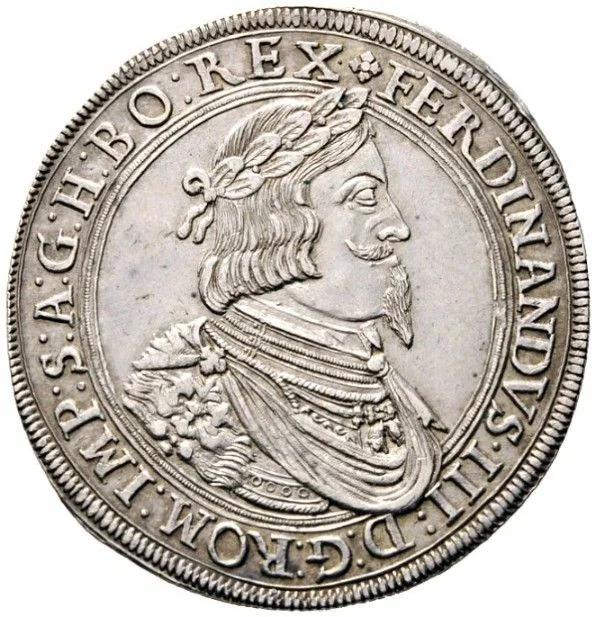
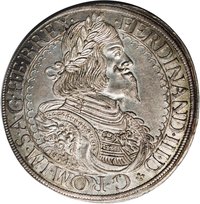
Description:
Laureate facing right, triple inner circle.
Inscription:
FERDINANDVS III D G ROM IMP S A G H BO REX
Script: Latin
Reverse
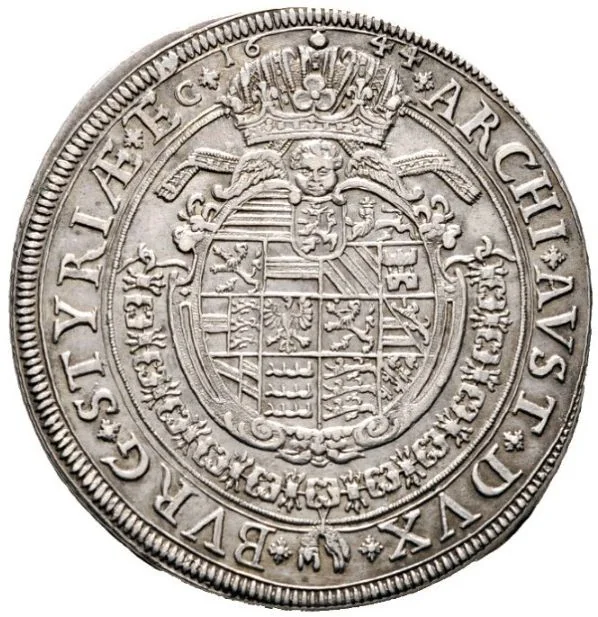
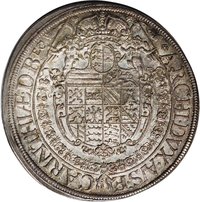
Description:
Arms with oval crown, small Styria shield (fire-spitting panther) above, within baroque frame and Golden Fleece chain, all in a circle. Crown breaks circle and legend. Date above. Legend from 1h: "Archidux Austriae Dux Burgundiae Styriae Etc".
Inscription:
ARCHI AVST DVX // BVR STYRIÆ ETC
Script: Latin
Edge
Mints
| Name | Mark |
|---|---|
| Graz | — |
Mintings
| Year | Mint Mark | Mintage | Quality | Collection |
|---|---|---|---|---|
| 1644 | — | — | ||
| 1646 | — | — | ||
| 1650 | — | — |
Historical background
In 1644, the Austrian Habsburg monarchy was embroiled in the final, devastating stages of the Thirty Years' War (1618-1648). The financial demands of maintaining large mercenary armies were catastrophic, leading to a state of near-permanent fiscal crisis. The traditional revenue from crown lands and taxes was utterly insufficient, forcing the emperors to rely heavily on loans from bankers and, most destructively, on the repeated debasement of the coinage. This practice, particularly of the small-denomination Kreuzer and Groschen used in daily life, became a primary tool of war finance, eroding the empire's monetary system.
The currency situation was one of extreme complexity and chaos. There was no single, unified Austrian currency; instead, a bewildering array of coins circulated, including imperial Reichsthalers, regional Guldens, and countless smaller coins minted by various Habsburg territories and even by autonomous cities. The heart of the crisis was the drastic reduction in the silver content of these coins through official debasement. As the Vienna mint produced vast quantities of "light" or "bad" coin, their real value plummeted, leading to rampant inflation. This triggered Gresham's Law in action, where "good" full-weight coins were hoarded or exported, leaving only the devalued money in circulation, further harming peasants, wage-earners, and soldiers paid in this degraded currency.
Efforts to control the situation, such as repeated minting ordinances that set official exchange rates between different coins, largely failed. These decrees, issued from Prague or Vienna, could not keep pace with market realities and were often ignored. The result was a severe loss of public trust in the currency, a thriving black market in money exchange, and deep economic hardship across the hereditary lands. The monetary disorder of 1644 was thus a direct reflection of the empire's desperate struggle for survival, with the state essentially funding its war effort through a hidden tax on the populace via inflation, destabilizing the economy for decades to come.
The currency situation was one of extreme complexity and chaos. There was no single, unified Austrian currency; instead, a bewildering array of coins circulated, including imperial Reichsthalers, regional Guldens, and countless smaller coins minted by various Habsburg territories and even by autonomous cities. The heart of the crisis was the drastic reduction in the silver content of these coins through official debasement. As the Vienna mint produced vast quantities of "light" or "bad" coin, their real value plummeted, leading to rampant inflation. This triggered Gresham's Law in action, where "good" full-weight coins were hoarded or exported, leaving only the devalued money in circulation, further harming peasants, wage-earners, and soldiers paid in this degraded currency.
Efforts to control the situation, such as repeated minting ordinances that set official exchange rates between different coins, largely failed. These decrees, issued from Prague or Vienna, could not keep pace with market realities and were often ignored. The result was a severe loss of public trust in the currency, a thriving black market in money exchange, and deep economic hardship across the hereditary lands. The monetary disorder of 1644 was thus a direct reflection of the empire's desperate struggle for survival, with the state essentially funding its war effort through a hidden tax on the populace via inflation, destabilizing the economy for decades to come.
✨ Legendary