

2 Ducats – Austrian Empire
Austria
Context
Years: 1641–1657
Country: Austria 
Issuer: Austrian Empire
Ruler: Ferdinand III
Currency:
(1520—1754)
Demonetized: Yes
References
KM: #Click to copy to clipboard899
Numista: #92921
Value
Bullion value: $1148.62
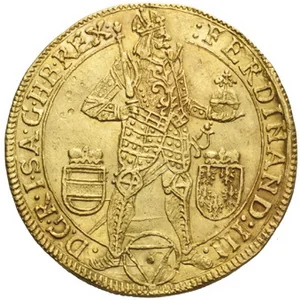
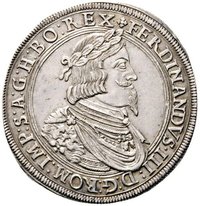
Obverse
Description:
Ferdinand III, central, flanked by shields of Austria and Lower Austria.
Inscription:
FERDINAND III // D G R I S A G H B REX
Script: Latin
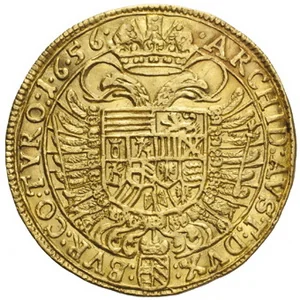
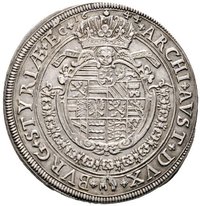
Reverse
Description:
Imperial eagle with composite arms within inner circle.
Inscription:
ARCHID AVST DVX // BVR CO TYR 1656
Script: Latin
Edge
Mints
| Name | Mark |
|---|---|
| Münze Österreich | — |
Mintings
| Year | Mint Mark | Mintage | Quality | Collection |
|---|---|---|---|---|
| 1641 | — | — | ||
| 1642 | — | — | ||
| 1643 | — | — | ||
| 1644 | — | — | ||
| 1645 | — | — | ||
| 1646 | — | — | ||
| 1647 | — | — | ||
| 1648 | — | — | ||
| 1649 | — | — | ||
| 1650 | — | — | ||
| 1652 | — | — | ||
| 1653 | — | — | ||
| 1654 | — | — | ||
| 1656 | — | — | ||
| 1657 | — | — |
Historical background
In 1641, the Habsburg Monarchy, often referred to as the Austrian Empire, was embroiled in the Thirty Years' War (1618-1648), a conflict that placed immense fiscal strain on its finances. The primary currency in circulation was the Reichsthaler, a large silver coin defined by the Imperial Minting Ordinance of 1559. However, the relentless costs of warfare led the Habsburg court in Vienna, under Ferdinand III, to engage in severe currency debasement. The government systematically reduced the silver content in minted coins while mandating they be accepted at their old, higher face value, a short-term measure to fund armies and pay debts that eroded public trust and sparked rampant inflation.
This period saw a chaotic multiplicity of currencies in daily use. Alongside debased imperial thalers, older, heavier "good money" like the Guldengroschen remained hoarded or used in foreign trade, while a flood of lightweight domestic coins, often small Kreuzers and Groschen, fueled local markets. Furthermore, various Habsburg crown lands (such as Bohemia and Hungary) and even individual cities retained minting rights, issuing their own often-debased subsidiary coinage. The result was a complex and unstable monetary environment where the real value of a coin depended heavily on its origin, age, and metal content, requiring money changers to be ubiquitous.
The economic consequences were severe. Price inflation hit the populace hard, particularly peasants and soldiers paid in devalued currency, while creditors and those on fixed incomes were ruined. This monetary instability weakened the overall Habsburg economy, hindering commerce and deepening the social misery caused by decades of war. The situation in 1641 was therefore one of acute crisis, characterized by a state-driven erosion of currency integrity that undermined economic stability and highlighted the desperate financial extremities of the empire during the war's final, brutal phase.
This period saw a chaotic multiplicity of currencies in daily use. Alongside debased imperial thalers, older, heavier "good money" like the Guldengroschen remained hoarded or used in foreign trade, while a flood of lightweight domestic coins, often small Kreuzers and Groschen, fueled local markets. Furthermore, various Habsburg crown lands (such as Bohemia and Hungary) and even individual cities retained minting rights, issuing their own often-debased subsidiary coinage. The result was a complex and unstable monetary environment where the real value of a coin depended heavily on its origin, age, and metal content, requiring money changers to be ubiquitous.
The economic consequences were severe. Price inflation hit the populace hard, particularly peasants and soldiers paid in devalued currency, while creditors and those on fixed incomes were ruined. This monetary instability weakened the overall Habsburg economy, hindering commerce and deepening the social misery caused by decades of war. The situation in 1641 was therefore one of acute crisis, characterized by a state-driven erosion of currency integrity that undermined economic stability and highlighted the desperate financial extremities of the empire during the war's final, brutal phase.
✨ Legendary