

3 kreuzers – Further Austria
Add to wishlist
Austria
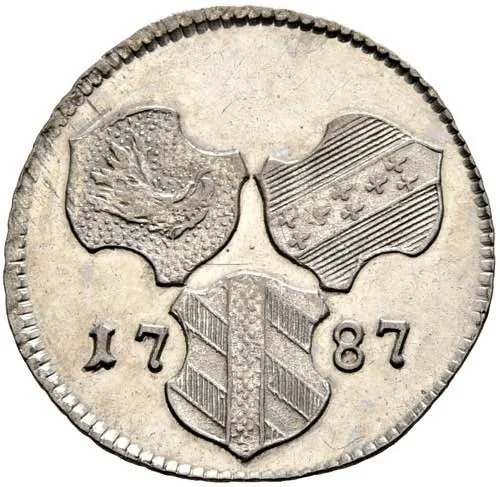
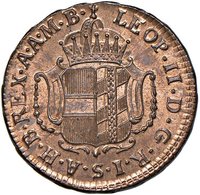
Obverse
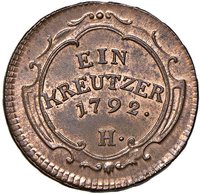
Reverse
Description:
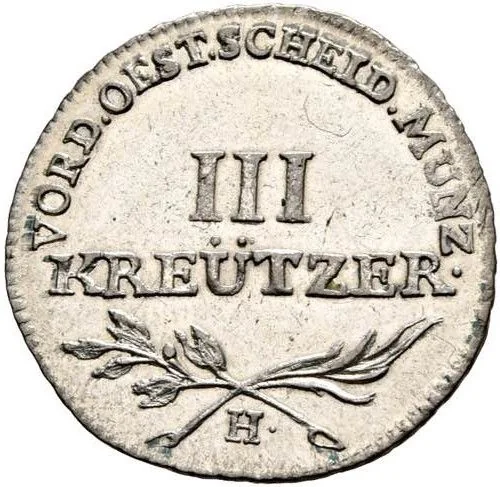
Crossed laurel and palm branches below, with the mintmark in the exergue. Value in center, legend around.
Inscription:
VORD OEST SCHEID MUNZ
III
KREUTZER
H
III
KREUTZER
H
Script: Latin
Edge
Plain
Categories
| Symbols> Coat of Arms |
Historical background
In 1786, the currency situation in Further Austria (Vorderösterreich) was characterized by complexity and fragmentation, a direct reflection of the territory's disparate geography and political structure. These Habsburg possessions, scattered across the Swabian region, the Black Forest, and parts of present-day Switzerland, were not a contiguous land but a collection of enclaves. Consequently, no single, unified Further Austrian currency existed. Economic life in towns like Freiburg im Breisgau or Konstanz was conducted using a mixture of circulating coins, primarily from the larger Austrian monetary system but heavily influenced by the strong trade currents of neighboring German states, particularly the prolific coinage of the Holy Roman Empire's various princes and free cities.
The primary unit of account for official and larger transactions was the Conventionsgulden, established by the Bavarian-Austrian monetary convention of 1753. This standard, pegged at 1 Gulden to 2/3 of a Cologne Mark of fine silver, provided a stable benchmark. However, daily commerce relied on a plethora of physical silver and small change coins, such as Kreuzers (with 60 Kreuzer to 1 Gulden) and Hellers. The practical challenge was the simultaneous circulation of coins minted by the Habsburg state, alongside those from nearby Württemberg, the ecclesiastical states, and imperial cities, each with varying metallic content and exchange rates, leading to constant calculations and agio fees.
This monetary mosaic was a source of administrative headache and economic inefficiency for the Habsburg authorities in Vienna. The year 1786 falls within the reign of the reformist Emperor Joseph II, whose centralizing policies sought to streamline administration. While his major monetary reforms would culminate posthumously in the 1792 Wiener Münzvertrag (Vienna Coinage Treaty), the situation in 1786 was one of transition. Local officials in Further Austria grappled with enforcing exchange rates, combating the inflow of debased foreign coin, and laying the groundwork for the more uniform currency system that would eventually emerge from Vienna's efforts to integrate its far-flung territories.
The primary unit of account for official and larger transactions was the Conventionsgulden, established by the Bavarian-Austrian monetary convention of 1753. This standard, pegged at 1 Gulden to 2/3 of a Cologne Mark of fine silver, provided a stable benchmark. However, daily commerce relied on a plethora of physical silver and small change coins, such as Kreuzers (with 60 Kreuzer to 1 Gulden) and Hellers. The practical challenge was the simultaneous circulation of coins minted by the Habsburg state, alongside those from nearby Württemberg, the ecclesiastical states, and imperial cities, each with varying metallic content and exchange rates, leading to constant calculations and agio fees.
This monetary mosaic was a source of administrative headache and economic inefficiency for the Habsburg authorities in Vienna. The year 1786 falls within the reign of the reformist Emperor Joseph II, whose centralizing policies sought to streamline administration. While his major monetary reforms would culminate posthumously in the 1792 Wiener Münzvertrag (Vienna Coinage Treaty), the situation in 1786 was one of transition. Local officials in Further Austria grappled with enforcing exchange rates, combating the inflow of debased foreign coin, and laying the groundwork for the more uniform currency system that would eventually emerge from Vienna's efforts to integrate its far-flung territories.
💎 Extremely Rare